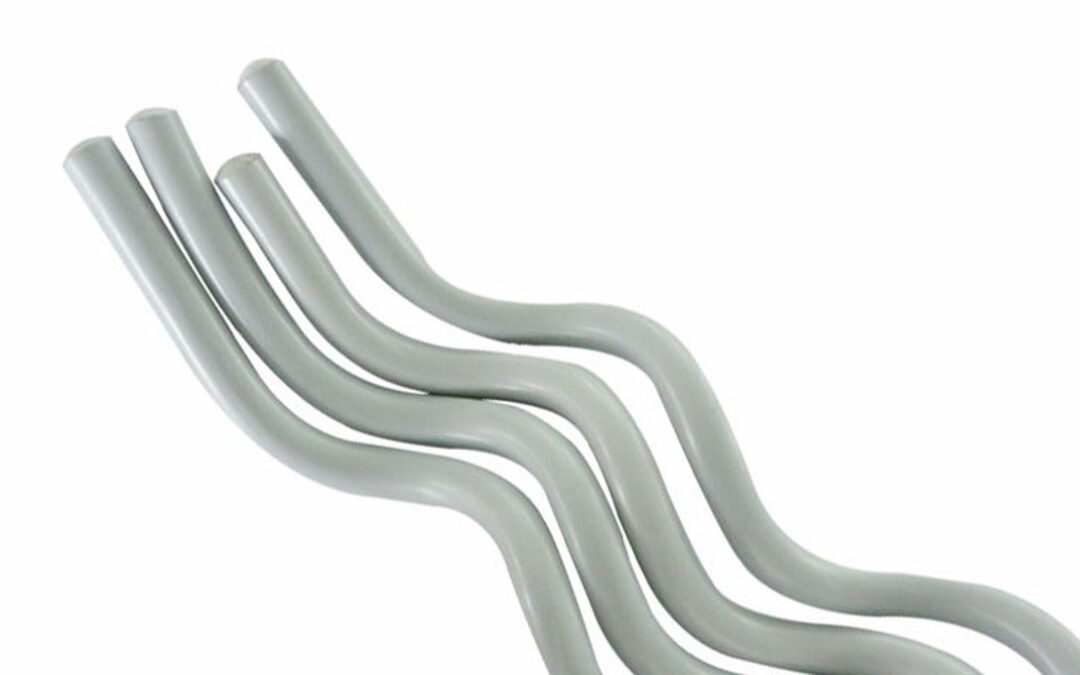
A spiral vibration damper is a mechanical device used on power lines, fiber optic cables, and telecom lines to mitigate wind-induced vibrations. They mitigate aeolian vibrations, a high-frequency and low-amplitude oscillation that causes fatigue failure. When wind flows across a suspended cable, it creates vortices that induce cyclic stresses in the conductor. The spiral vibration damper disrupts this process and dissipates energy before it accumulates. Spiral vibration dampers consist of a UV-stabilized polymer that forms a helical rod that wraps around the conductor. The polymer material absorbs vibrational energy and converts it into low-level heat. Their spiral shape changes the way air flows around the cable, disrupting the steady patterns that can cause vibrations. They are designed with a specific pitch and length to match conductor diameter and vibration frequency. Spiral vibration dampers are lightweight, corrosion-resistant, and use no metallic components. Quality assurance for the dampers ensures their continued performance.
Importance of conducting quality assurance for spiral vibration dampers used in power networks.
Conducting quality assurance for spiral vibration dampers determines where the damper performs its fatigue-mitigation function over full service life on overhead lines. Quality assurance verifies correct helical pitch, length, and stiffness. It also confirms it properly fits on the conductor diameter and has consistent material elasticity. These controls ensure the damper absorbs energy, which allows cyclic stress to persist and speed up conductor fatigue. Conducting cyclic fatigue and tensile integrity checks ensures no cracking, enough mechanical grip, and resistance to creep deformation. Failures can lead to localized stress concentration and eventual strand breakage. The damper materials undergo QA to ensure resistance to UV radiation, thermal cycling, and moisture and chemical exposure. Material degradation reduces damping efficiency and causes the damper to fracture. Quality assurance ensures proper damper manufacturing to prevent abrasion damage to conductor insulation and installation inconsistencies.
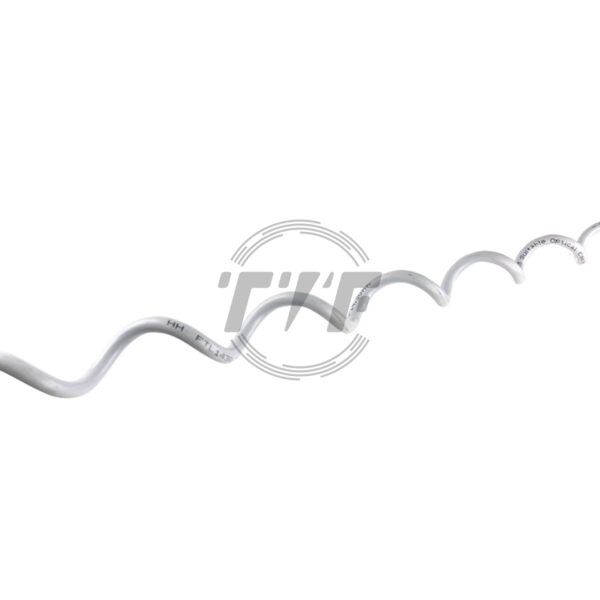
Spiral Vibration Damper
Spiral Vibration Dampers are helically-shaped devices designed to control aeolian vibrations in overhead power lines caused by wind. Installed directly onto conductors or shield wires, they dissipate vibration energy through flexural motion and friction, reducing the risk of fatigue damage to cables, hardware, and splices. Their simple, tool-free application makes them ideal for use in both new installations and retrofit scenarios.
Key Features:
- Efficient Vibration Control: Minimizes aeolian vibration to extend conductor and hardware lifespan.
- Tool-Free Installation: Wrap-around design enables fast, easy mounting without special tools.
- Corrosion-Resistant Material: Manufactured from UV-stabilized PVC or similar durable polymer.
- Wide Compatibility: Available for a range of conductor sizes and configurations.
- Weatherproof Design: Performs reliably in harsh environmental conditions.
- Non-Interfering: Lightweight and balanced to avoid affecting conductor sag or tension.
The role of quality assurance during the manufacture of spiral vibration dampers
Quality assurance during manufacturing ensures the spiral vibration dampers achieve their intended damping function, mechanical integrity, and environmental durability. Small deviations in geometry or material properties can reduce the performance of the dampers. Quality assurance aligns manufacturing outputs with recognized standards and utility specifications. These include IEC guidelines for overhead line accessories and ASTM International test methods for polymer performance. Here is how quality assurance impacts the manufacture of spiral vibration dampers.

- Process control in extrusion and forming—QA enforces temperature and pressure control to avoid internal stress, uniform wall thickness and density, and stable helical pitch and diameter.
- Dimensional accuracy and fit validation – the damping mechanisms depend on proper mechanical coupling with the conductor. Quality assurance verifies internal diameter tolerance for secure grip, correct spiral pitch and length, and consistency.
- Mechanical performance testing – manufactured dampers undergo tensile and flexural tests, fatigue and cyclic loading tests, and creep resistance testing. These tests confirm that the damper will maintain performance under continuous load.
- Environmental and aging tests – QA stimulates field conditions to ensure durability through UV aging tests, thermal cycling, and chemical exposure tests.
- Surface quality and finishing inspection – quality assurance checks smoothness and absence of cracks, uniform color and finish, and no micro-fractures that could propagate under vibration.
- Traceability and batch certification—each production batch is documented, linking finished products to raw material lots and process parameters. It helps maintain test records and compliance certificates.
- Raw material qualification and control – this includes polymer selection and verification to confirm mechanical strength and elasticity. This process establishes the baseline properties governing damping capacity and service life.
Common quality failures facing spiral vibration dampers used in power networks
Most quality failures in spiral vibration dampers originate from material defects, geometric inconsistencies, or inadequate process control. Degradation in their mechanical or aerodynamic behavior reduces damping effectiveness and speeds up conductor fatigue. These failures include:

- Material degradation and embrittlement—the most common failure is loss of polymer integrity. This is due to insufficient UV stabilization, poor additive dispersion, and use of substandard resin.
- Incorrect dimensional tolerances – manufacturing deviations in geometry lead to poor conductor coupling. This shows an oversized internal diameter, an undersized diameter, and an inconsistent helical pitch.
- Inadequate mechanical strength – failures occur when dampers cannot withstand dynamic loading. This may arise from low tensile strength, poor fatigue resistance, and excessive creep deformation.
- Surface defects and finishing flaws – quality lapses during extrusion that produce burrs, rough edges, microcracks, and non-uniform surface texture.
- Environmental resistance failures—dampers exposed to harsh environments may fail due to thermal cycling instability, moisture ingress, and salt fog exposure in coastal and industrial zones.
- Batch inconsistency and lack of standardization – inadequate quality assurance leads to variability due to differences in stiffness, elasticity, or geometry between batches.
- Improper material formulation—incorrect polymer formulation can cause excessive rigidity, excessive softness, and thermal instability.
- Poor installation retention—incorrect material stiffness may cause the damper to slide along the conductor under vibration. This may result in localized sections of the conductor remaining unprotected from vibration.
Materials for spiral vibration dampers and how quality assurance protects them
Selecting the right materials for the dampers helps sustain long-term damping performance under wind-induced oscillations driven by vortex shedding. Conducting quality assurance for the spiral vibration dampers preserves the material properties from raw resin through the finished product. QA ensures incoming polymers meet specifications and prevents substandard or off-spec resin from entering production. The process includes process control during manufacturing, mechanical property validation, environmental resistance testing, and dimensional verification. QA prevents material degradation, variability, and hidden defects that would compromise damping efficiency and expose conductors to fatigue. Here are the common materials for spiral vibration dampers.
High-density polyethylene
This offers high impact strength, flexibility, and chemical resistance. It also provides good performance under repeated cyclic loading. Lack of QA leads to inconsistent density, poor additive blending, or contamination that reduces elasticity and fatigue resistance.
Polyvinyl chloride (PVC)
This offers a good stiffness-to-flexibility balance, is cost-effective for large-scale deployment, and requires UV stabilizers and plasticizers for outdoor durability. QA prevents plasticizer migration or inadequate UV stabilization that leads to embrittlement.

Engineered polymers
These are designed for enhanced damping performance, improved temperature stability, and flexibility range. They are tailored for specific conductor sizes. QA prevents formulation variability that leads to unpredictable stiffness.
Additives and stabilizers
Performance depends on additives such as UV stabilizers, antioxidants, and colorants. QA prevents incorrect dosage that creates weak points and speeds up degradation.
TTF-certified spiral vibration dampers. Why we certify:
TTF’s approach to power line hardware services results in optimal product quality, strict adherence to custom design, and reduced cost. We are constantly checking manufacturing processes, addressing material concerns, and improving staff expertise to ensure the best quality product. Our quality control for the spiral vibration dampers begins with the first batch of samples that you received from us. And this continues through all production phases, where our QC staff never stop looking for opportunities to improve product quality. We offer:

- Rockwell Hardness Testing per ASTM E18
- Brinell Hardness Testing per ASTM E10
- Magnetic Particle Testing per ASTM E1444
- CMM (Coordinate Measuring Machine) Testing
- 24″ Optical Comparator for Complex Measurements
- Tensile/proof load testing up to 160,000 lbs (700 kN)
- Hot Dip Galvanizing Plating Thickness per ASTM E376
- Torque Testing
- Roughness Testing
- Lifetime Sample Retention
- Dimensional Testing
- Mechanical Testing
- Tolerance Analysis
- Tooling Life Analysis
The benefits of using spiral vibration dampers in power networks
Spiral vibration dampers serve on distribution and telecom lines to provide a simple, low-mass solution to wind-induced oscillations driven by cortex shedding. The dampers are substitutes for heavier damping systems in high-voltage and long-span transmission lines. They ease installation, offer corrosion resistance, and distributed damping. Their benefits are as discussed below.

- Effective mitigation of aeolian vibration – the helical profile alters the conductor’s aerodynamic characteristics and introduces distributed damping along the span. This reduces cyclic stress amplitudes, limits fatigue damage in conductor strands, and extends the service life of the line.
- Distributed damping – spiral dampers add minimal mass to the conductor, provide distributed contact, and avoid significant changes to sag and tension calculations.
- Corrosion resistance and durability – polymeric dampers are non-metallic, resist moisture, chemicals, and pollution, and perform well in coastal and industrial environments.
- Compatibility with insulated and fiber cables—spiral dampers are effective on ADSS fiber optic cables and covered conductors and telecom lines.
- Improved network reliability – spiral dampers reduce the likelihood of conductor strand breakage, lower fault and outage rates, and increase grid stability and continuity of supply.
- Cost-effectiveness for distribution networks – the dampers have lower unit costs compared to engineered damping systems. They also offer reduced installation and maintenance costs and are scalable for wide network deployment.
- Low maintenance requirements—proper damper installation reduces moving parts, the need for periodic change, and maintenance-free service intervals.
In conclusion,
Spiral vibration dampers control wind-induced oscillations in overhead networks by disrupting vortex shedding and dissipating cyclic energy along the conductor. Their effectiveness depends on material quality, geometric precision, and manufacturing consistency. Quality assurance controls material selection, production, and field deployment. It protects the mechanical integrity, environmental resistance, and dimensional accuracy. Quality assurance prevents common failures such as embrittlement, slippage, and fatigue degradation. Well-manufactured and properly validated spiral vibration dampers deliver reliable, low-maintenance vibration control for distribution and telecom networks. However, inadequate QA undermines performance and exposes infrastructure to accelerated wear, higher maintenance costs, and reduced service life.