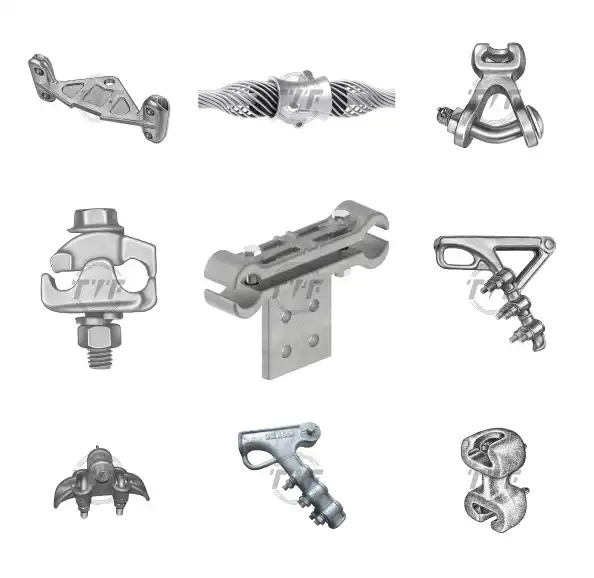
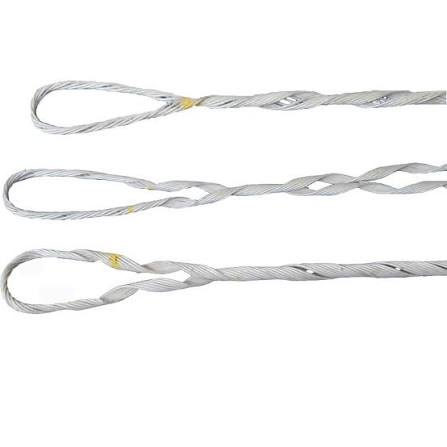
Preformed tension clamps are components used to terminate and secure overhead conductors, OPGW, or ADSS cables under mechanical tension. The clamp consists of helically formed wires manufactured to match the diameter and construction of the conductor. It transfers the longitudinal tensile load from the conductor to the supporting structure while maintaining a secure grip without the need for fasteners. Preformed tension clamps also help maintain conductor integrity under wind-induced vibration and other mechanical disturbances. They serve at deadends, angles, and termination structures. Their distributed gripping action helps prevent conductor slippage, strand damage, and premature mechanical failure. Preformed tension clamps serve in BESS interconnection, renewable energy projects, and transmission and distribution networks. These connections need properly selected and quality assured tension clamps to enhance the mechanical reliability of overhead connections and help maintain conductor clearances.
Features and components of the preformed tension clamps
Preformed tension clamps consist of designs that help provide a secure, strong termination for overhead conductors and cables. The clamps offer high tensile strength, distributed load transfer, reliable conductor grip, corrosion resistance, and vibration resistance. Poor or lack of correct sizing of the clamp can cause conductor slippage, strand damage, or premature mechanical failure. Here are the key components of the tension clamps.
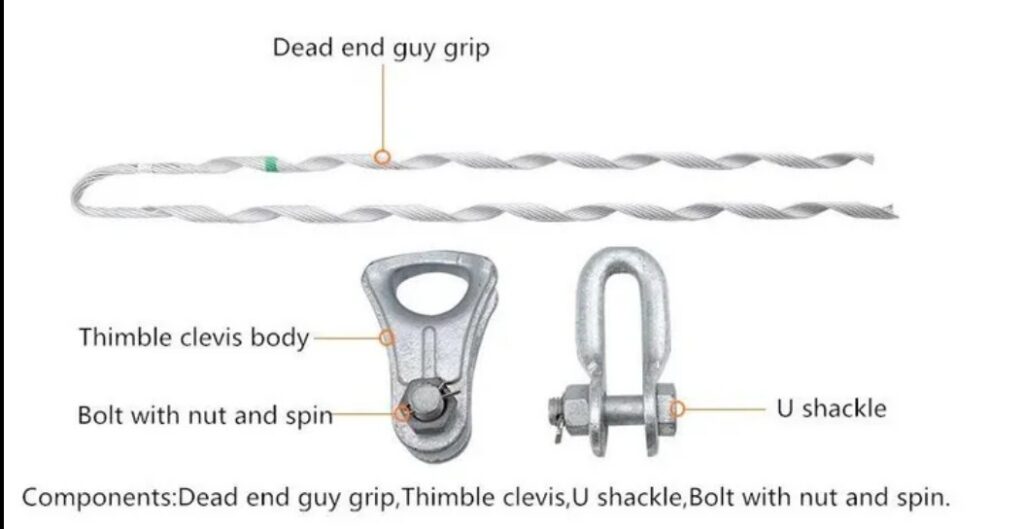
- Tension rods – these are helical elements that wrap around the conductor or cable. They have a geometry and material that determines much of the clamp’s gripping and tensile performance.
- Reinforcing rods – these are installed beneath the tension rods to protect the conductor and distribute mechanical stress. They are ideal where the conductor needs extra reinforcement at the termination point.
- Deadend eye or anchor loop—the eye provides the mechanical connection between the preformed assembly and the supporting hardware. It helps connect insulator strings, a clevis, or tower fittings.
- Thimble—the thimble helps maintain the geometry of the connection and reduces wear between the clamp and the attached hardware.
- Armor rods – these provide an extra protective layer around the conductor. They also help reduce abrasion, bending stress, and localized mechanical damage.
- Connection hardware—this includes clevises, shackles, links, eye fittings, or other attachment hardware. They connect the tension clamps to the supporting structure.
The roles of quality assurance in the manufacturing process of preformed tension clamps are crucial.
Conducting quality assurance during the manufacture of preformed tension clamps helps them withstand mechanical loads on overhead conductors. QA helps detect failures that can result in conductor slippage, cable damage, line sag, or structural failure. During manufacture at the TTF Power factory, the preformed tension clamps undergo several processes that contribute to the mechanical reliability, safety, and long-term performance of overhead power infrastructure. Here are the key roles of QA during manufacturing.
- Ensuring raw material quality – QA verifies that materials used for helical rods, reinforcing rods, and fittings meet specified mechanical and chemical requirements. Material inspections include chemical composition verification, yield strength testing, hardness testing, and dimensional checks.
- Controlling dimensional accuracy—this ensures the diameter, length, pitch, helix angle, and rod geometry correspond to the intended conductor. QA inspections ensure the finished rods match specified dimensions, maintain consistent helical geometry, and fit around the conductor.
- Verifying helical forming quality – during the forming process, QA checks for uniform helix formation, correct pitch, consistent rod curvature, and correct rod alignment. This ensures the clamp distributes mechanical loads around the conductor.
- Testing tensile performance – this includes verifying the mechanical strength of the finished tension clamp. These tests determine whether the clamps can withstand their specified rated mechanical loads without failure.
- Checking conductor compatibility – QA confirms each clamp is compatible with its designated conductor or cable diameter. Inspection verifies conductor diameter, strand configuration, clamp identification, and correct reinforcing components.
- Inspecting surface finish and corrosion protection – common inspections include coating thickness, uniformity, adhesion, and surface condition. This helps extend service life in humid, coastal, industrial, and polluted environments.
- Detecting manufacturing defects – inspections help identify cracks, burrs, scratches, surface pits, improper forming, deformation, and corrosion.
Quality failures of preformed tension clamps in power networks
Preformed tension clamps secure overhead conductors and transfer mechanical loads to poles and towers. Quality failures of the clamps arise during material selection, forming, assembly, installation, or service. These failures can lead to conductor damage or mechanical failure. Common quality failures include:
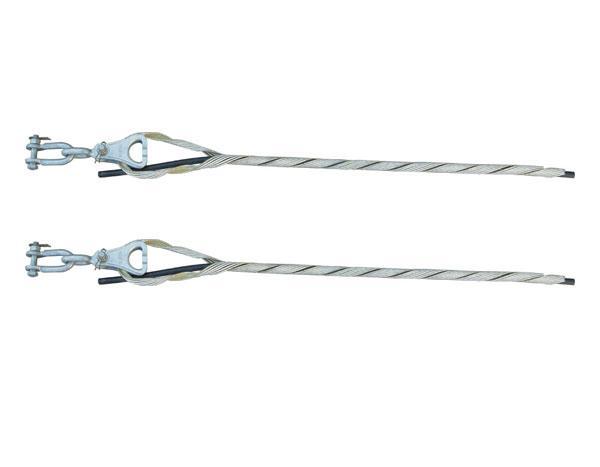
- Incorrect helical dimensions—the rods may have incorrect diameter, pitch, length, or helix angle due to poor manufacturing control. These cause inadequate conductor grip, uneven load distribution, conductor slippage, and excessive pressure on conductor strands.
- Insufficient tensile strength – poor material selection, incorrect heat treatment, forming defects, or manufacturing inconsistencies can lead to clamp failure.
- Conductor slippage – slippage occurs when the clamp cannot maintain enough grip on the conductor. This comes from incorrect clamp sizing, improper helical geometry, and insufficient gripping length.
- Strand damage – improperly distributed gripping pressure can damage conductor strands. This causes strand deformation, scratching, flattening, localized abrasion, and strand breakage.
- Cracks and surface defects—defects such as cracks, sharp edges, burrs, pits, and deep scratches can cause stress concentration points. This eventually leads to fatigue cracking and premature failure.
- Corrosion and coating failure – insufficient corrosion protection causes deterioration of steel components. Common failures include insufficient galvanizing, uneven coating, peeling, or premature oxidation.
Materials used for preformed tension clamps and how quality assurance protects them
Preformed tension clamps combine high tensile strength, controlled elasticity, corrosion resistance, and dimensional stability. This is crucial since they carry mechanical loads from overhead conductors. Selecting materials for the clamps is this crucial, as they influence clamp performance. Additionally, conducting quality assurance ensures that the selected materials and finished components meet the required specifications. QA protects these materials by verifying chemical composition, confirming mechanical properties, controlling material consistency, and ensuring forming characteristics.
Aluminum alloy
These are commonly for preformed components designed for aluminum-based conductors such as AAC, AAAC, and some ACSR applications. Aluminum alloy offers good corrosion resistance, low density, and good electrical compatibility with aluminum conductors.
Galvanized steel
Galvanized high-strength steel serves where high mechanical strength is needed. The zinc coating provides protection against atmospheric corrosion. It is suitable for components facing tensile loads such as reinforcing and tension rods. QA verifies the steel’s mechanical properties and the quality of the galvanized coating.
Aluminum-clad steel
This one combines a high-strength steel core with an aluminum exterior layer. It offers high tensile strength, good corrosion resistance, reduced risk of environmental deterioration, and compatibility with many overhead conductor systems.
Stainless steel
Steel is essential for specific fittings or applications that need enhanced corrosion resistance. Stainless steel tension clamps are ideal in coastal environments, high-humidity areas, industrial environments, and corrosive pollutants.
Protective coatings and finishes
Some steel components use protective coatings to protect against corrosion. QA verifies coating thickness, uniformity, adhesion, and surface condition according to the applicable specification.
TTF-certified preformed tension clamps. Why we certify:
TTF’s approach to power line hardware services results in optimal product quality, strict adherence to custom design, and reduced cost. We are constantly checking manufacturing processes, addressing material concerns, and improving staff expertise to ensure the best quality product. Our quality control for the preformed tension clamps begins with the first batch of samples that you received from us. And this continues through all production phases, where our QC staff never stop looking for opportunities to improve product quality. We offer:

- Tolerance Analysis
- Tooling Life Analysis
- Rockwell Hardness Testing per ASTM E18
- Brinell Hardness Testing per ASTM E10
- Magnetic Particle Testing per ASTM E1444 CMM (Coordinate Measuring Machine) Testing
- 24″ Optical Comparator for Complex Measurements
- Tensile/proof load testing up to 160,000 lbs (700 kN)
- Hot Dip Galvanizing Plating Thickness per ASTM E376
- Torque Testing
- Roughness Testing
- Lifetime Sample Retention
- Dimensional Testing
- Mechanical Testing
Advantages of preformed tension clamps in power networks
Preformed tension clamps provide the mechanical termination and anchoring needed to secure overhead conductors and cables. Their helical design allows them to grip conductors over a long section, distributing mechanical forces rather than concentrating them at a single point. Here are their key benefits in power networks.
- High mechanical strength – preformed tension clamps withstand longitudinal loads from conductor tension, wind, ice, and environmental forces.
- Reduced conductor damage – the helical rods distribute gripping pressure around the conductor. It reduces localized stress that could cause strand deformation, abrasion, and strand breakage.
- Reliable conductor anchoring – the clamps provide secure termination that helps prevent conductor slippage under mechanical loading.
- Effective load distribution – the preformed design distributes mechanical forces over a larger conductor length. This reduces stress concentration and can improve the fatigue performance of the connection.
- Resistance to vibration—a well-designed and installed preformed tension clamp helps maintain a stable mechanical connection under repeated loading.
In summary,
Preformed tension clamps serve in modern power networks to provide reliable anchoring and secure termination of overhead conductors. They have a helically formed design that distributes mechanical loads, reduces conductor damage, and improves resistance to vibration, fatigue, and environmental stresses. The clamps consist of materials such as aluminum alloys, galvanized steel, aluminum-clad steel, and stainless steel. These materials provide strength and corrosion resistance for diverse applications. However, their performance depends on quality assurance, material verification, dimensional inspection, helical forming control, tensile testing, corrosion protection, and final inspection. These help prevent failures such as conductor slippage, strand damage, cracking, and corrosion. Therefore, it is important to select properly designed and quality-assured preformed tension clamps. This is crucial for improving the safety and reliability of power networks.