A J hook is a J-shaped galvanized steel support fitting used in power distribution and telecommunications infrastructure. It supports, routes, or suspends cables and conductors without causing mechanical damage. The J hook is from hot-dip galvanized carbon steel or stainless steel to provide high mechanical strength and corrosion resistance for outdoor service. These materials help protect against rust, UV exposure, rain, industrial pollution, and coastal salt corrosion. The J hook supports overhead cables and conductors and maintains the correct cable routing along poles. J hooks undergo quality assurance that helps meet strict quality standards, including dimensional accuracy, high tensile strength, load testing, and corrosion resistance testing. Proper selection for the J hook helps extend cable service life while reducing maintenance and outage risks.
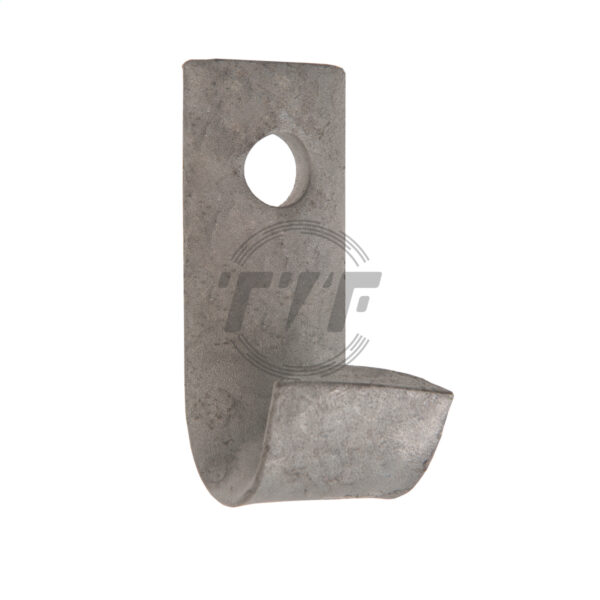
Guy Hook, J-HOOK STYLE, Weight 0.84 lb
The J Hook is a high-strength pole line hardware fitting designed to securely support and route overhead power conductors, ADSS fiber optic cables, and telecommunications cables on utility poles and transmission structures. Manufactured from forged or formed carbon steel and protected with a hot-dip galvanized finish, the J hook provides excellent mechanical strength, corrosion resistance, and long-term durability in demanding outdoor environments. It is widely used in power distribution, transmission, and communication networks to maintain proper cable alignment, reduce mechanical stress, and ensure reliable cable support.
Key Features:
- Manufactured from high-strength forged or formed carbon steel
- Hot-dip galvanized for superior corrosion resistance
- Smooth curved profile minimizes cable abrasion and stress concentration
- High mechanical load capacity for overhead line applications
- Precision-machined threaded shank for secure installation
- Excellent resistance to weather, UV exposure, and industrial pollution
- Suitable for supporting ADSS cables, power conductors, and communication cables
- Compatible with utility poles, crossarms, and mounting brackets
- Available in multiple sizes and thread configurations
- Low-maintenance design with extended service life
- Manufactured under strict quality assurance and international quality standards
- Ideal for power distribution, transmission, telecommunications, and fiber optic network construction
Structure and components of the J hook
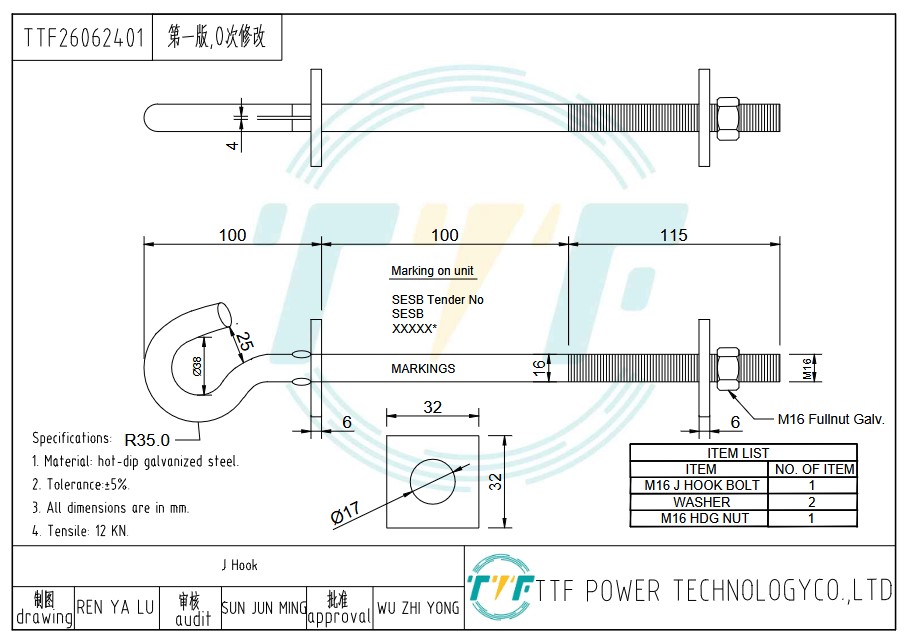
A J hook is designed to carry the weight of cables, conductors, or auxiliary hardware in overhead power distribution and telecommunication systems. It consists of engineered components that provide high mechanical strength, secure fastening, and corrosion resistance. Each component helps support cables, transfer mechanical loads, and ensure reliability in overhead power distribution and telecommunication infrastructure. Key components include the following:
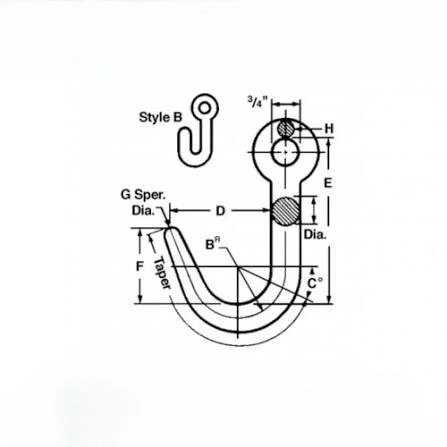
- J-shaped hook body—this is the load-bearing component that features a curved profile that supports cables. It prevents cable slipping during normal operations. The body supports cable weight, distributes mechanical loads, and prevents excessive cable bending.
- Curved saddle section – the curved part of the hook is where the cable or suspension hardware rests. It has a smooth finish, rounded edges, a uniform contact area, and reduced stress concentration.
- Straight shank – this connects the hook body to the mounting hardware. It transfers mechanical loads from the hook into the support structure. The shank may be fully threaded, partially threaded, a plain forged shaft, or welded to a mounting plate.
- Threaded section – the threaded end allows secure installation through utility poles, brackets, or steel structures. This section accommodates hex nuts, lock nuts, flat washes, and spring washers.
- Mounting nuts and washers—these secure the J hook to the supporting structure by clamping the hook, preventing movement, and maintaining preload during vibration.
The roles of quality assurance during the production of the J hook
Quality assurance ensures every J hook produced meets the required mechanical, dimensional, and corrosion-resistance standards for use in power distribution infrastructure. QA helps detect defects that compromise the integrity of the entire installation. Here are the roles of quality assurance during J-hook manufacture.
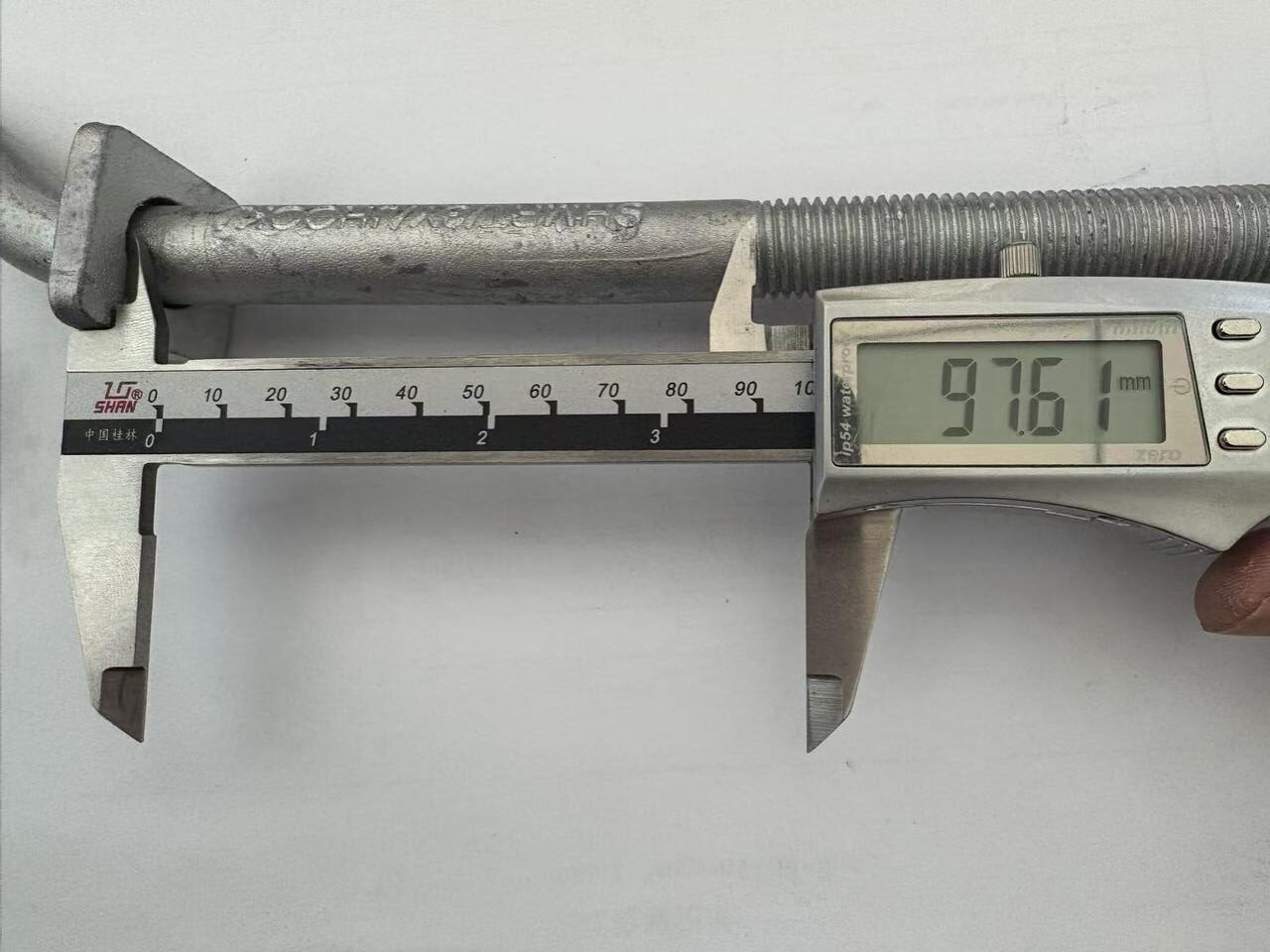
- Raw material verification – this includes confirming material grade through mill certificates, chemical composition analysis, and mechanical property verification. Using certified raw materials ensures the J hook possesses the required tensile strength, ductility, and toughness to withstand mechanical loading without failure.
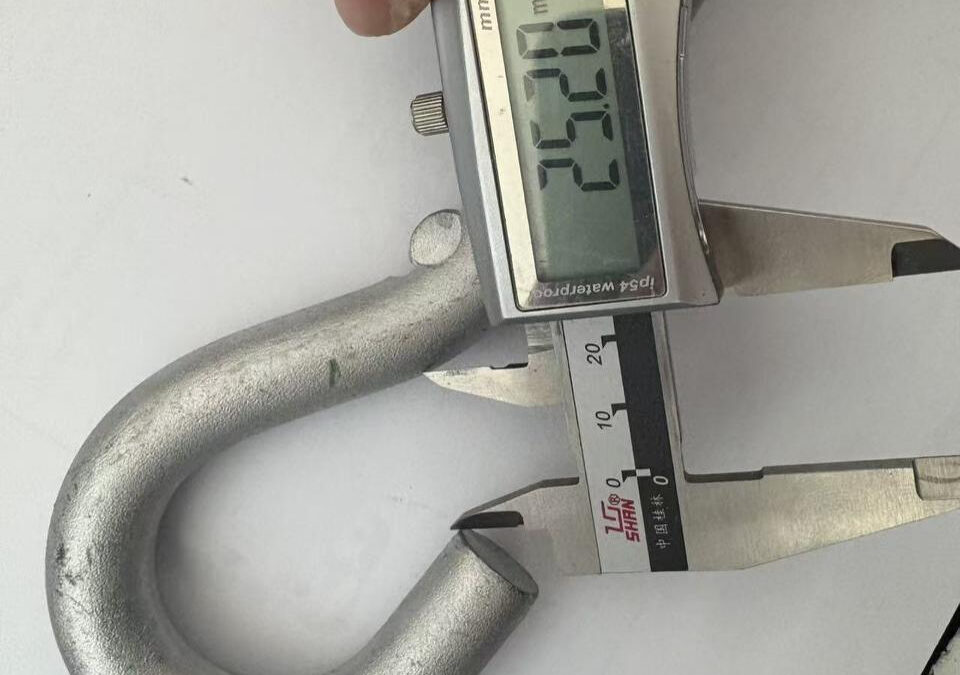
- Dimensional inspection – accurate dimensions ensure that the J hook fits the poles, brackets, bolts, and suspension hardware. The process includes measuring hook radius, verifying shank diameter, checking thread dimensions, and inspecting bend angles.
- Forging and forming quality control— the QA process includes monitoring forming temperature, verifying bend radius, and inspecting for deformation. This prevents stress concentrations, hidden fractures, and reduced fatigue life.
- Thread quality inspection – this includes thread profile inspection, thread pitch verification, and surface finish inspection. High-quality threads ensure secure fastening, proper preload, reliable load transfer, and resistance to loosening under vibration.
- Mechanical strength testing – mechanical testing confirms that the J hook can support its specified working loads. QA ensures tensile testing, yield strength testing, proof load testing, and ultimate load testing. The tests verify that every production batch can withstand installation loads, wind-induced vibration, cable tension, and service conditions.
- Surface finish inspection – surface quality affects durability and cable protection. The QA process includes visual inspection, roughness measurement, burr removal verification, and edge smoothness inspection. This prevents cable jacket damage, reduces abrasion, reduces stress raisers, and improves corrosion protection.
- Galvanizing quality control – this includes coating thickness measurement, adhesion testing, uniform coating inspection, and zinc coverage verification. Proper galvanizing extends service life, prevents rust formation, and protects against moisture and industrial pollutants.
Quality failure modes in J hooks
J hooks serve in power distribution and telecommunications infrastructure to suspend or guide cables, conductors, and other hardware. The face is mechanical loading, environmental exposure, and vibration. Identifying and preventing quality failure modes ensures the reliability and safety of overhead networks. Common quality failure modes for the J hook include:
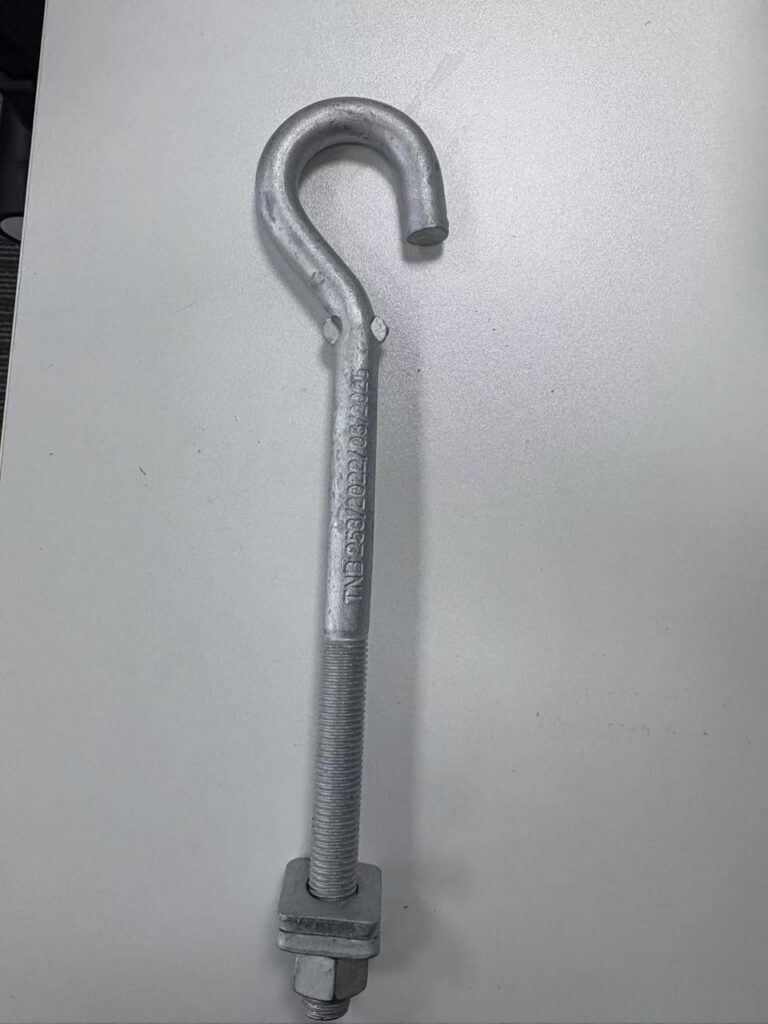
- Material defects – failure can occur if low-grade steel, contaminated alloys, or defective raw materials are used. These defects arise from incorrect steel grade, poor chemical composition, excessive impurities, and improper heat treatment. These lead to reduced tensile strength, brittle fracture under load, and premature fatigue failure.
- Surface cracks – cracks develop during forging, bending, machining, or welding. This may arise from excessive forming stress, incorrect bending radius, and poor forging temperature control. These lead to crack propagation, sudden structure failure, and reduced fatigue life.
- Improper bend geometry – the curved section of the J hook distributes loads evenly. Incorrect geometry creates localized stresses. This comes from poor tooling, incorrect bending angles, and worm-forming dies. These practices lead to uneven load distribution, permanent deformation, increased stress concentration, and cable damage due to sharp contact points.
- Thread defects – threaded J hooks depend on accurate threads for secure installation. Inaccuracy comes from poor machining, damaged threads, incorrect thread pitch, and burrs. These lead to loose installation, reduced clamping force, and thread stripping.
- Poor galvanizing quality – protective zinc coating is critical for corrosion resistance. Poor quality causes thin coating, uneven galvanizing, and poor surface preparation. These lead to early rust formation, corrosion, reduced service life, and increased maintenance costs.
- Fatigue failure – J hooks face repeated loading from cable tension, wind, and vibration. These cause stress concentrations, surface cracks, poor material quality, and overloading. These cause progressive crack growth, sudden fracture, and cable support failure.
Materials for the J hook and the importance of quality assurance
J hooks are designed to provide reliable mechanical support for overhead power lines, fiber optic cables, and telecommunication infrastructure. The material selected should ensure they withstand tensile loads, vibration, moisture, UV radiation, and corrosive environments. The material influences their strength, durability, and service life. Quality assurance for the J hook ensures the materials meet mechanical, chemical, and corrosion-resistant requirements. Common materials include:
Carbon steel
This is the common material for the J hook due to its excellent combination of strength, toughness, and cost-effectiveness. Carbon steel offers high tensile strength, good ductility, machinability, and economy for large-scale production. Carbon steel J hooks serve in overhead distribution lines, utility pole hardware, ADSS cable support systems, and telecommunications infrastructure. QA verifies that the carbon steel meets the specified material grade and achieves the required tensile and yield strength.
Hot-dip galvanized steel
Hot-dip galvanized steel improves corrosion resistance and is ideal for long outdoor service life. They serve in utility transmission lines, coastal power networks, rural electrification projects, and communication towers. Quality assurance ensures uniform zinc coating thickness, coating adhesion, and complete surface coverage.
Stainless steel
This is crucial for installations in highly corrosive environments where galvanized coatings may not provide sufficient protection. Stainless steel provides high strength, fatigue performance, and minimal maintenance requirements. Stainless steel J hooks serve in coastal installations, offshore facilities, and chemical plants. QA confirms correct stainless-steel grade, proper alloy composition, corrosion resistance, and surface finish quality.
Alloy steel
Heavy-duty J hooks are from alloy steel with higher mechanical strength. Alloy steel also offers toughness, improved fatigue resistance, and wear resistance. The J hooks serve in high-load cable systems, heavy transmission infrastructure, and industrial power installations. Quality assurance ensures proper heat treatment, correct hardness, tensile strength, and reliable fatigue performance.
TTF-Certified J hooks. Why we certify:
TTF’s approach to power line hardware services results in optimal product quality, strict adherence to custom design, and reduced cost. We are constantly checking manufacturing processes, addressing material concerns, and improving staff expertise to ensure the best quality product. Our quality control for the J hook begins with the first batch of samples that you received from us. And this continues through all production phases, where our QC staff never stop looking for opportunities to improve product quality. We offer:

- Tolerance Analysis
- Tooling Life Analysis
- Rockwell Hardness Testing per ASTM E18
- Brinell Hardness Testing per ASTM E10
- Magnetic Particle Testing per ASTM E1444 CMM (Coordinate Measuring Machine) Testing
- 24″ Optical Comparator for Complex Measurements
- Tensile/proof load testing up to 160,000 lbs (700 kN)
- Hot Dip Galvanizing Plating Thickness per ASTM E376
- Torque Testing
- Roughness Testing
- Lifetime Sample Retention
- Dimensional Testing
- Mechanical Testing
In conclusion,
J hooks provide secure mechanical support for overhead cables, fiber optic lines, and other hardware. Their performance depends on the design, high-quality materials, and strict manufacturing processes. Comprehensive quality assurance goes through raw material verification and dimensional inspection. It ensures that the J hook meets standards for strength, durability, corrosion resistance, and safe operation. Quality assurance helps identify and prevent quality failure modes. This helps manufacturers produce reliable J hooks that reduce maintenance costs, extend service life, and contribute to the safety and reliability of overhead utility networks.