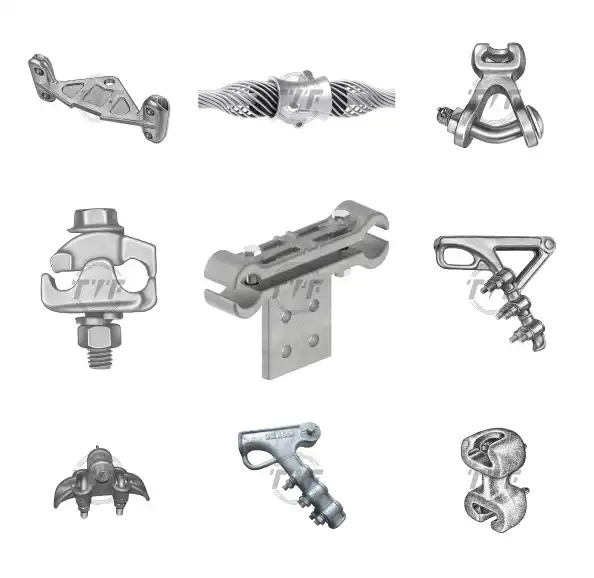
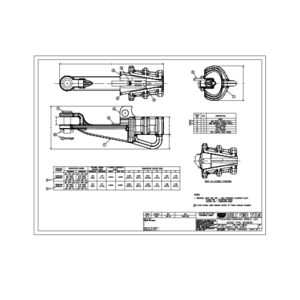
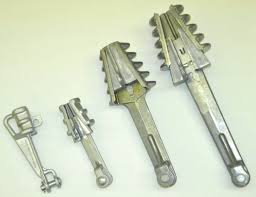
An automatic wedge deadend in power distribution and telecommunications networks anchors, terminates, and tensions conductors and cables without need for bolts, compression tools, or complex installation equipment. The deadend consists of the body, wedges, and bail. These components contain the gripping mechanism and the attachment point that connect the poles, crossarms, insulators, and hardware assemblies. When the conductors experience tension, the wedges are pulled deeper into the body to create the self-tightening grip. Automatic wedge deadends are manufactured from hot-dip galvanized steel, aluminum alloy, high-strength forged steel, and corrosion-resistance coatings. When selecting the deadend, it is crucial to consider conductor type, conductor diameter range, rated mechanical loads, corrosion resistance needs, and utility standards and specifications. Additionally, it is crucial to select quality-assured automatic wedge deadends to ensure their reliability and durability in overhead power networks.
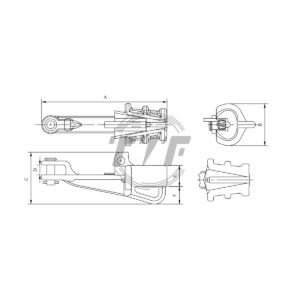
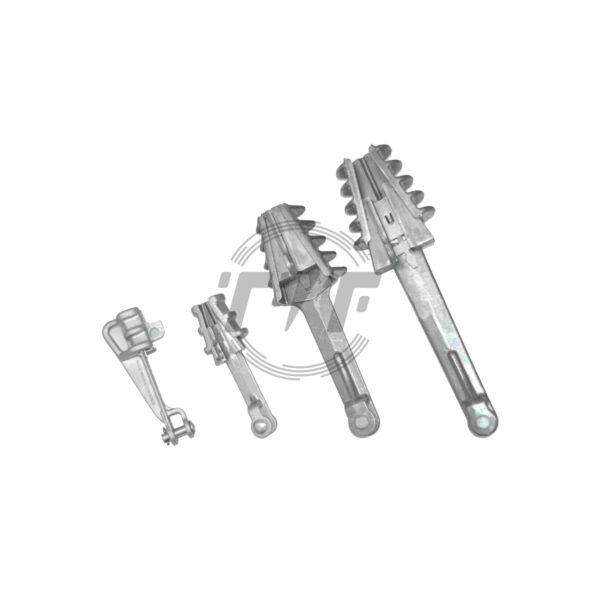
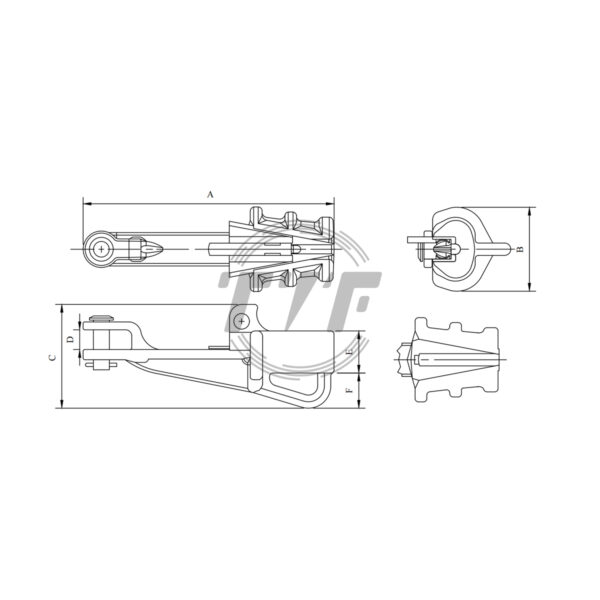
Automatic Side Opening Wedge Deadend
An automatic wedge deadend is a self-energizing conductor termination fitting used in overhead power line construction to anchor and maintain tension on AAC, AAAC, and ACSR conductors. It operates through an internal wedge mechanism that increases gripping force as line tension rises, ensuring secure load transfer between the conductor and supporting structure. Designed for fast installation and long-term reliability, it eliminates the need for compression tools while delivering consistent mechanical performance in distribution and transmission networks.
Key Features:
- Self-tightening wedge mechanism for progressive gripping under load
- Compatible with AAC, AAAC, and ACSR conductors
- High mechanical holding strength with anti-slip performance
- Tool-free or minimal-tool installation for reduced labor time
- Hot-dip galvanized or corrosion-resistant finish for outdoor durability
- Even load distribution to minimize conductor damage
- High resistance to vibration, wind load, and mechanical fatigue
- Suitable for distribution, transmission, and telecom support lines
- Compact, lightweight design for easy handling and installation
- Long service life with minimal maintenance requirements
Key components of the automatic wedge deadend
The automatic wedge deadend consists of several components working together to anchor and tension an overhead conductor. These components include:
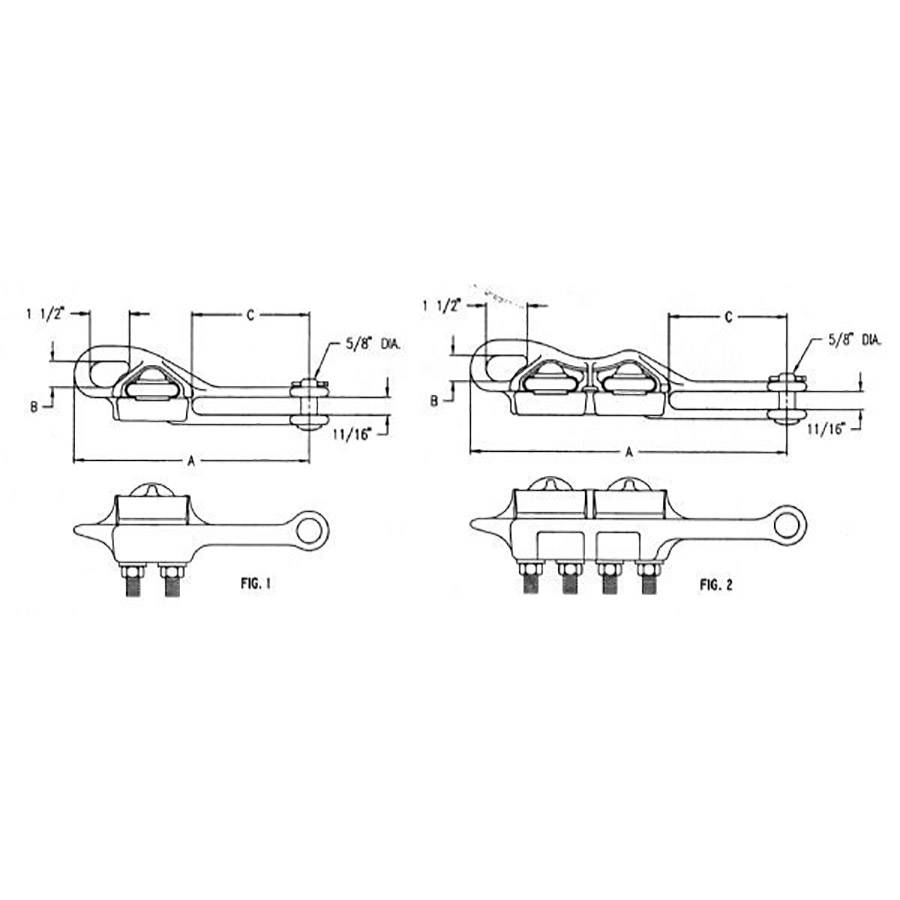
- Body—this is the main housing of the deadend assembly that contains the internal wedges and provides the structural strength needed to withstand conductor tension. It houses the wedge mechanism, transfers mechanical loads to the support structure, and protects internal components from exposure.
- Wedges – these are the gripping elements inside the body that move inward under tension to create a firm grip. It holds the conductor, prevents conductor slippage, and increases gripping force as line tension increases.
- Bail—the bail is the loop-shaped attachment connected to the body. It connects the deadend to the insulators, brackets, or pole hardware. It allows load transfer from the conductor to the supporting structure and eases installation and positioning.
- Keeper – this is the retaining clip that holds wedges in place during installation and prevents accidental wedge displacement before the conductor.
- Conductor groove – the groove is the internal channel where the conductor is placed. It guides conductor positioning, ensures even distribution of gripping pressure, and reduces conductor damage during operation.
- Attachment eye—the dead end may feature an eye, a clevis, or another connection point. It provides compatibility with line hardware and enables attachment to insulator strings, brackets, and crossarms.
Quality assurance roles are essential during the manufacture of automatic wedge deadends
Conducting quality assurance during the dead-end manufacture ensures that it meets the mechanical, dimensional, and durability needs for safe operation in overhead power and telecommunication networks. Quality assurance during manufacture detects defects that can compromise line reliability and safety. Here are the roles of quality assurance during dead-end manufacture.
- Verification of raw material quality—QA teams ensure that the selected materials, such as steel, aluminum alloy, or forged components, meet specified material grades. This helps prevent the use of substandard materials that could lead to premature failure.
- Dimensional accuracy control—quality assurance verifies body dimensions, wedge geometry and surface finish, bail and attachment point dimensions, and conductor groove specifications. Dimensional inspections ensure proper gripping action and compatibility with conductor sizes.
- Monitoring manufacturing processes – the processes may include forging, casting, machining, stamping, welding, and heat treatment. This process helps identify deviations before they affect product performance and ensures consistent production quality.
- Heat treatment verification – quality assurance evaluates hardness levels, heat treatment cycles, and material microstructure. Proper heat treatment ensures the fitting can withstand mechanical loading and environmental stresses.
- Surface finish and coating inspection – corrosion protection ensures the automatic wedge deadends operate in outdoor environments. QA inspections check hot-dip galvanization thickness, coating uniformity, surface defects, and adhesion quality.
- Mechanical performance testing—these tests include ultimate tensile strength testing, proof load testing, slip resistance testing, and load retention testing. These tests confirm that the deadend can withstand specified operating and overhead conditions.
- Wedge grip performance evaluation—QA verifies that wedges engage properly, grip strength meets design requirements, conductors do not slip under load, and the gripping action does not damage the conductor.
Common quality failure modes of automatic wedge deadends in overhead networks
Automatic wedge deadends anchor conductors in overhead power and telecommunications networks. However, the wedge deadends may experience manufacturing defects, material deficiencies, improper installation, or environmental impacts. These defects may lead to quality failures that compromise network reliability and safety. During manufacture, detecting the failure modes helps improve quality control and assist utilities in selecting reliable hardware. Here are the common quality failures in automatic wedge deadends.
- Conductor slippage—this arises from improper dimensions, poor manufacturing tolerances, incorrect conductor size selection, and surface defects on wedges. This leads to loss of conductor tension, increased line sag, service interruptions, and potential conductor detachment.
- Wedge failure – the wedge mechanism is the primary load-bearing component inside the fitting. This arises from material defects, improper heat treatment, casting flaws, and manufacturing cracks. These lead to reduced gripping capability, sudden mechanical failure under load, and increased risk of conductor release.
- Body cracking—the deadend body must withstand mechanical loads throughout its service life. Cracking comes from inferior raw materials, forging defects, improper casting processes, and stress concentrations. These cause structural weakening, reduced load-carrying capacity, and complete fitting failure.
- Improper wedge engagement – the self-tightening mechanism depends on smooth wedge movement and proper alignment. This comes from poor machining accuracy, manufacturing burrs, and dimensional inconsistencies. These cause uneven load distribution, reduced grip strength, and increased conductor damage.
- Bail failure – this comes from material fatigue, weld defects, forging imperfections, and excessive loading. These lead to loss of conductor support, structural collapse of the deadend assembly, and safety hazards.
- Fatigue failure – Overhead lines face vibration from wind, temperature changes, and mechanical loading. These result in crack initiation and growth, reduced service life, and unexpected mechanical failure.
Materials for automatic wedge deadends and the importance of quality assurance
Automatic wedge deadends face high mechanical loads, environmental exposure, and long service periods in overhead power and telecommunication networks. Material selection should ensure strength, durability, corrosion resistance, and reliable conductor retention. Conducting quality assurance helps protect the materials throughout manufacturing processes and ensures the deadend meets performance requirements. During QA, the teams verify material grade certifications, chemical composition, mechanical properties, and supplier documentation. Key materials for the automatic wedge dead ends include:
Forged steel
This is common for deadend bodies, bails, and load-bearing components because of its high tensile strength and toughness. Forged steel offers high mechanical strength, fatigue resistance, good impact resistance, and heavy conductor loads. Forged steel serves in main body assemblies, bail connections, and structural load-bearing parts.
Galvanized steel
Most automatic wedge deadends are from carbon steel and protected through hot-dip galvanization. It offers strong mechanical performance, corrosion resistance, and long service life in outdoor environments. Galvanized steel is ideal for deadend bodies, attachment hardware, suspension, and anchoring components.
Aluminum alloy
Aluminum alloys have a lightweight construction, natural corrosion resistance, and good strength-to-weight ratio. It is ideal for wedges, housing components, and distribution line fittings.
High-strength alloy steel
Alloy steels improve mechanical performance for some automatic wedge deadends. It provides higher tensile strength, improved wear resistance, and fatigue performance. It is ideal for high-load wedge mechanisms and transmission line hardware. Stainless steel Steel provides superior corrosion resistance, excellent durability, and reduced maintenance needs. Stainless steel wedge deadends are ideal for coastal installations, industrial environments, and specialized utility hardware.
TTF certified automatic wedge deadends. Why we certify:
TTF’s approach to power line hardware services results in optimal product quality, strict adherence to custom design, and reduced cost. We are constantly checking manufacturing processes, addressing material concerns, and improving staff expertise to ensure the best quality product. Our quality control for the automatic wedge deadends begins with the first batch of samples that you received from us. And this continues through all production phases, where our QC staff never stop looking for opportunities to improve product quality. We offer:

- Tolerance Analysis
- Tooling Life Analysis
- Rockwell Hardness Testing per ASTM E18
- Brinell Hardness Testing per ASTM E10
- Magnetic Particle Testing per ASTM E1444 CMM (Coordinate Measuring Machine) Testing
- 24″ Optical Comparator for Complex Measurements
- Tensile/proof load testing up to 160,000 lbs (700 kN)
- Hot Dip Galvanizing Plating Thickness per ASTM E376
- Torque Testing
- Roughness Testing
- Lifetime Sample Retention
- Dimensional Testing
- Mechanical Testing
The benefits of automatic wedge deadends in overhead power networks
Automatic wedge deadends terminate, anchor, and maintain tension in conductors. Their design provides mechanical efficiency and operational reliability, which makes them crucial in modern grid infrastructure. Here are the benefits of the automatic wedge deadends.
- High mechanical holding strength – the wedge deadends provide strong and reliable conductor anchoring.
- Self-energizing grip mechanism – the wedge design is self-reinforcing for increased line tension for a stronger grip, and the enhanced load is evenly distributed across the conductor surface.
- Improved safety during installation – automatic wedge deadends have simplified handling that enhances safety.
- Compatibility with most conductor types – the wedge deadends function with aluminum conductors, all aluminum alloy conductors, and aluminum conductor steel reinforced.
- Reduced conductor damage – wedge systems distribute pressure evenly to reduce strand cutting, maintain conductor mechanical integrity, and extend conductor service life.
In conclusion,
Automatic wedge deadends provide reliable conductor termination, stable tension control, and efficient load transfer. Their performance depends on key components such as body, wedges, and attachment hardware that meets strict material and dimensional requirements. Quality assurance is essential during manufacturing to ensure raw material integrity, corrosion protection, mechanical strength, and durability. These prevent failures such as conductor slippage, wedge malfunction, and fatigue cracking. Properly manufactured automatic wedge deadends provide faster installation, strong mechanical holding capacity, and reduced maintenance needs. This contributes to the reliability, efficiency, and resilience of modern electrical transmission and distribution infrastructure.