A forged steel anchor shackle is a heavy-duty mechanical connector used to join, secure, or terminate loads in lifting, rigging, and infrastructure applications. It offers high strength, durability, and safety under demanding load conditions. The shackle features a bow-shaped body with a removable pin. Manufacturing it through a hot-forging process aligns with the metal’s grain structure. These materials enhance tensile strength, fatigue resistance, and impact performance. The forged steel anchor shackle provides high load-bearing capacity and corrosion resistance. It works in power transmission and distribution infrastructure, renewable energy projects like solar and wind, construction and civil engineering works, marine rigging, mining, and heavy industrial applications. Additionally, it combines structural integrity, versatility, and long-term performance. The anchor shackle is indispensable in modern industrial and energy infrastructure projects.
The working principle of the forged steel anchor shackle
Forged steel anchor shackles ensure secure, controlled, and safe connections in lifting and structural applications. Its performance depends on how load forces are distributed through the forged body and pin under tension. The anchor shackle consists of the bow and the pin. During installation, the pin is removed, the load-bearing elements are seated within the bow, and the pin is inserted and tightened. The bow’s rounded shape allows many attachments while reducing stress concentrations. The tensile force is transmitted from the connected components into the shackle pin. The force is then distributed by the pin into the forged bow, which carries the load. The bow’s curved profile ensures that forces flow along the grain-aligned forged steel, which reduces localized stress. The shackle maintains mechanical integrity by balancing load distribution, resisting fatigue, and preventing disengagement.
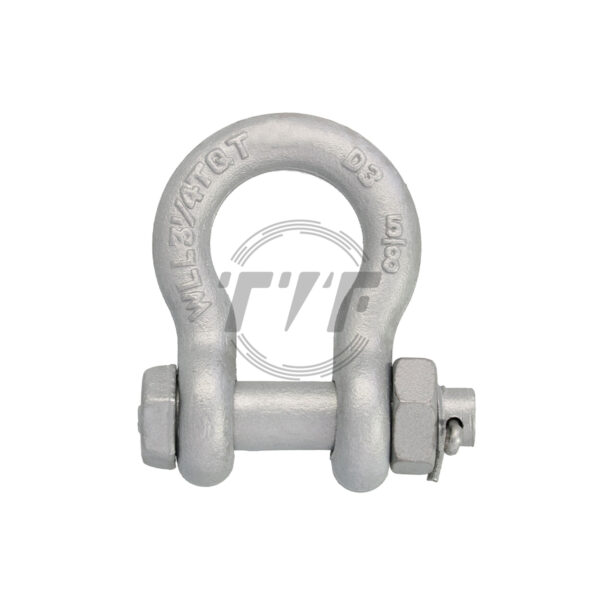
Forged Steel Anchor Shackle
The forged steel anchor shackle is a high-strength mechanical connector used in power line construction to anchor, connect, and transfer tensile loads between conductors, insulator strings, and line hardware. Manufactured through hot forging and heat treatment, it delivers superior load-bearing capacity, fatigue resistance, and long-term reliability in transmission and distribution networks.
It is designed for dead-end, angle, and structural anchoring applications, the anchor-shaped bow ensures uniform load distribution, while the precision-machined pin provides secure engagement under continuous and dynamic line loads. Protective surface finishes enable dependable performance in harsh outdoor environments.
Key Features
- Hot-forged carbon or alloy steel for high tensile strength
- Defined Working Load Limit (WLL) with high safety factor
- Wide bow design for improved load distribution and angular loading
- High-strength pin with secure retention (screw or bolt-type)
- Excellent resistance to fatigue, shock, and vibration
- Hot-dip galvanized finish for corrosion protection
- Suitable for transmission, distribution, and substation applications
Significance of forged steel anchor shackle in power networks
The forged steel anchor shackle provides safe, high-strength, and reliable connection points. This is ideal for mechanical loads within transmission and distribution infrastructure. It influences network reliability, structural stability, and operational safety. In power networks, conductors, insulators, and hardware assemblies face tensile forces from line tension, wind loading, and thermal expansion. The shackles transfer mechanical loads between towers, poles, anchor points, and line hardware. It maintains correct conductor tension in dead-end and anchoring applications. It prevents overstressing of insulators and fittings. The wide bow design of forged steel anchor shackles allows them to connect many fittings without excessive stress concentrations. The shackles are valuable in angle towers, substation gantries, and renewable energy interconnections. Forged steel anchor shackles ensure safe load transfer, structural reliability, and system reliability. This makes them crucial for traditional grids and modern energy systems.
The components and features of the anchor shackle
The shackles consist of components and features designed to meet the mechanical, environmental, and safety demands of power networks. Each of these contribute to load capacity, reliability, and service life. The key features include high mechanical strength, a defined working load limit, resistance to fatigue, corrosion protection, and wide load compatibility. Its key components include:

- Shackle body—the bow is the load-bearing component of the shackle. Its round profile allows the shackle to hold connection points while maintaining proper load distribution. The steel grain follows the contour of the bow to improve tensile strength. This makes the bow vital for dead-end and anchoring applications in power transmission lines.
- The pin—this secures the connected hardware within the shackle and transfers the load into the bow. The pin is from high-strength alloy or carbon steel. The pin must be machined to ensure tight seating, prevent shear failure, and maintain alignment under load.
- Threads and pin retention system—the threaded sections prevent accidental disengagement. It features deep and well-formed threads for high shear resistance. It also has locking mechanisms to prevent loosening due to vibration or thermal cycling. Enhancing secure pin retention is crucial for long-term mechanical stability.
Types of the forged steel anchor shackle
Screw pin anchor shackle

This shackle features a removable threaded pin that screws into the shackle body. It allows quick assembly and disassembly and requires no extra locking hardware. The screw pin shackle works in temporary rigging and lifting operations, line stringing, and maintenance in power networks. This shackle is not ideal for long-term installations subject to vibration, as it may loosen.
Bolt-type anchor shackle

This shackle is ideal for permanent or semi-permanent installations. The smooth bolt passes through the shackle body. It is then secured with a nut and cotter pin to prevent accidental pin rotation. The shackle is ideal for dead-end and anchoring points in transmission and distribution lines. It also works in substations and structural power network components.
Round pin anchor shackle

The round pin anchor shackles use a straight, unthreaded pin retained by a cotter pin. It allows quick installation compared to bolt-type shackles. Round shackles provide better resistance to shear than threaded pins. It works best in light- to medium-duty rigging and applications where load direction remains consistent.
Wide body anchor shackle

The anchor shackle features a larger bow radius than standard anchor shackles. It features increased internal width for sling connections, reduced side loading on the bow, and improved load distribution. It works in multi-leg sling assemblies, angle structures in power transmission networks, and anchoring applications.
High strength anchor shackles

These shackles are manufactured from alloy steel and heat-treated for enhanced performance. This shackle has a higher working load limit compared to carbon steel shackles. It is designed for extreme load and fatigue conditions. High-strength shackles work in high-voltage transmission lines, renewable energy infrastructure, and offshore installations.
Technical specifications for the forged steel anchor shackle
Checking the technical specifications for the forged steel anchor shackle help define their mechanical capacity, material performance, dimensional accuracy, and compliance with industry standards. These specifications ensure safe load transfer, structural integrity, and long-term reliability. The specifications are essential for reliable performance in power transmission, distribution, and other high-load infrastructure systems. Here are the technical specifications for the forged steel anchor shackles.

- Material specifications—the shackles are from carbon steel or alloy steel for improved grain flow. It is also heat-treated to achieve necessary strength and toughness. The material properties include high tensile and yield strength. This helps resist permanent deformation for enhanced impact toughness for outdoor operations.
- Working load limit – this defines the greatest allowable load under normal service conditions. It varies by size, commonly from 0.5 tonnes to over 100 tonnes. The shackle is marked with working load limit (WLL), size, and manufacturer identification.
- Dimensional specifications—finding precise dimensions ensures compatibility with other line hardware and fittings. Key parameters include bow diameter, inside width and length, pin diameter, and throat opening.
- Pin and thread specifications—the pin is specified for high shear and tensile strength, precision-matched threads, and a smooth bearing surface to reduce wear. Bolt-type shackles include a high-strength bolt, matching nut, and cotter pin for positive locking.
- Corrosion protection – the shackles feature common finishes that include hot-dip galvanization for long-term outdoor protection and zinc-plated finishes for controlled environments.
- Operating conditions—the specifications define allowable service conditions. The conditions include temperature range for safe operation, load orientation, and restrictions on shock loading.
Application areas for the anchor shackles
The anchor shackles work in diverse industries that demand mechanical strength, secure load transfer, and reliability. Their applications depend on their ability to withstand heavy static and dynamic loads, harsh environmental conditions, and safe operations. Forged steel anchor shackles are ideal for the following applications.

- Power transmission and distribution networks—forged steel anchor shackle secure conductors at dead-end and angle towers. They connect insulator strings, clevis fittings, and tension hardware. They ensure dependable performance under wind loading, ice accretion, and thermal expansion.
- Renewable energy infrastructure – the forged steel anchor shackle support renewable energy projects by handling variable and high-load conditions. They work in solar power plants for module support structures, wind farms for tower erection and blade lifting, and grid interconnections linking renewable assets to transmission lines.
- Transportation and infrastructure projects—anchor shackles work in railway electrification systems, bridge construction, and tunnel infrastructure.
- Substations and switchyards—anchor shackles serve in busbar assemblies, help structural bracing and equipment anchoring, and support cable and suspension systems. In substations, they provide secure, vibration-resistant connections in environments with high electrical and mechanical stress.
- Construction and civil engineering – forged steel anchor shackles are ideal for structural lifting and positioning, load anchoring, and suspension of formwork.
- Mining and heavy industry—anchor shackles help in hoisting and material handling, conveyor and equipment anchoring, and structural load connections in harsh operating conditions.
- Marine and offshore application—the anchor shackles provide corrosion resistance and mechanical strength to mooring and anchoring systems, dockyard rigging, offshore platforms, and subsea installations.
Safety practices for handling forged steel anchor shackles
Proper handling of the forged steel anchor shackle helps prevent mechanical failure, equipment damage, and personal injury in power networks and heavy infrastructure with high loads and risks of failure. These practices include proper selection and rating, pre-use inspection, proper installation practices, load alignment, environmental awareness, maintenance, and personal safety. Following these practices ensures forged steel shackles perform safely and reliably in the various application areas. The practices also help protect personnel, preserve infrastructure integrity, and maintain uninterrupted operation in power networks and heavy industrial environments.