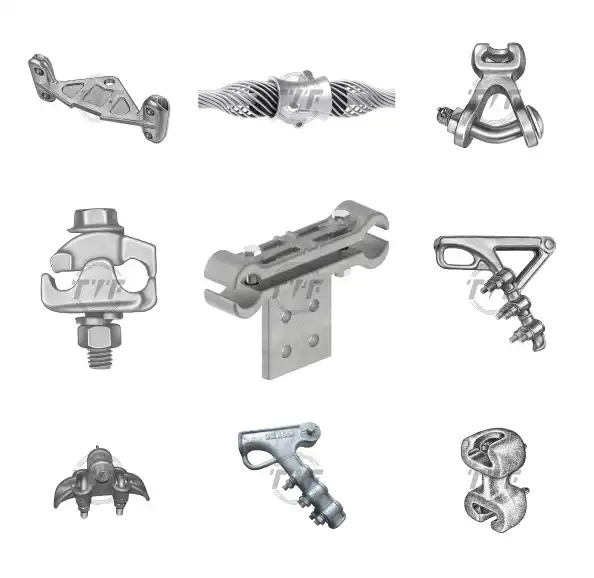

A drop wire clamp is a mechanical fitting used to secure, anchor, and support drop conductors on service lines that run from a utility pole to end users. Properly selected and installed clamps reduce maintenance frequency, prevent premature conductor failure, and ensure long-term mechanical integrity of overhead service drops. A failure of a drop wire clamp presents mechanical, electrical, safety, and operational risks. Drop wire risks lead to safety hazards, electrical interruptions, hardware damage, thermal risks, and increased maintenance costs. Therefore, it is crucial to put in place strict quality assurance, correct load rating selection, and periodic inspection that reduces these risks. Quality assurance for the drop wire clamp delivers a clear value proposition to meet technical, safety, and performance standards. TTF-certified drop wire clamps reduce failure risk by verifying material integrity, dimensional accuracy, and load compliance before deployment.
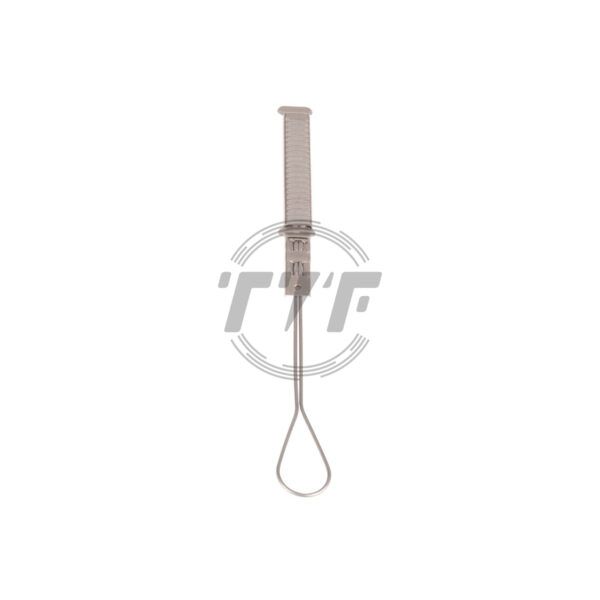
Drop Wire Clamp
A drop wire clamp is a mechanical device designed for securing and supporting drop wires in overhead power line and telecommunication installations. It ensures firm grip and reliable tensioning while preventing slippage or wire damage. The clamp is typically made of corrosion-resistant materials, providing durability and stability in outdoor environments. Its compact design allows for quick installation and long-term performance in aerial distribution networks.
Key Features:
- High Mechanical Strength – Provides secure grip on drop wires under tension.
- Anti-Slip Design – Prevents wire slippage without damaging insulation.
- Corrosion Resistance – Manufactured with stainless steel or UV-resistant thermoplastic for outdoor durability.
- Easy Installation – Tool-free, quick assembly for efficient line construction.
- Wide Compatibility – Supports various wire diameters for power and telecom applications.
- Weather Resistance – Maintains performance in extreme environmental conditions.
Significance of conducting quality assurance for drop wire clamps
Conducting quality assurance for drop wire clamps is crucial, as the fittings are load-bearing components in overhead distribution networks. Failure of the drop wire clamps affects safety, reliability, and regulatory compliance. Quality assurance verifies mechanical strength, grip performance, and material integrity. It ensures clamps can withstand design loads without slippage or fracture. QA reduces the risk of falling conductors, electrical contact incidents, and line-worker exposure during installation and maintenance. It ensures the drop wire clamps maintain consistent holding force, distribute strain without damaging conductor strands, and perform under wind, thermal cycling, and vibration. TTF-certified drop wire clamps undergo a process that assesses corrosion resistance, coating quality, and alloy composition. They are verified to resist moisture, UV, and pollutants to extend clamp service life. This is crucial to maintain performance in harsh environments.
The role of quality assurance in drop wire clamp manufacturing
Conducting quality assurance before manufacturing ensures that every clamp produced meets defined mechanical, material, dimensional, and performance requirements before use on overhead power networks. It transforms production from output-focused fabrication to controlled risk management. Quality assurance also ensures clamps enter the network with predictable performance. It helps reduce field failures and protects the safety, reliability, and reputation of manufacturers and utilities. Here are the roles of quality assurance for drop wire clamps.

- Raw material verification—quality assurance begins with verification of incoming materials. It also includes chemical composition of steel or aluminum alloys, mechanical properties, and coating materials. This prevents substandard or incompatible materials from entering production.
- Process control fabrication—QA establishes controls across forming, machining, casting, and assembly stages. These include monitoring of forging or casting parameters to avoid internal defects, dimensional inspections, and verification of wedge, bolt, or gripping component alignment.
- Surface treatment and corrosion protection checks—quality assurance checks galvanization thickness, adhesion and coverage of protective coatings. It also checks resistance to corrosion, moisture, and UV exposure.
- Mechanical and functional testing—the process needs routing and type testing, which includes tensile and load-holding tests. These tests help to confirm rated mechanical strength. It also includes slippage tests under sustained load, fatigue, and vibration testing where specified.
- Defect detection and corrective action—QA identifies cracks, sharp edges, or coating defects. It also identifies assembly errors or missing components and dimensional nonconformities.
Common quality failures in drop wire clamps and how the TTF-certified process prevents them
Quality failures arise from material defects, poor process control, or inadequate inspection. A structured quality assurance system addresses these risks by preventing defects before clamps reach the network. Quality assurance shifts drop wire clamp production from defect detection to defect prevention. It ensures that common failure nodes are identified and eliminated before installation. They do so by integrating material verification, controlled manufacturing processes, systematic testing, and traceability. Common failures include:

- Insufficient mechanical strength—the clamps can fracture, deform, or slip under rated tensile load. This may be from incorrect alloy selection, inconsistent forging, and lack of tensile and proof-load testing. TTF-certified clamps prevent incoming material certification and mechanical property verification.
- Conductor slippage and poor grip—service drop conductors may slip out or mitigate under sustained load. This arises from incorrect clamp geometry, gripping surface finish, and mismatch between clamp size and conductor range. Conducting quality assurance prevents dimensional inspections against design drawings and functional slippage.
- Conductor strand or insulation damage—the clamp edges cut strands or abrade insulation, which leads to premature conductor failure. Quality assurance ensures surface finish inspections and deburring controls and assembly checks. This helps to ensure correct force distribution.
- Corrosion and coating degradation—drop wire clamps may undergo rusting which reduces mechanical strength and service life. There are also tests on conductor coating thickness measurement and adhesion tests. These tests also include salt spray tests, and batch-level inspection of surface treatment quality.
- Dimensional non-conformity—dimensional failures may cause the clamp not to fit hooks, brackets, or pole hardware. Quality assurance ensures statistical process control, gauge calibration, and tooling maintenance programs.
TTF-certified drop wire clamp assurance process
The TTF-certified assurance process for drop wire clamps is an end-to-end control framework. It is designed to ensure mechanical reliability, dimensional accuracy, durability, and standard compliance. It is crucial to ensure their assurance before the product is deployed in overhead power networks. TTF-certified assurance reduces field failures, protects public safety, and ensures long-term reliability. Here is the assurance process for drop wire clamps.
Design and specification control
The QA process begins by validating rated mechanical load and safety factors, conductor size and type compatibility, and corrosion-resistance requirements.
Incoming raw material inspection
All materials are verified before use to check the chemical composition and mechanical properties of steel. It also ensures the certification of galvanizing or coating inputs and visual inspection for surface defects.
In-process manufacturing control
QA monitors critical fabrication stages, including forging, casting, or machining parameter control. It also includes dimensional checks on load-bearing and conductor-contact surfaces.
Surface treatment and corrosion protection verification
QA checks coating thickness and uniformity, adhesion and coverage of galvanization, and resistance to corrosion through testing. This ensures long-term structural integrity in aggressive environments.
Assembly verification
This includes checking proper alignment of wedges, bolts, torque application, and absence of sharp edges.
Mechanical and functional testing
Finished drop wire clamps undergo performance validation, including tensile and proof-load testing, slippage and grip performance tests, and vibration testing where specified.
Final inspection and conformity assessment
QA conducts visual inspection for defects and finish quality, dimensional verification of critical interfaces, and review of test results against acceptance criteria.
Documentation and traceability
Quality assurance maintains full traceability through batch identification and marking, inspection and test reports, and certificates of conformity and compliance. This supports audits, warranty claims, and corrective actions.
TTF Certified. Why Do We Certify?
TTF’s approach to power line hardware services results in optimal product quality, strict adherence to custom design, and reduced cost. We are constantly checking manufacturing processes, addressing material concerns, and improving staff expertise to ensure the best quality product. Our quality control begins at the first batch of samples that you received from us. This continues through all production phases, where our QC staff never stop looking for opportunities to improve product quality. We can provide:

- Dimensional Testing
- Mechanical Testing
- Tolerance Analysis
- Tooling Life Analysis
- Rockwell Hardness Testing per ASTM E18
- Brinell Hardness Testing per ASTM E10
- Magnetic Particle Testing per ASTM E1444
- CMM (Coordinate Measuring Machine) Testing
- 24″ Optical Comparator for Complex Measurements
- Tensile/proof load testing up to 160,000 lbs (700 kN)
- Hot Dip Galvanizing Plating Thickness per ASTM E376
- Torque Testing
- Roughness Testing
- Lifetime Sample Retention
Benefits of TTF-certified drop wire clamps for utilities and grid operators
TTF-certified drop wire clamps deliver measurable technical, operational, and commercial benefits for utilities and grid operators. The certification shows the product has passed a structured quality assurance regime embedded in the manufacturing lifecycle. TTF-certified drop wire clamps provide utilities and grid operators a practical quality assurance guarantee. It reinforces reliability, safety, cost control, and supply chain accuracy. Here are the benefits of TTF-certified drop wire clamps.

- Increased operational reliability—TTF certification reflects extensive testing and quality control across mechanical loads, material properties, and environmental performance. This reduces the incidence of clamp failures such as slippage, corrosion, or structural failure after installation.
- Reduced maintenance and lifecycle costs—certified drop wire clamps show consistent performance and longer service life. This is due to controlled manufacturing and validated material quality. This leads to lower emergency repair frequency, reduced spare parts inventory, and extended replacement cycles.
- Enhanced safety and predictable field performance—TTF-certified clamps suggest that the clamps have met defined mechanical and environmental criteria. This reduces the risk of unexpected failures that could lead to dropped conductors and electrical contact.
- Supplier and procurement confidence—TTF certification embeds documented quality assurance processes into the supply chain. They also enable utilities to check and compare vendors based on documented test results and manufacturing controls.
- Risk mitigation and regulatory alignment—drop wire clamp certification aligns with international or utility-driven quality expectations.
In conclusion,
Drop wire clamps enhance safety, reliability, and service continuity in overhead power distribution networks. Conducting quality assurance from design and raw material selection, manufacturing, testing, and traceability transforms drop wire clamps into controlled and dependable load-bearing assets. QA delivers tangible value to utilities and grid operators by reducing field failures, lowering lifecycle costs, and supporting regulatory compliance. Conducting quality assurance for drop wire clamps is a risk management and performance assurance mechanism. It underpins safe, resilient, and cost-efficient overhead power networks.
Sources: