
Bolted cable spacers are mechanical fittings used to maintain a fixed separation between bundled conductors in overhead transmission and distribution networks. The cable spacers are assembled and secured using bolts that clamp around individual conductors to hold them at a specified spacing. Bolted cable spacers in these networks preserve the designed phase bundle configuration and ensure consistent electrical spacing. They prevent physical contact that could damage strands or insulation. Proper spacing reduces corona discharge, radio interference, and audible noise in transmission lines. Most bolted spacers integrate damping elements to reduce fatigue and stress on conductors and hardware. Bolted cable spacers consist of clamping arms, high-strength galvanized or stainless steel bolts, elastomer inserts, and articulated joints. Quality assurance for bolted cable spacers ensures they perform reliably throughout their service life and follow stringent utility and regulatory environments. TTF-certified bolted cable spacers are tested against harsh environmental conditions to check for durability.
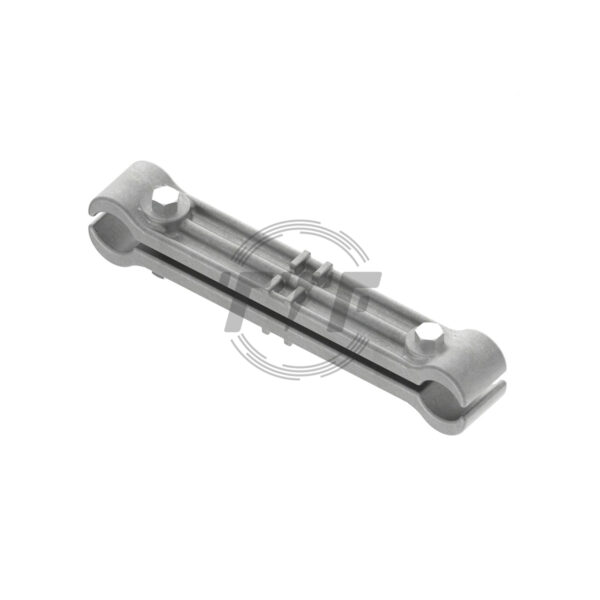
Cable Spacer
Bolted cable spacers are precision-engineered fittings used to maintain fixed separation between bundled conductors in overhead transmission lines. Installed at defined intervals along span lengths, they control sub-conductor spacing to mitigate aeolian vibration, prevent conductor clashing, and preserve bundle geometry under wind and thermal loading conditions.
Manufactured from high-strength aluminum alloy or galvanized steel components with elastomeric inserts, bolted cable spacers provide secure mechanical retention while minimizing conductor surface damage. The bolted assembly design enables accurate torque-controlled installation and reliable long-term performance in high-voltage environments.
Key Features
- Fixed Bundle Spacing: Maintains predetermined conductor separation for electrical and mechanical stability.
- Vibration Control: Reduces sub-span oscillation and galloping in bundled conductor systems.
- High Mechanical Strength: Designed to withstand tensile, compressive, and dynamic wind loads.
- Corrosion Resistance: Hot-dip galvanized steel or corrosion-resistant aluminum alloy construction.
- Elastomeric Clamping Inserts: Protect conductor strands from abrasion and stress concentration.
- Torque-Controlled Bolted Design: Ensures consistent clamping force and secure installation.
- Standards Compliance: Manufactured to meet relevant IEC and utility transmission standards.
- Low Maintenance Performance: Engineered for extended service life in harsh environmental conditions.
Significance of conducting quality assurance for bolted cable spacers
Conducting quality assurance for bolted cable spacers ensures mechanical integrity, electrical reliability, and long-term transmission line performance. The spacers operate under mechanical stress and environmental exposure. Failure of cable spacers can lead to conductor damage, forced outages, or safety incidents. TTF-certified bolted cable spacers withstand aeolian vibration, subspan oscillation, wind-induced galloping, ice loading, and short-circuit electromagnetic forces. Quality assurance verifies proper alloy composition and tensile strength, correct bolt grade, torque retention capability, and fatigue resistance under cyclic loading. It also ensures correct groove geometry, controlled clamping pressure, elastomer insert quality, and surface smoothness. Improper spacing alters electric field distribution, which increases corona discharge, radio interference, and power losses. Quality assurance confirms dimensional tolerances and spacing accuracy to preserve the electrical characteristics of bundled conductors. Modern grids with high renewable penetration experience fluctuating load flows and dynamic conditions. TTF-certified spacers maintain conductor geometry, prevent bundle distortion, and preserve system reliability.
The role of quality assurance in TTF-certified bolted cable spacers manufacturing
During the manufacture of TTF-certified bolted cable spacers, quality assurance acts as a structured control system that validates mechanical strength, dimensional accuracy, and long-term performance under service. Quality assurance is a control system that governs material selection, production processes, testing, compliance, and traceability. It detects defects and prevents them to ensure long-term performance in high-voltage transmission networks. Here are the roles of quality assurance in bolted cable spacer manufacturing.

- Raw material qualification—spacer bodies are from high-strength aluminum alloys. Quality assurance ensures chemical composition conformity, mechanical properties, and absence of casting porosity. For bolt and fastener certification, QA includes hardness testing, tensile and proof load testing, and verification of coating adhesion.
- Process control during manufacturing—QA process controls casting or forging oversight, machining precision, and assembly controls. Improper groove machining can cause strand deformation or uneven clamping pressure.
- Mechanical and performance testing—the process integrates laboratory and field-simulated testing to validate design performance. Key tests include slip tests, fatigue and vibration tests, ultimate mechanical load tests, and environmental testing.
- Dimensional and tolerance verification—QA ensures accurate center-to-center spacing, conformance to bundle geometry, and consistency across production batches. Deviations from specified tolerances can alter electric field distribution and increase corona effects.
- Standards compliance and certification—quality assurance ensures conformity with IEC transmission line hardware standards, IEEE specifications, and utility technical procurement specifications.
- Risk mitigation and lifecycle assurance—QA reduces premature fatigue failures, bolt loosening incidents, conductor strand damage, and outage risks. It enhances transmission line reliability and reduces total lifecycle costs.
Common failures for bolted cable spacers used in overhead transmission networks
Quality failures in bolted cable spacers arise from material control, manufacturing precision, assembly practices, or inadequate validation testing. These failures may lead to structural or electrical performance failures. Common failures include:

- Bolt loosening and torque loss—bolt failures include insufficient initial torque, improper thread engagement, and lack of locking features. These failures may lead to clamp slippage, bundle spacing deviation, increased conductor movement, and progressive fatigue damage.
- Clamp slippage on conductors—conductor slippage arises from incorrect groove geometry, poor surface finish, inadequate clamping pressure, and elastomer insert degradation. These failures may lead to conductor strand abrasion, loss of bundle symmetry, increased corona discharge, and elevated radio interference.
- Conductor strand damage—quality issues include sharp machining edges, burrs in clamp grooves, excessive compressive force, and misaligned clamp halves. These result in fretting corrosion, strand breakage, and reduced conductor fatigue life.
- Casting or forging defects—spacer bodies manufactured from aluminum alloys show porosity, cold shuts, shrinkage cavities, and inclusions. The internal defects reduce strength and can lead to structural fracture under dynamic loads.
- Corrosion failures—common causes of these failures include insufficient galvanization thickness, poor coating adhesion, and galvanic incompatibility between materials. Corrosion failures may cause bolt weakening, clamp body pitting, and loss of mechanical integrity.
- Fatigue cracking—these arise from cyclic wind loading, subspan oscillation, poor material grain structure, and stress concentration at bolt holes. Fatigue cracks initiate at high-stress points and propagate over time.
- Elastomer insert degradation—this arises from UV degradation, hardening, or improper bonding. Degraded inserts reduce vibration damping efficiency and speed up conductor fatigue.
Quality assurance process for the bolted cable spacers
The quality assurance process for bolted cable spacers in overhead transmission networks ensures mechanical integrity, electrical performance, and durability under dynamic loading conditions. The process extends to design validation, material control, manufacturing oversight, performance testing, and final certification. The process includes:
Design qualification and prototype validation
The spacer design undergoes qualification testing to confirm compliance with standards. Common tests include slip tests, ultimate tensile load tests, fatigue tests under cyclic vibration, and short-circuit current withstand tests.
Raw material inspection
The aluminum body undergoes chemical composition analysis, mechanical property testing, and visual inspection for casting defects. The bolt and fastener undergo grade certification review, hardness testing, proof load and tensile strength testing.
In-process manufacturing controls
Quality assurance during production focuses on dimensional accuracy and structural integrity. The forging control assurance includes mold inspection, porosity detection, and surface defect inspection. Other controls include machining oversight and assembly control.

Routine and sample testing
Cable spacers undergo production-level verification, which includes slip resistance tests, proof load tests, and torque retention tests. It also includes a salt spray corrosion test, a thermal cycling test, and UV exposure tests.
Final inspection
The quality assurance teams perform visual inspections, dimensional confirmation, surface coating verification, and packaging inspection before dispatch. The batch is then accompanied by inspection reports, test certificates, compliance declarations, and batch traceability documentation.
TTF certified bolted cable spacers. Why do we certify?
TTF’s approach to power line hardware services results in optimal product quality, strict adherence to custom design, and reduced cost. We are constantly checking manufacturing processes, addressing material concerns, and improving staff expertise to ensure the best quality product. Our quality control begins with the first batch of samples that you received from us. And this continues through all production phases, where our QC staff never stop looking for opportunities to improve product quality. We can provide:

- Tolerance Analysis
- Tooling Life Analysis
- Rockwell Hardness Testing per ASTM E18
- Brinell Hardness Testing per ASTM E10
- Magnetic Particle Testing per ASTM E1444
- CMM (Coordinate Measuring Machine) Testing
- 24″ Optical Comparator for Complex Measurements
- Tensile/proof load testing up to 160,000 lbs (700 kN)
- Hot Dip Galvanizing Plating Thickness per ASTM E376
- Torque Testing
- Roughness Testing
- Lifetime Sample Retention
- Dimensional Testing
- Mechanical Testing
Benefits of quality assurance for bolted cable spacers used in transmission networks
Quality assurance for bolted cable spacers influences transmission line reliability, conductor lifespan, and grid stability. Bolted cable spacers face dynamic and environmental stresses where QA ensures they perform within design parameters. Here are the key benefits of quality assurance for bolted cable spacers.

- Enhanced mechanical reliability—bolted cable spacers withstand aeolian vibration, subspan oscillation, wind galloping, and ice loading. Quality assurance ensures verified material strength, proper bolt grade and torque integrity. This helps reduce the risk of spacer fracture, bolt loosening, and clamp slippage under loading conditions.
- Protection of conductor integrity—poor-quality spacers can damage aluminum strands, create fretting corrosion, and introduce stress concentration points. Quality assurance validates accurate groove geometry, controlled clamping pressure, and proper elastomer performance.
- Improved electrical performance—correct conductor spacing maintains electric field distribution, corona suppression, radio interference control, and audible noise reduction. It ensures stable electrical performance and compliance with regulatory noise.
- Corrosion resistance and environmental durability—quality assurance verifies galvanization thickness, coating adhesion, material compatibility, and resistance to salt spray.
- Enhanced grid stability—modern transmission networks integrate large-scale renewables. This leads to variable load flows, dynamic mechanical stresses, and long-distance bulk power transfer. QA improved transmission line resilience and system reliability.
In conclusion,
Quality assurance for bolted cable spacers ensures mechanical integrity, conductor protection, and electrical performance in overhead transmission networks. QA reduces risks related to fatigue failure, bolt loosening, corrosion, and dimensional non-conformance. The QA process includes design validation, raw material inspection, in-process controls, and performance testing. It also enhances lifecycle durability, ensures compliance with IEC and IEEE standards, and reduces total cost of ownership. In grids integrating large-scale renewables, QA systems strengthen transmission reliability, preserve bundle geometry, and support long-term system stability under dynamic operating conditions.