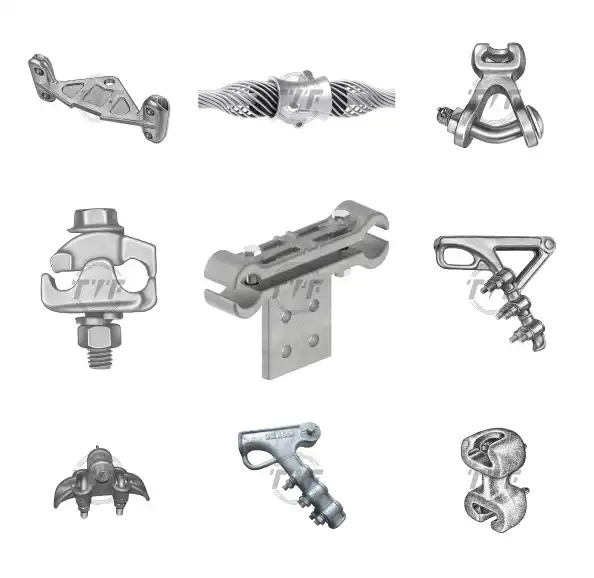
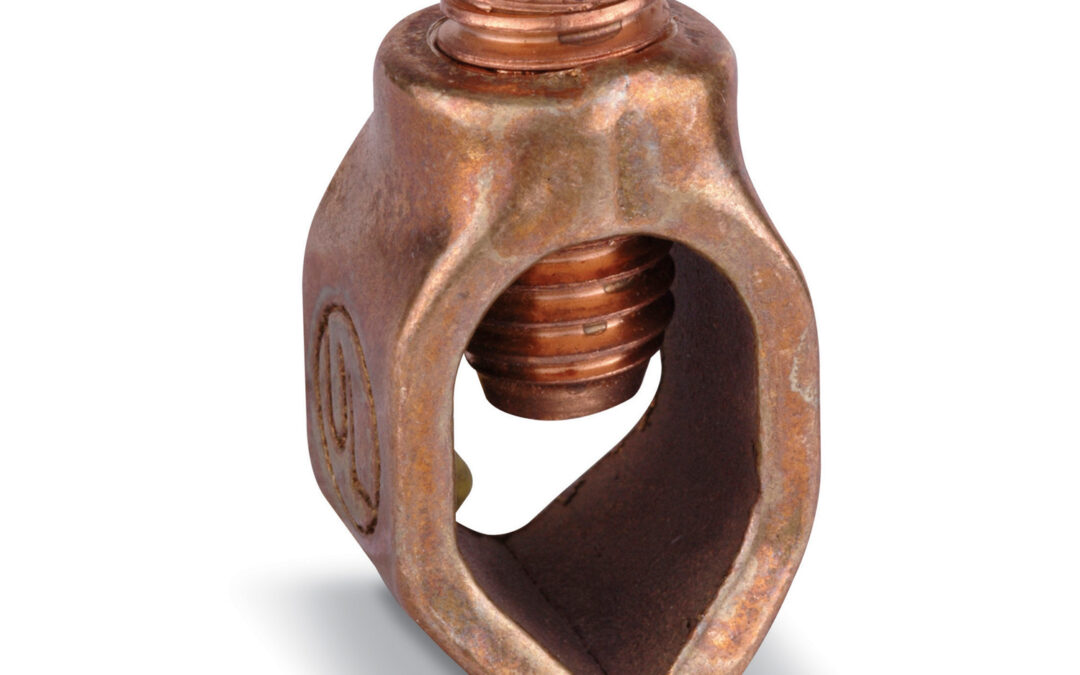
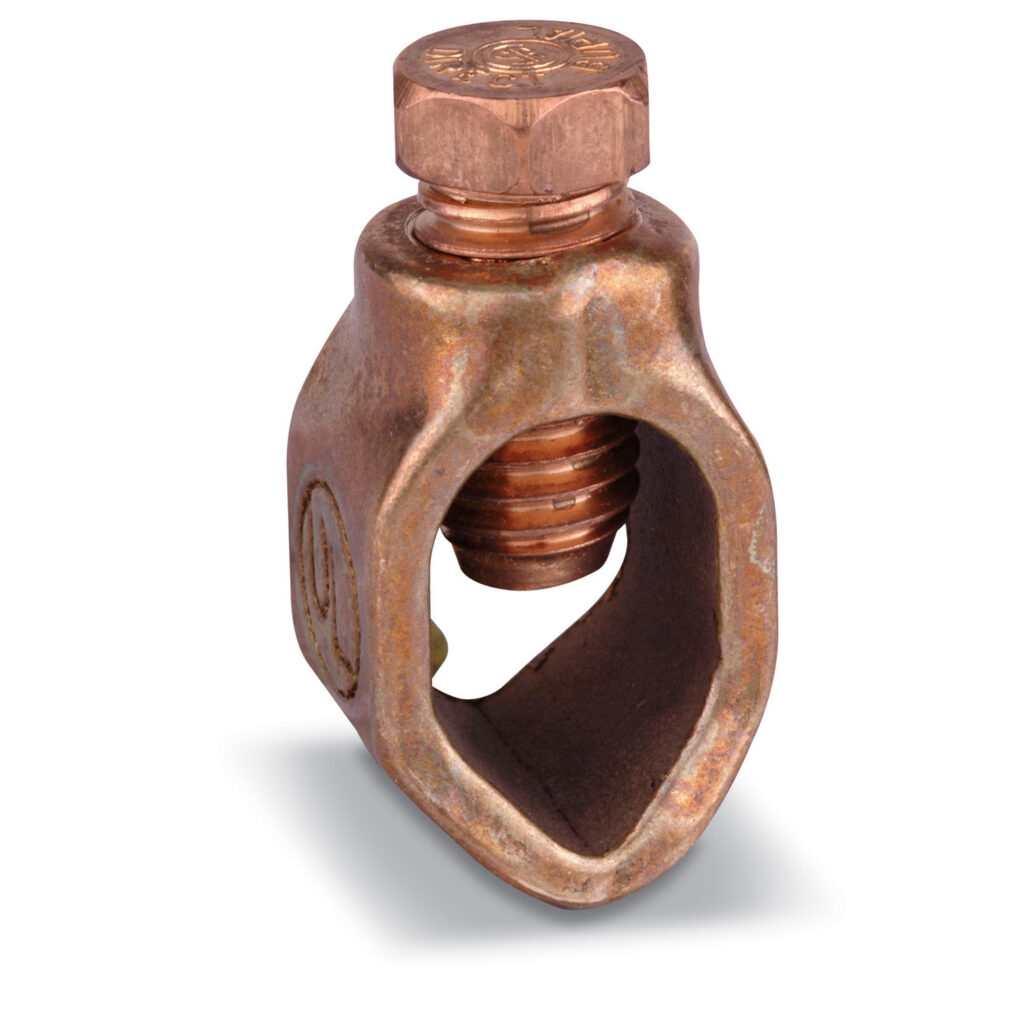
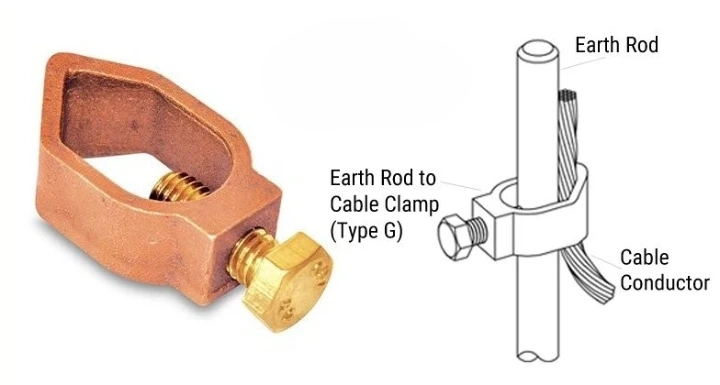
A ground rod clamp is a mechanical connector used in electrical power systems to securely bond a grounding conductor to a ground rod. The ground rod clamp provides a low-resistance, permanent electrical connection between the earthing electrode and the grounding conductor. It provides a connection for dissipating fault currents, lightning strikes, and transient overvoltages into the soil. Ground rod clamps ensure uninterrupted current flow from equipment to earth during fault conditions and maintain a reference potential to stabilize voltage levels. The clamps act as part of the grounding systems in substations, transmission lines, and renewable energy installations. Ground rod clamps maintain tight mechanical pressure over long periods even under thermal cycling and environmental exposure. Ground rod clamps are made of copper or copper alloys, bronze, and galvanized steel. Conducting quality assurance for the ground rod clamps prevents failures like increased ground resistance, corrosion, thermal damage, and electric shock.
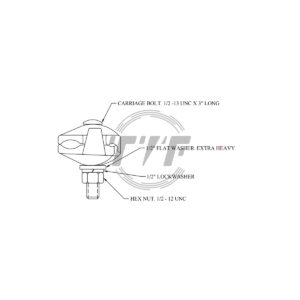
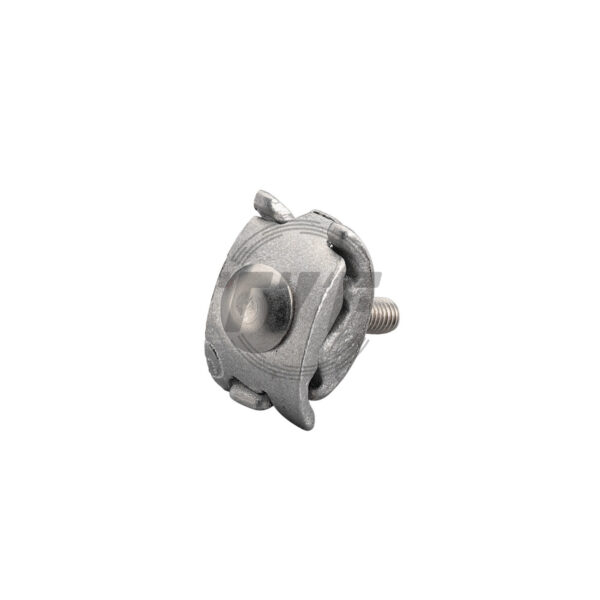
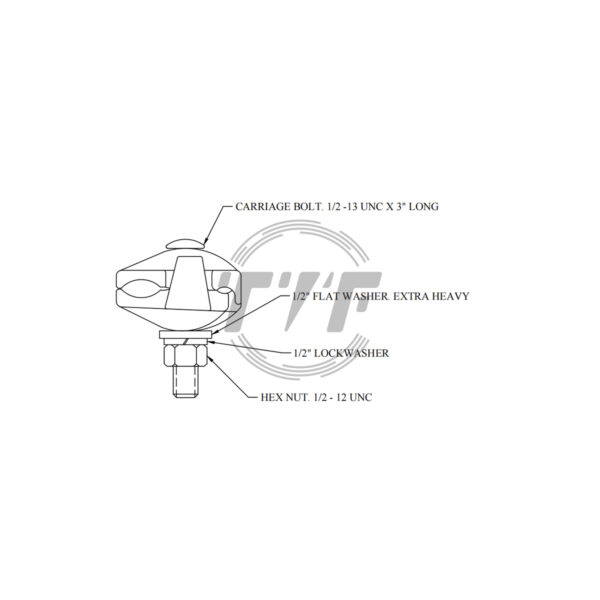
Clamp with 1/2 in Bolt Diameter
A ground rod clamp is a precision-engineered connector used to bond a grounding conductor to an earth electrode in power line construction. It provides a low-resistance, mechanically secure interface that enables efficient dissipation of fault currents and lightning surges into the ground. Designed for direct-burial and outdoor service, the clamp maintains stable electrical continuity under thermal cycling, vibration, and corrosive soil conditions. It is compatible with standard ground rod diameters and a range of conductor sizes, supporting reliable earthing across transmission, distribution, and renewable energy installations.
Key Features
- High conductivity interface: Copper or copper-alloy construction for minimal contact resistance
- Robust mechanical retention: Optimized bolt/set-screw design for sustained clamping force
- Corrosion resistance: Tin-plated or equivalent protective finishes for long-term durability
- Wide compatibility: Accommodates standard rod sizes and solid/stranded conductors
- Low thermal rise: Engineered to perform under high fault current conditions
- Secure installation: Anti-loosening thread design with defined torque capability
- Environmental durability: Suitable for direct burial and harsh outdoor environments
- Standards compliance: Designed to meet applicable IEEE/IEC grounding requirements
Importance of conducting quality assurance for ground rod clamps
Quality assurance for ground rod clamps impacts grounding system integrity, fault performance, and reliability of power networks. QA ensures the clamp maintains low contact resistance under all operating conditions. Poorly manufactured clamps lead to micro-aps or uneven contact pressure, increasing resistance and limiting the effective dissipation of fault currents, lightning surges, and switching transients. Quality assurance validates thread accuracy and torque capacity, mechanical strength, and resistance to loosening. Failure in mechanical integrity leads to loose connections which cause arcing, overheating, and system failure. QA verifies material composition, resistance to oxidation, moisture, and soil chemistry, and coating adhesion and uniformity. It also ensures conformity to established standards such as IEEE grounding standards and IEC earthing system requirements. Compliance ensures that clamps meet minimum threshold for conductivity, durability, and safety. This is crucial for utility-scale and renewable energy projects.
The roles of quality assurance during ground rod clamp manufacturing
Conducting quality assurance during ground rod clamps manufacturing ensures that the clamps deliver consistent electrical conductivity, mechanical strength, and environmental durability.
- Material verification – QA for the clamps begins with raw material control to ensure they meet specified conductivity, tensile strength, and corrosion-resistance thresholds. The controls include chemical composition analysis, conductivity verification, and coating thickness checks for galvanized components. This prevents substandard materials from entering production, which could compromise performance.
- Process control and manufacturing precision – QA enforces tight dimensional tolerances and surface quality. This ensures thread accuracy and pitch validation, surface finish inspection, and mold consistency checks in casting processes.
- Mechanical performance testing – QA validates that clamps withstand installation and service stresses. This includes torque testing to confirm clamping force, tensile and pull-out tests, and fatigue simulations.
- Electrical performance validation – this phase includes verifying low-resistance electrical continuity. This is through corrosion resistance testing between conductor and rod interface, current-carrying validation, and thermal rise testing.
- Environmental and corrosion testing – ground rod clamps serve in aggressive environments with soil moisture, chemicals, and temperature variations. QA conducts salt spray testing for corrosion resistance, aging tests, and coating adhesion and uniformity verification.
- Assembly and fit validation – QA ensures proper interaction between all components through fit checks, alignment verification, and ease of installation assessment to reduce field errors.
- Final inspection and traceability – QA conducts visual inspections for defects, dimensional audits, batch marking and traceability coding.
Common quality failures facing ground rod clamps
Most of the quality failures in ground rod clamps arise from deficiencies in materials, manufacturing control, or installation compatibility. The clamp forms an electrical interface where minor defects intensify into significant grounding inefficiencies. These failures can lead to ineffective grounding and elevated voltages, equipment damage, increased maintenance frequency, and safety risks for personnel and infrastructure. Here are the common failures in ground rod clamps.
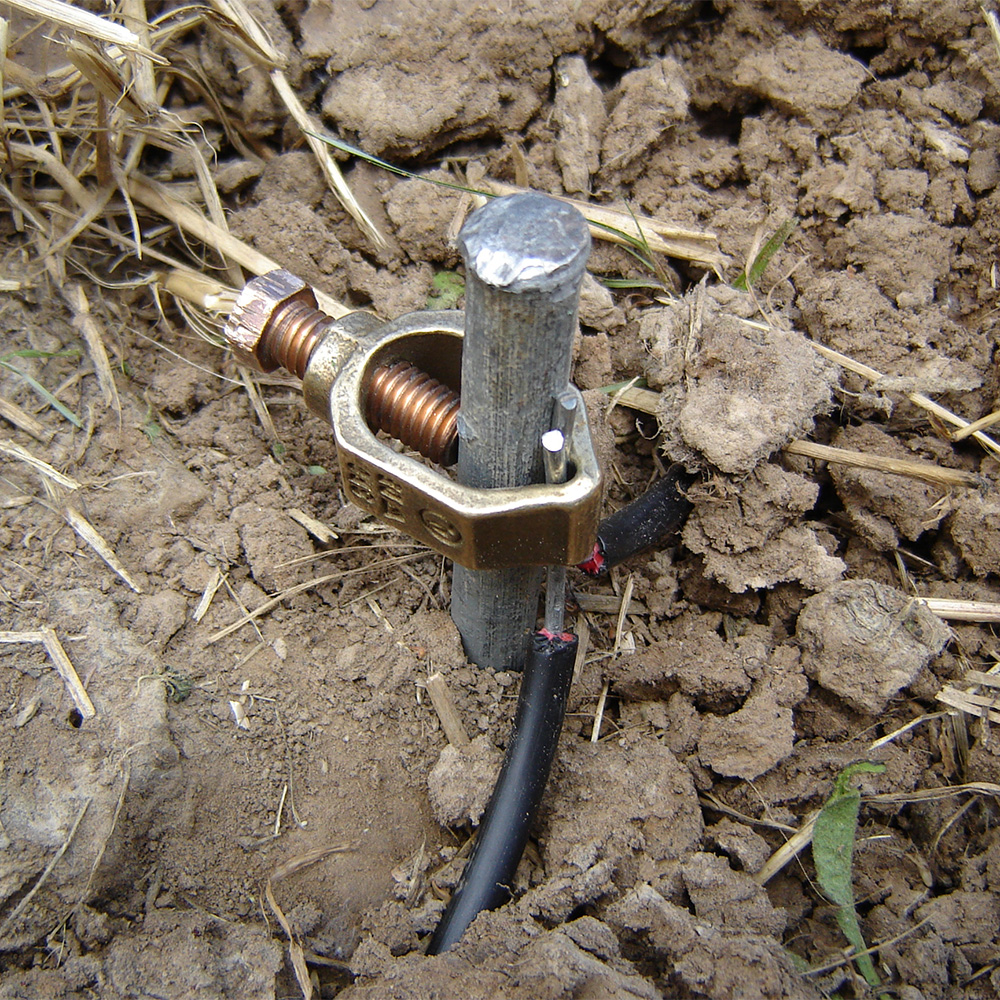
- High contact resistance at the interface – this is elevated contact resistance between the conductor and the ground rod. It arises from poor surface finish, inadequate clamping force, and misalignment preventing full metal-to-metal contact.
- Corrosion and material degradation – ground rod clamps face moisture, soil chemicals, and temperature variation. Failure arises from use of low-grade alloys, thin protective coatings, or dissimilar metals that create galvanic corrosion.
- Mechanical loosening and loss of clamping force—clamps may lose their ability to maintain pressure due to thread wear, thermal expansion and contraction cycles, and vibration in energized infrastructure environments.
- Thread stripping and bolt failure – improper heat treatment can lead to stripped threads, bolt fracture under torque, and inability to achieve specified tightening force.
- Casting and manufacturing defects – QA gaps lead to porosity and internal voids, surface cracks, and dimensional inconsistencies. These defects reduce mechanical strength and may spread under stress leading to premature failure.
- Inadequate conductivity materials – using materials with lower conductivity than required lead to higher resistive losses, reduced efficiency in fault current dissipation, and increased thermal stress.
- Poor fit and compatibility issues – improper matching to the conductor size causes partial contact surfaces, uneven pressure distribution, and installation difficulty leading to improper assembly.
- Coating and plating failures – protective coating may fail due to inconsistent thickness, peeling, or poor adhesion during production.
- Thermal performance failure – a low-quality clamp may overheat due to resistive losses, experience material softening, or lose clamping pressure.
Materials for ground rod clamps and how quality assurance protects them
Material selection for ground rod clamps depends on electrical conductivity, mechanical strength, and corrosion resistance. Quality assurance protects these properties from material intake through finished product release. It ensures the clamp maintains a stable, low-impedance grounding path. To protect material performance, quality assurance conducts chemical composition control, conductivity verification, mechanical property verification, surface and plating inspection, corrosion resistance testing, and galvanic compatibility assessment. QA prevents failure modes such as rising contact resistance, thread failure, rapid corrosion, loss of clamping force, and localized overheating. Quality assurance support fault current dissipation, limits voltages, and reduces maintenance costs in power networks. Here are the common materials for ground rod clamps.
Copper and high-conductivity copper alloys
These provide low electrical resistance at the conductor-rod interface. It offers high conductivity, good ductility, moderate mechanical strength, strong resistance to soil environments. These alloys serve in direct-burial earthing systems, substations, and renewable plants where low impedance is crucial
Bronze
Bronze balances conductivity with higher mechanical strength and wear resistance than pure copper. It offers excellent corrosion resistance, better thread durability, and improved resistance to galling. Bronze is ideal for clamps with threaded fasteners exposed to repeated torqueing or vibration.
Brass
This includes copper-zinc alloys with acceptable conductivity and machinability. These materials provide lower conductivity than copper, good corrosion resistance, and easy machining of precise threads. Brass ground rod clamps serve general-purpose functions where extreme conductivity is not the limiting factor.
Galvanized steel
This delivers high mechanical strength at lower costs. It offers low conductivity and relies on zinc coating for corrosion protection. Galvanized steel ground rod clamps are mostly used in mechanical retention components.
Platings and coatings
These enhance surface conductivity stability and corrosion resistance. They include tin plating that improves contact performance, zinc to protect steel, and nickel to improve wear and corrosion resistance.
TTF certified ground rod clamps. Why we certify.
TTF’s approach to power line hardware services results in optimal product quality, strict adherence to custom design, and reduced cost. We are constantly checking manufacturing processes, addressing material concerns, and improving staff expertise to ensure the best quality product. Our quality control for the ground rod clamps begins with the first batch of samples that you received from us. And this continues through all production phases, where our QC staff never stop looking for opportunities to improve product quality. We offer:
- Tolerance Analysis
- Tooling Life Analysis
- Rockwell Hardness Testing per ASTM E18
- Brinell Hardness Testing per ASTM E10
- Magnetic Particle Testing per ASTM E1444
- CMM (Coordinate Measuring Machine) Testing
- 24″ Optical Comparator for Complex Measurements
- Tensile/proof load testing up to 160,000 lbs (700 kN)
- Hot Dip Galvanizing Plating Thickness per ASTM E376
- Torque Testing
- Roughness Testing
- Lifetime Sample Retention
- Dimensional Testing
- Mechanical Testing
Advantages of using ground rod clamps in power networks
Ground rod clamps deliver functional and operational advantages crucial to grounding system performance in power networks. They ensure that the earthing system remains electrically effective and mechanically stable over time. Key benefits include the following:
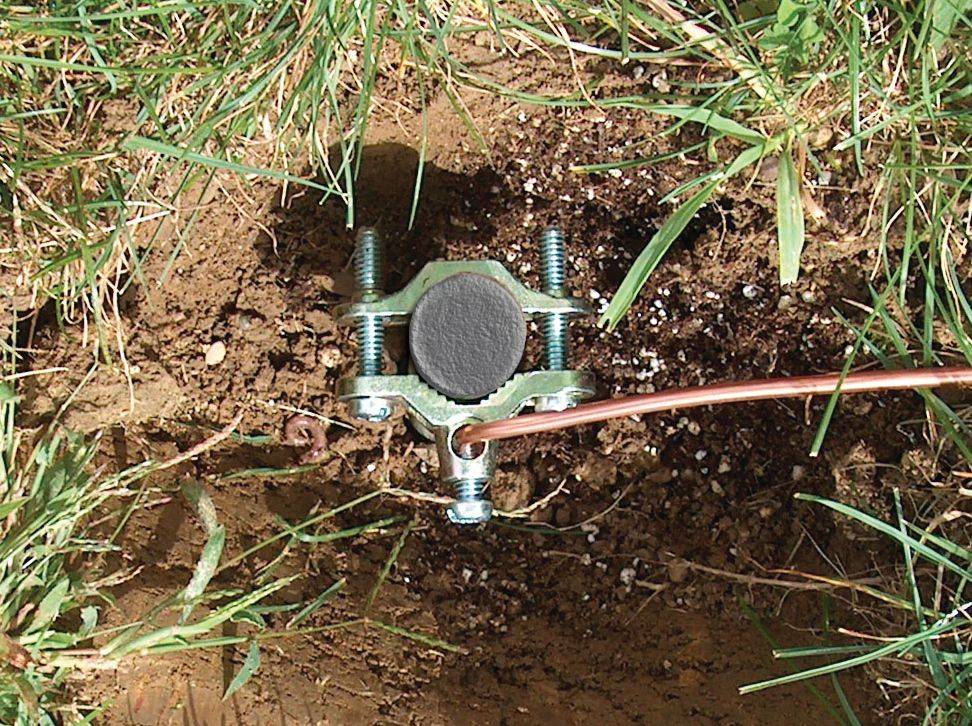
- Reliable electrical continuity – ground rod clamps create a secure, low-resistance interface between the grounding conductor and the earth electrode.
- Enhanced safety for personnel and equipment—the clamps reduce voltages, risk of electric shock, and protect sensitive equipment.
- Effective lightning and surge protection – ground rod clamps provide a direct path for lightning currents, prevent accumulation of dangerous voltages, and improve resilience of substations, transmission lines, and renewable energy installations.
- Corrosion resistance – ground rod clamps resist oxidation and chemical degradation, maintain conductivity, and reduce the likelihood of premature grounding failure.
In summary.
Ground rod clamps are critical components within power networks’ grounding systems. They influence electrical safety, fault performance, and reliability. Their effectiveness depends on maintaining a stable, low-resistance connection between the conductor and the earth electrode. Ground rod clamps are from materials such as copper alloys. Bronze, or coated steel. Combining material integrity with quality assurance helps achieve consistent electrical conductivity, mechanical strength, and corrosion resistance. Quality assurance helps prevent failures such as high contact resistance, corrosion, loosening, and thermal degradation. Their performance underpins grid stability and operational continuity in transmission lines, substations, and renewable energy installations.