
A strap guy hook is a metal accessory used to secure guy wires to the utility poles. It is made of carbon steel and hot-dip galvanized to withstand corrosion and mechanical strength. The guy hook secures and fastens support straps in utility infrastructure, electrical distribution, construction, and rigging applications. It is designed to anchor guy straps or guy wires to poles, crossarms, or structural frames; the strap guy hook provides a fixed point where a tensioned strap can attach to maintain stability. Strap guy hooks help distribute mechanical tension across the pole or supporting structure. It also prevents pole tilt, vibration, or movement caused by live tension, wind load, or uneven weight distribution. The guy hook features heavy-duty forged steel, a curved hook design, holes, and high tensile strength to withstand line and wind forces.
How does a strap guy hook work?
The working of the strap guy hook depends on secure anchoring, load transfer, and tension retention within overhead line and structural support systems. It allows a guy strap or guy wire to attach to a pole, crossarm, or frame while maintaining mechanical stability. The hooks feature a curved geometry that creates a mechanical interlock with the guy strap. The strap seat distributes force, while the interlock ensures the strap remains in place during tension adjustments. The hook transfers the load to the pole through bolts and forged steel construction. The load path created prevents the strap from bearing the force and keeps the entire support system balanced. Its design keeps the straps from slipping by combining curvature that locks the strap, friction between the strap, and downward load direction. Its material combination ensures corrosion resistance, high tensile strength, and the ability to withstand continuous dynamic loads.
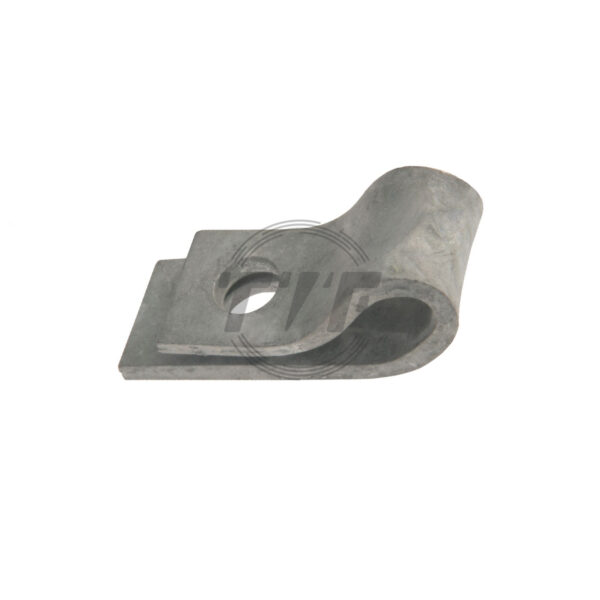
Strap Guy Hook
The strap guy hook is a high-strength anchoring component designed for secure attachment of guy straps in power line construction. Engineered for durability and load-bearing efficiency, it ensures pole stability under mechanical stress, wind loads, and conductor tension. Ideal for transmission and distribution networks, it provides reliable long-term performance in harsh outdoor environments.
Key Features:
- Forged steel construction for maximum tensile strength
- Hot-dip galvanized for superior corrosion resistance
- Curved strap seat to prevent slippage and abrasion
- Single or double mounting holes for versatile installation
- Compatible with standard guy straps and pole hardware
- Suitable for distribution, transmission, and telecom poles
- Withstands dynamic and environmental loads for long service life
Significance of strap guy hooks in power transmission and distribution networks
Strap guy hooks play a crucial role in keeping power transmission and distribution networks stable, safe, and mechanically resilient. They ensure the networks endure the constant tension, wind loads, and shifting environmental conditions. Strap guy hooks secure guy straps that counter wind pressure and uneven conductor pull by anchoring the strap to the pole. They help maintain the alignment of wooden poles, steel poles, and concrete poles. Strap hooks distribute mechanical loads and redirect horizontal forces into controlled tension paths. This reduces stress on components such as insulators, crossarms, and pole tops. By keeping the guy straps anchored, the guy hooks support safe line operation across rural and urban networks. The guy hooks allow utilities to reinforce poles without full structural replacement. This in turn makes the network upgrades more cost-effective and efficient. Strap guy hooks help keep stabilization systems intact and maintain line geometry, conductor clearance, and system reliability.
Features and components of the guy hook
The performance of the strap guy hook depends on features designed to handle mechanical stress in pole-line systems. These features allow the hooks to work with guy straps, guy wires, pole bands, crossarms, and anchoring hardware. These features and components include:

- Hook body—the main body is a forged or cast steel component shaped to create a strong mechanical seat for the guy strap. It has high strength to withstand heavy and sustained tension.
- Strap seat—this is the section where the guy straps rests into the hook. It consists of a curved profile to lock the strap during tension, an increased friction surface for better grip, and a load-distributing design to prevent concentrated stress points.
- Mounting hole—strap guy hooks need rigid attachment to poles through a pre-engineered mounting interface. It allows the hook to transfer force into the supporting structure.
- Forged steel construction—strap guy hooks are from hot-dip galvanized forged steel that offers resistance to outdoor conditions and high mechanical loads.
- Load-bearing curve—the hook’s design allows it to maintain tension and prevent slippage. Their design includes a rounded, closed, or semi-closed curve, a downward-oriented strap path, and a smooth finish to reduce wear on the guy strap.
- Reinforced ribs—these allow the hook to handle sudden impact loads and long-term mechanical stress. It provides strength under dynamic movement and allows ease of installation in tight pole-mounted spaces.
Types of tensioning hardware
Standard strap guy hook

This guy hook features a simple curved hook profile, a single mounting hole, and a design for general-purpose guying applications. It stabilizes light- to medium-load poles and supports routine distribution lines.
Heavy-duty guy hook

This is designed for higher mechanical stress. It has reinforced forged steel, a larger strap seat, and a higher tensile load capacity. It works in high-tension distribution lines, poles in windy regions, and areas with heavy conductor loading.
Double-hole guy hook

This hook includes two mounting holes to provide extra holding power. It offers better load distribution, reduced risk of rotation, and enhanced stability in heavy guying applications. The double-hole hooks are ideal for transmission poles, heavily loaded corner poles, and poles that encounter uneven conductor pull.
Angle strap guy hook

These hooks help position the strap at a specific angle. It features offset hook geometry, designed to align straps, and helps manage angular tension forces. It is ideal for dead-end configurations, poles with asymmetrical line pulls, and where straight-line hooks cannot maintain proper alignment.
Transmission-grade strap guy hook

These are specifically for high-capacity tension systems. They feature thick cross-sections, heavy forged steel, and oversized strap seats. They are ideal for extra-high voltage transmission lines, long-span structures, and tight line angles.
Enclosed strap guy hook

The enclosed hook provides a closed loop for greatest retention. It reduces accidental strap slip-off, provides better security, and is ideal for high-vibration areas.
Technical specifications for pole guying hardware
Strap guy hooks are engineered to meet mechanical, dimensional, and environmental standards. This is crucial for the guy hooks to perform reliably in power transmission and distribution systems. Their technical specifications determine how much load the hooks can handle and how they fit onto poles. These specifications include:

- Material specifications—strap guy hooks are from forged carbon steel, malleable iron, and hot-dip galvanized steel for corrosion resistance. These materials provide high tensile strength, impact and vibration resistance, and the ability to withstand cyclical loading.
- Mechanical strength ratings—utilities choose strap guy hooks depending on their load-bearing capacity. Their ratings include working load limits ranging between 1,500 and 6,000 lbs, ultimate tensile strength, and safety factors between 2.0 and 3.0 for utility-grade hardware.
- Dimensional specifications—the dimensions for the strap guy hook vary by manufacturer and application. Common parameters include hook opening width 10-30 mm, strap seat radius 12-25 mm, length 85-160 mm, body thickness 8-20 mm, and mounting hole diameter 12-19 mm.
- Mounting hole and bolt compatibility – strap guy hooks work with 5/8-inch or ¾ ¾-inch through-bolts, galvanized steel washers, and nuts.
- Galvanization and coating standards—the strap guy hooks follow coating standards such as ASTM A153 hot-dip galvanizing and ISO 1461 for zinc coating for corrosion protection.
- Design standards and compliance—utilities expect compliance with industry standards such as IEC standards for mechanical line hardware, ANSI for pole line hardware, and utility-specific specifications for transmission and distribution lines.
- Environmental specifications—strap guy hooks have ratings for temperature changes, high humidity environments, dynamic wind-induced vibrations, and UV exposure.
- Tensile and fatigue performance—the hooks undergo proof-loading tests, tensile tests, and fatigue cycling tests. This ensures stability even under repeated tension fluctuations.
Application areas of strap guy hooks
Strap guys work across power, telecom, construction, and industrial support systems. They provide a secure anchoring point for tensioned straps. They offer strength and reliability for stability, load distribution, and long-term durability. Here are the application areas of strap guy hooks.

- Power transmission and distribution networks—the guy hooks stabilize wooden, steel, and concrete poles. They anchor guy straps that counteract conductor tension, support poles, and reinforce corner, deadend, and heavy-load poles.
- Telecom infrastructure—telecommunication towers, fiber distribution poles, and wireless masts—needs reliable mechanical support. Strap guy hooks help maintain stability in dense cabled lines.
- Renewable energy installations—solar and wind power infrastructure integrate overhead support systems that use guying components. Strap guy hooks secure poles supporting solar plant power lines, reinforcing meteorological towers, and anchoring structural frames exposed to high winds.
- Railway electrification and infrastructure—guying hardware is essential in maintaining overhead support systems. The strap hooks stabilize poles, reinforce poles, and handle uneven tension forces from overhead wire systems.
- Rural electrification projects—poles in rural areas face strong winds, loose soil, and long conductor spans. Strap guy hooks help reinforce poles at an affordable cost. This makes them crucial for expanding networks into remote locations.
Following best practices for utility pole hooks
It is essential to follow best practices for strap guy hooks to ensure mechanical stability, long-term durability, and safe operations within power transmission, distribution, telecom, and construction environments. These practices help ensure the guying systems perform reliably under harsh weather, high tension, and continuous vibrations. Common practices include selecting the right strap guy hooks and corrosion-resistant materials and ensuring proper mounting and bolt selection. It is also important to maintain alignment between strap and load direction, inspect the strap seat, follow tensioning procedures, and conduct maintenance. Additionally, it is crucial to follow utility and engineering standards such as ANSI, IEC, and utility engineering specifications.