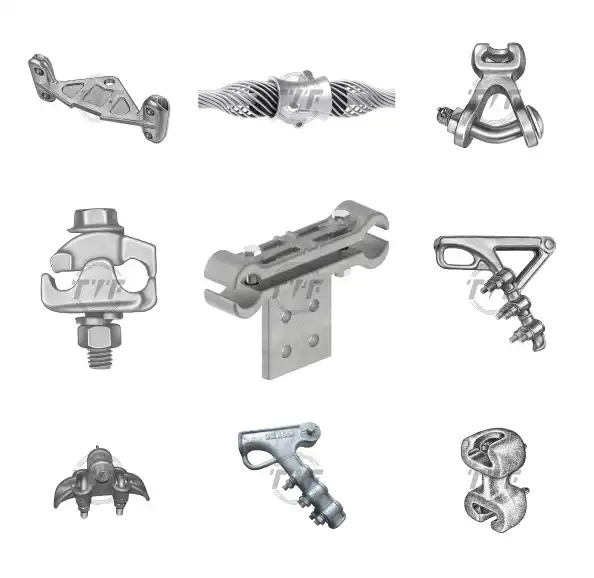

A strain clamp is a mechanical device used in overhead power line construction to secure and anchor conductors under high tension. The clamp holds the conductor where the line ends, changes direction, or experiences heavy mechanical load. Strain clamps transfer mechanical tension from the conductor to the towers and prevent sag. They also maintain electrical continuity, protect the conductor from damage, and support line stability. Strain clamps function in dead-end towers, angle towers, substation terminations, and long-span crossings. They keep conductors secure in high-stress zones, reduce the risk of line failure, and ensure safe and stable power transmission across demanding environments.
The working of the strain clamp
The strain clamp converts the tension of the conductor into a secure, distributed grip that anchors the line without causing damage. The clamp applies controlled pressure around the conductor to withstand the full mechanical tension of the line. Its body tightens around the conductor through bolts or hydraulic compression. After tightening, friction and radial pressure lock the conductor in place. The tapered wedge slides into a housing when tension is applied to increase the grip. Strain clamps distribute pressure using contoured grooves, alloy liners, and large contact surfaces. After gripping the conductor, the clamp transfers the tensile force to the pole through the clamp body, a socket, and insulator strings at deadends. This relieves the conductor from carrying unsupported tension over long distances. Strain clamps ensure the line remains stable under wind pressure, ice loading, thermal expansion, and sudden mechanical shocks.
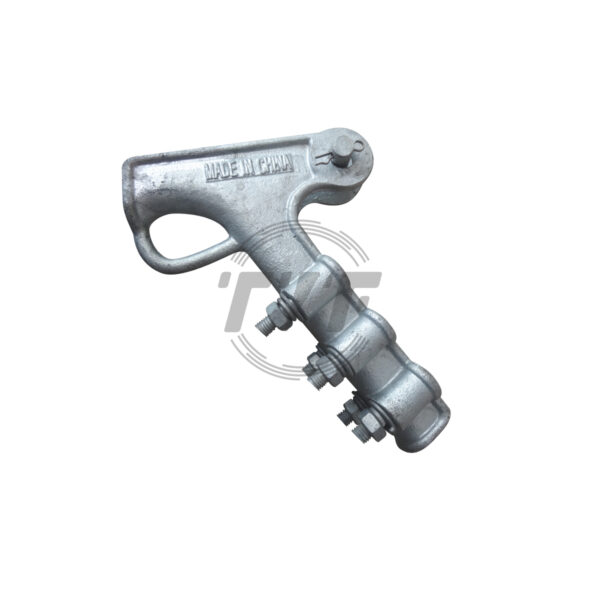
Strain Clamp
A strain clamp is a mechanical device used in power line construction to anchor, support, and transmit the mechanical load of conductors or overhead ground wires to poles and transmission towers. It provides a secure grip without causing damage to the conductor, ensuring mechanical stability in both tension and suspension applications. Strain clamps are critical for maintaining conductor alignment and preventing slippage under high tensile forces, wind, or ice loading.
Key Features:
- High Mechanical Strength – Designed to withstand heavy tensile loads while maintaining conductor stability.
- Corrosion Resistance – Manufactured from aluminum alloy or galvanized steel for durability in outdoor environments.
- Secure Conductor Grip – Provides firm clamping without damaging the conductor strands.
- Ease of Installation – Simple, tool-assisted installation suitable for both new construction and line maintenance.
- Versatile Applications – Compatible with various conductor sizes and materials.
- Thermal Performance – Maintains electrical conductivity and mechanical strength under temperature variations.
Importance of using strain clamps in overhead power networks
Using strain clamps in overhead power lines enhances safety, reliability, and efficiency of power transmission. Strain clamps secure the conductor at critical points to ensure the mechanical load is properly transferred to the support structure. They prevent the lines from sagging, snapping, or structural failure. The clamps distribute clamping pressure and prevent crushing, fraying, or deformation of the wire. Strain clamps maintain the position and alignment of conductors along the line. By anchoring conductors, the clamps prevent movement caused by wind, vibrations, or ice to reduce the risk of line faults and outages. Proper installation of strain clamps reduces the risk of conductor detachment, accidents to maintenance, and power outages due to mechanical failure. Some strain clamp designs maintain low-resistance electrical contact to ensure reliable power flow while serving as a mechanical anchor. Strain clamps offer safety, reliability, and efficiency in overhead power transmission.
The components and features of strain clamps
Strain clamps consist of several components and features that ensure mechanical stability and electrical continuity. These components help anchor the conductor, ensure line stability, and reduce maintenance issues. Strain clamps offer high tensile strength, conductor protection, durability, ease of installation, electrical conductivity, and movement resistance. Here are the key components of the strain clamps.

- The body—strain clamp housing consists of aluminum alloy, galvanized steel, or high-strength copper alloy. It provides the main structural support and distributes mechanical loads along the conductor. It can withstand corrosion, high mechanical stress, and environmental factors.
- Gripping mechanism—this holds the conductor without causing damage to ensure a strong grip. It does this while allowing controlled installation. Common types include wedge-type and compression-type mechanisms.
- Eye attachment—this connects the clamp to tower insulators or other support structures. They offer flexibility for angular alignment while transferring the tensile load.
- Contact surface—this cushions the conductor, prevents abrasion, and ensures uniform pressure distribution. This is crucial for high-voltage lines that demand conductor integrity.
- Bolts and fasteners—these fasteners secure the clamp around the conductor and lock it in place. It offers adjustability for tension and replacement without conductor damage.
Types of strain clamps
Bolted strain clamps

These clamps feature bolts to tighten the clamp body around the conductor. It provides adjustable grip through threaded bolts and is suitable for large conductors and high-voltage lines. They function in dead-end towers, angle towers, and substation terminations that need mechanical strength.
Compression strain clamps

Compression clamps use hydraulic tools to compress the clamp around the conductor. It provides uniform pressure along the conductor, reduces the risk of strand damage, and maintains electrical continuity. It functions in high-voltage transmission lines, long spans, and areas with extreme weather conditions.
Wedge-type clamps

The clamps use a wedge mechanism that tightens as tension increases on the conductors. It consists of a self-tightening design and quick installation without hydraulic tools and is effective for both standard and stranded conductors. They serve in medium- to high-voltage lines and lines without frequent maintenance requirements.
Suspension strain clamps

The clamp connects to insulator strings and reduces bending stress on the conductor. It serves on straight-line spans and loaded transmission lines.
Custom clamps

These are the bundle conductor clamps for bundled conductors in high-voltage transmission lines. They are also designed for harsh climates with ice or wind-induced conductor galloping.
Technical specifications for strain clamps
Technical specifications for train clamps ensure they can withstand the mechanical, electrical, and environmental demands of overhead power lines. They guide in selecting the right clamp for a specific conductor type and transmission environment. Here are the key technical specifications.

- Mechanical strength specifications—this includes rated tensile strength that ranges from 40 to 95 kN for distribution lines and 100 to 300+ kN for high-voltage transmission lines. It includes slip strength, which shows the tension level at which the conductor starts slipping within the clamp.
- Material specifications—different parts of the clamp consist of different materials that allow their long service life. The clamp body consists of aluminum alloy or galvanized steel; bolts are made of galvanized steel or stainless steel, while liners consist of aluminum alloy, polymer, or neoprene rubber.
- Electrical specifications—the clamp should have low resistance to maintain electrical continuity. It must withstand the conductor’s operating temperatures ranging from 75°C to 95°C for standard lines and 100°C to 120°C for modern high-temperature low-sag.
- Conductor compatibility—the strain clamp should match ACSR, AAAC, ACAR, ACCC, and copper conductors. The size should range from 16 mm up to 700 m or more for large transmission lines. Some of the clamps have grooves and liners shaped to fit round or compacted stranded conductors.
- Dimension and installation specs—the clamp should match hardware interfaces such as insulator strings, yoke plates, or terminals. The dimensions should follow ANSI, IEC, or NEMA standards. The clamps should also have precise torque values that ensure correct grip without damaging the conductor.
- Protection specs—some clamps are hot-dip galvanized or anodized aluminum to provide durability. They should tolerate aeolian vibration and galloping without fatigue cracking. The clamp should also operate from -40°C to +120°C to ensure performance under extreme weather.
Applications and uses of the strain clamp in power networks
Strain clamps anchor, stabilize, and protect conductors throughout power transmission and distribution networks. They function across structural points with mechanical tension, directional changes, and environmental stress. Strain clamps secure and stabilize conductors to ensure energy transfer and maintain the reliability of transmission and distribution networks. Here are the applications of strain clamps in power networks.

- Deadend towers—strain clamps serve at the end of a line section where the conductor must be anchored. It transfers full conductor tension to the tower through insulator strings. The clamp ensures stable termination without deformation.
- Angle and corner towers—strain clamps hold the conductor at the angle point and prevent lateral movement. It absorbs extra mechanical stresses created by the directional deviation.
- Long span crossings—the clamps provide strong anchorage to withstand high tension, wind loading, and environmental stress. This is crucial for spans across rivers, highways, valleys, and railways.
- Transition points between line sections—they function at points where conductor type, sag, or tension changes. The clamps offer a stable transition in these sections to maintain mechanical balance between different line segments.
- Substations and switching yards—strain clamps help secure bus conductors and anchor connections to circuit breakers, isolators, transformers, and gantries. They ensure mechanical stability and maintain electrical continuity at fixed equipment interfaces.
- Mid-span tensioning and repair work—the clamps support temporary anchoring during maintenance, emergency line repairs, and conductor stringing operations. They act as tensioning points when sections of conductors need to be isolated or replaced.
- Bundle conductor systems—the clamps anchor twin, triple, and bundle conductors while maintaining tension. They ensure balanced electrical and mechanical performance in high-capacity lines.
- Renewable energy integration lines—the clamps serve in transmission lines connecting wind farms, solar plants, BESS, and geothermal sites. Strain clamps support the structural reliability of new grid infrastructure.
Best practices for strain clamps in power networks
Proper use of strain clamps in power networks depends on installation standards, proper handling, and maintenance. Following these practices ensures the clamps perform under tension, environmental load, and long-term operation. To ensure the best performance for the clamps, it is crucial to select the right clamp for the conductor, follow manufacturer specifications, protect the conductor during installation, and ensure proper alignment and hardware compatibility. It is also essential to maintain electrical continuity, track clamp condition, use proper tools, and apply anti-corrosion measures. Following these practices strengthens line stability, reduces conductor damage, and supports long-term grid reliability across transmission and distribution networks.