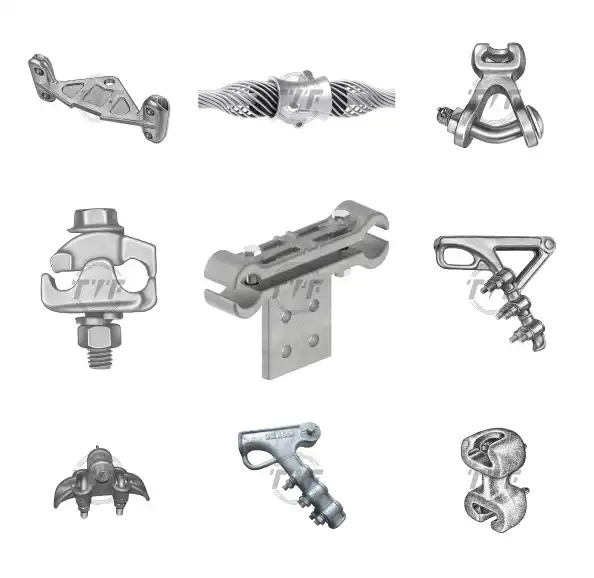
The steel insulated secondary clevis is a type of spool insulator bracket used to provide a secure attachment point for insulated conductors and service wires. It is also known as a D-iron or D-bracket. The secondary clevis connects the spool insulator to the pole so that the spool insulator can support and insulate the conductors. It also connects secondary line components to poles, brackets, or other support structures while maintaining the intended mechanical arrangement of the distribution system. Steel-insulated secondary clevises consist of a clevis body, attachment holes, an insulating component, and retaining components. These components offer structural attachment, connection to the secondary line assembly, and load transfer. The secondary clevis provides high mechanical strength and durability. Additionally, the clevis is manufactured from high-quality materials and protections, including carbon steel, insulating materials, hot-dip galvanizing, and corrosion-resistant fasteners. Manufacturers also conduct quality assurance for the clevis to help maintain mechanical integrity.
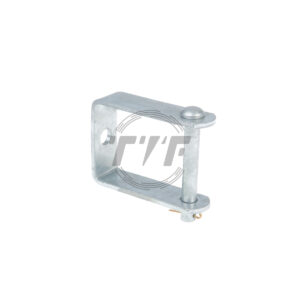
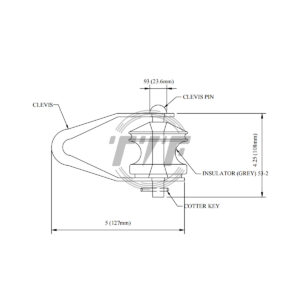
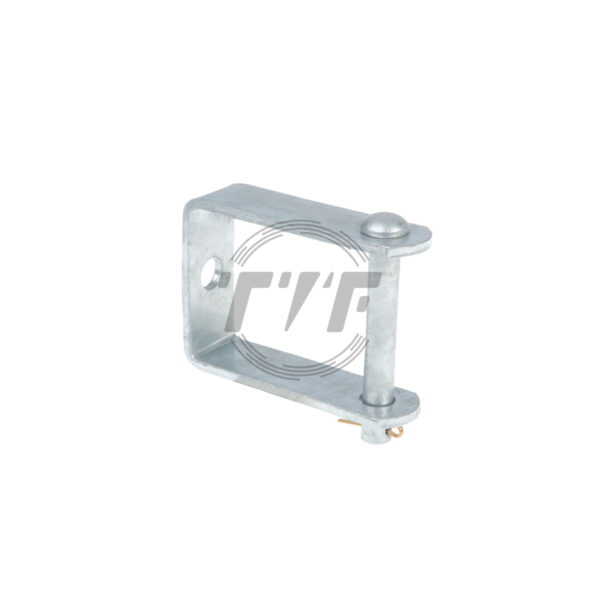
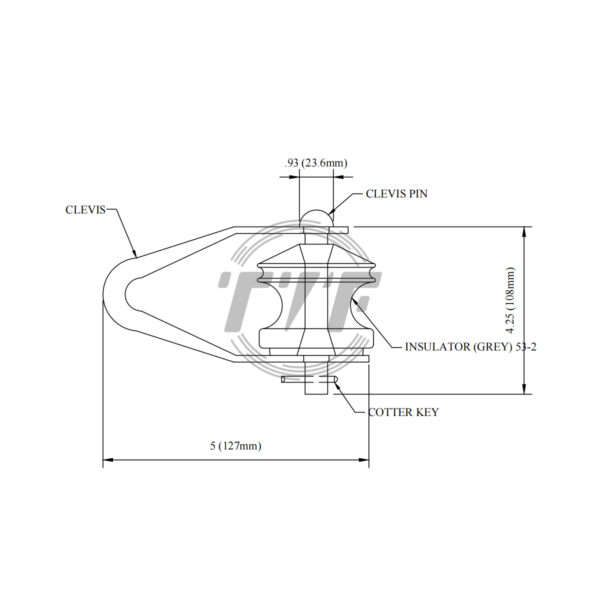
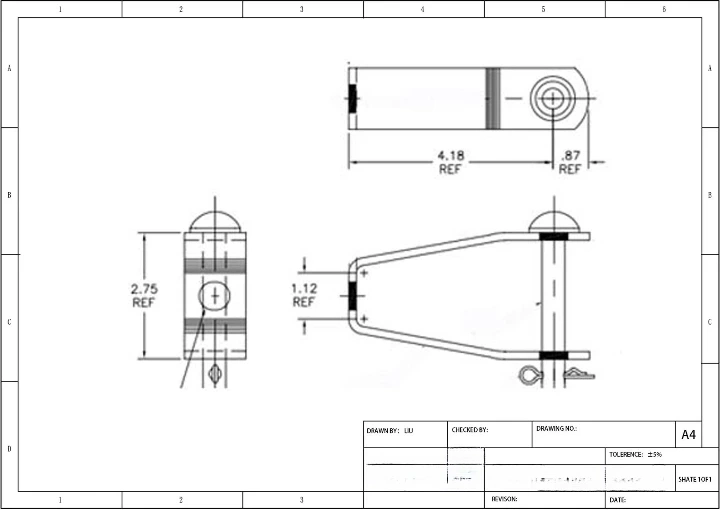
Steel Insulated Secondary Clevis, Weight: 2.7 lb
A steel insulated secondary clevis is a power line hardware fitting designed to provide a secure mechanical connection in compatible secondary overhead distribution assemblies. Manufactured from durable steel and protected with a suitable corrosion-resistant coating, it supports reliable attachment and long-term performance in outdoor utility environments. Depending on the product design, insulating components may provide electrical isolation where specified. Correct selection requires verifying the fitting’s dimensions, load rating, insulation configuration, and compatibility with the intended power line assembly.
Key Features:
- Durable steel construction: Provides mechanical strength for overhead distribution applications.
- Corrosion protection: A suitable coating, such as hot-dip galvanizing, helps resist rust and environmental degradation.
- Secure connection design: Clevis openings accommodate compatible pins, bolts, or connecting hardware.
- Insulation options: Specified insulating components provide electrical isolation where included in the design.
- Installation compatibility: Designed for use with compatible secondary distribution fittings and support assemblies.
- Quality assurance: Dimensional checks, material verification, coating inspections, and specified mechanical tests help ensure consistent performance.
- Outdoor suitability: Supports dependable service when correctly selected, installed, and maintained.
Structure and components of a steel-insulated secondary clevis
A steel-insulated secondary clevis is designed to provide a mechanical connection within compatible secondary overhead distribution networks. Its structure may include an insulating component or work with a separate insulator. These components form a mechanical connection that supports the intended secondary distribution arrangement. Before installation, it is crucial to check the body dimensions, hole spacing, and steel grade and coating coverage and inspect the body for cracks. These components include:
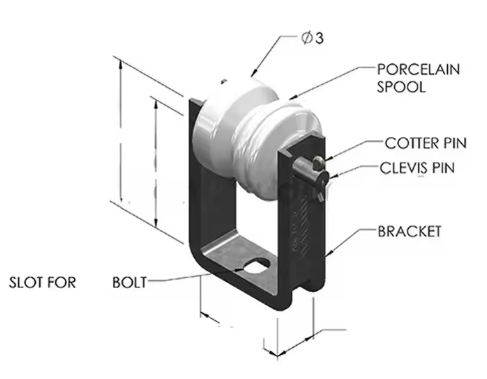
- Steel clevis body—the main load-bearing component made of steel to provide the strength needed for its intended application. The clevis-shaped geometry forms an attachment point for compatible pins, bolts, or mating fittings. The body transfers mechanical loads between the connected hardware and the support structure.
- Pin holes and connection openings—the clevis body has holes that accommodate the designated connecting pin, bolt, or other fastening components. The holes establish the mechanical connection and help maintain alignment between mating components.
- Clevis pin – the pin secures the clevis to a bracket or a compatible fitting. The pin holds the connected components together and transfers the loads for which the joint is designed.
- Nuts, washers, and retaining devices—some of the clevis assemblies use nuts, washers, cotter pins, or other retaining mechanisms. These fasteners secure the connection and help prevent unintended loosening or separation during service.
- Insulating component—the insulating insert, sleeve, or bushing provides the specified electrical separation at the designated interface. Other designs have insulation provided by a separate component in the wider assembly. It meets the electrical isolation requirements of the specific arrangement.
- Mounting interface—the clevis connects to an approved support bracket, pole-mounting fitting, or other structural components. The mounting provides the interface through which mechanical loads are transferred to the supporting structure.
The importance of quality assurance during the manufacture of steel insulated secondary clevis
Quality assurance during the secondary clevis manufacture is crucial because they contribute to the mechanical integrity and reliability of the secondary overhead power distribution system. QA ensures that the clevis meets the required material, dimensional, mechanical, and corrosion-resistance specifications before installation on a utility pole. It helps identify manufacturing defects such as an incorrectly positioned pinhole, inadequate steel strength, poor galvanizing, or a defective insulating component. Quality assurance helps manufacturers identify and prevent these defects before products reach utilities, contractors, and distributors. QA roles during Clevis manufacture include:
- Ensuring material quality and mechanical strength—the steel used during clevis manufacture should have the mechanical properties needed for its intended application. Common quality checks include material certification, mechanical testing, raw material inspection, and manufacturing process control.
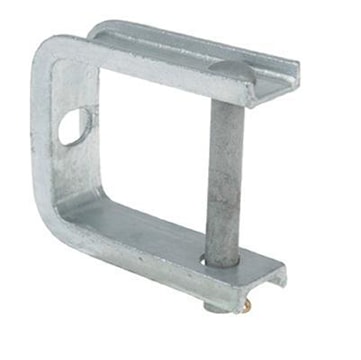
- Maintaining dimensional accuracy—a steel-insulated secondary clevis must fit with its brackets, pins, bolts, and other hardware. Quality assurance creates dimensional controls throughout production. Key check points include clevis body length, pin-hole diameter and alignment, fastener dimensions, and contact surfaces.
- Preventing manufacturing defects—QA helps identify defects before they cause operational problems. Defects may originate during steel cutting, bending, punching, welding, machining, coating, or final assembly.
- Improving corrosion resistance—steel insulated secondary clevis face rain, humidity, temperature variations, industrial pollutants, and coastal salt. QA helps control corrosion protection through verifying surface preparation, inspecting hot-dip galvanizing, measuring coating thickness, and checking for bare areas.
- Verifying the electrical safety of insulating components—the insulating component offers electrical isolation. The clevis consists of an insulating insert, sleeve, bushing, or another dielectric component. QA should confirm that the component meets the needed electrical and environmental performance specifications.
- Ensuring mechanical load performance—the clevis and its connections should withstand the mechanical loads specified for their intended application. Quality assurance helps verify performance through design validation, process controls, and mechanical testing.
Quality failure modes of steel insulated secondary clevis in power networks
Steel-insulated secondary clevises serve in compatible secondary overhead power distribution lines to connect and support line hardware. Their performance depends on material strength, dimensional accuracy, corrosion protection, connection integrity, and electrical insulation quality. Common quality failure modes include:
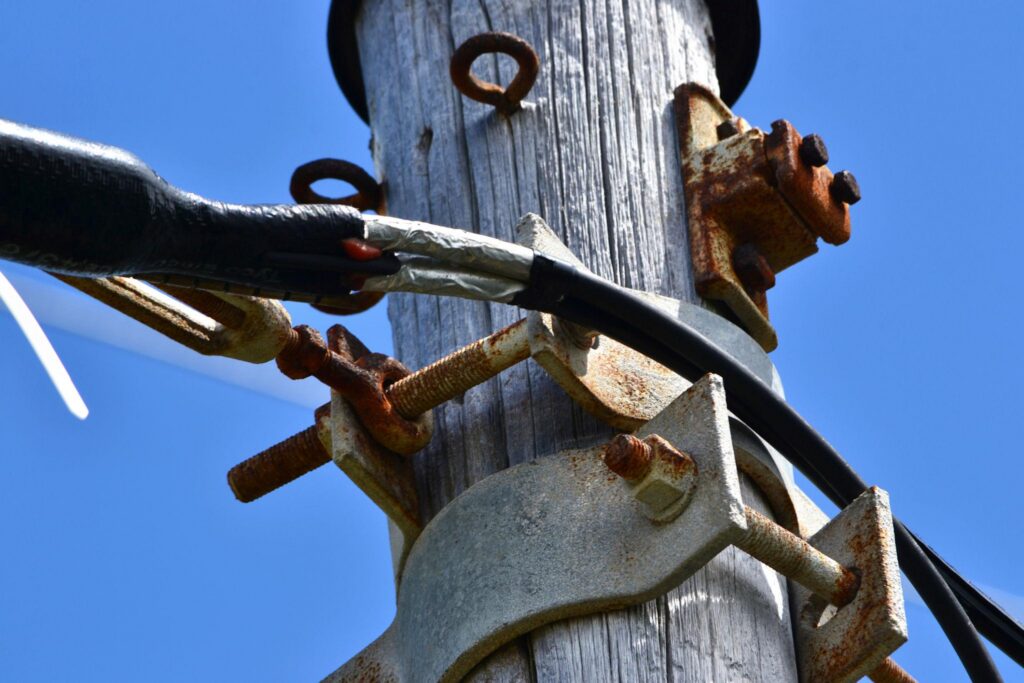
- Corrosion and protective coating failure—corrosion is a common deterioration mechanism for steel hardware used outdoors. To prevent corrosion, manufacturers should verify surface preparation, galvanizing quality, coating thickness, and finished-product condition.
- Structural cracking and steel fracture—this occurs when defects in the steel create locations where stresses concentrate. These defects may originate in the raw material, punching, forming, machining, or welding processes. Quality control measures for the clevis include incoming material inspection, controlled fabrication, dimensional checks, and visual examinations.
- Dimensional inaccuracies and poor manufacturing tolerances—dimensional errors can prevent a steel-insulated secondary clevis from fitting with its mating hardware. Common defects include incorrect pin-hole diameter, misaligned spaced holes, incorrect clevis width, and deformed connection surfaces.
- Material degradation and fatigue—material degradation occurs when the clevis experiences repeated mechanical loads over a long period. Quality control measures include sound manufacturing practices, smooth transitions, corrosion protection, and design verification.
Materials and coating protections for steel insulated secondary clevis and the importance of quality assurance
The durability of the steel-insulated secondary clevis depends on the quality of the steel, the corrosion-protection system, and any insulating components incorporated into the design. Steel must withstand the specified mechanical loads, while protective coatings help prevent corrosion caused by moisture, pollution, and outdoor exposure.
Carbon steel
This is common for the main clevis body because of its mechanical strength, availability, and suitability for fabrication. The specified grade must provide the strength and ductility needed for the intended loading conditions. QA protection offers material certificates, grade verification, mechanical testing, and incoming material inspection.
Steel fasteners and connecting pins
The clevis functions with pins, bolts, nuts, and washers manufactured from specified steel grades. Their dimensions, strength, and compatibility with the clevis maintain the integrity of the assembled connection. Inspection verifies fastener dimensions, thread quality, mechanical properties, and compatibility with the specified coating system.
Insulating polymers
The clevis often use an insulating insert, sleeve, or bushing that must provide electrical and environmental performance. QA conducts material identification, dimensional checks, visual inspection, and applicable dielectric and environmental tests to help verify the insulating components’ performance.
TTF-certified steel insulated secondary clevis. Why choose our clevises?
TTF’s approach to power line hardware services results in optimal product quality, strict adherence to custom design, and reduced cost. We are constantly checking manufacturing processes, addressing material concerns, and improving staff expertise to ensure the best quality product. Our quality control for the steel insulated secondary clevis begins with the first batch of samples that you received from us. And this continues through all production phases, where our QC staff never stop looking for opportunities to improve product quality. We offer:
- Tolerance Analysis
- Tooling Life Analysis
- Rockwell Hardness Testing per ASTM E18
- Brinell Hardness Testing per ASTM E10
- Magnetic Particle Testing per ASTM E1444 CMM (Coordinate Measuring Machine) Testing
- 24″ Optical Comparator for Complex Measurements
- Tensile/proof load testing up to 160,000 lbs (700 kN)
- Hot Dip Galvanizing Plating Thickness per ASTM E376
- Torque Testing
- Roughness Testing
- Lifetime Sample Retention
- Dimensional Testing
Benefits of steel-insulated secondary clevis in power networks
The steel-insulated secondary clevis provides a secure mechanical connection between supporting structures and other hardware. Its steel construction offers mechanical strength while the insulating component provides the specified electrical isolation. Here are their main benefits in power networks.
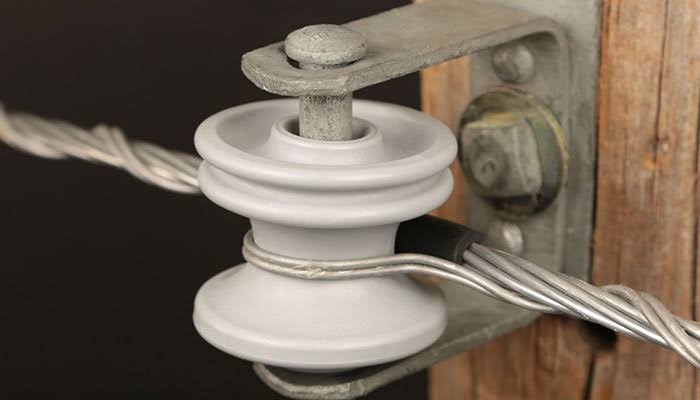
- Provide reliable mechanical support—the steel-insulated secondary clevis provides a stable mechanical connection between compatible power line hardware. They improve the integrity of mechanical connections and help maintain the alignment of connected hardware.
- Support reliable secondary power distribution—the clevis preserves the mechanical integrity of the distribution arrangement and reduces the likelihood of connection-related problems that could need corrective maintenance.
- Improving corrosion resistance—the secondary clevis has coatings that provide a protective barrier and corrosion protection. The level of protection depends on coating thickness, application quality, and environmental severity.
- Support network reliability and service continuity—the clevis helps reduce the risk of mechanical connection problems by maintaining the intended attachment between hardware components.
In summary,
A steel-insulated secondary clevis provides secure mechanical connections between supporting structures and line components. It includes a steel clevis body, connection holes, pins or bolts, fasteners, and a mounting interface. The insulating components provide specified electrical isolation depending on the design. The secondary clevis consists of carbon steel and compatible steel fasteners with hot-dip galvanizing protection. Quality assurance for the clevis covers material strength, dimensional accuracy, coating quality, mechanical performance, and insulation requirements. Poor assurance leads to corrosion, structural cracking, dimensional defects, fastener loosening, and mechanical overloading. This ensures safe operation and long-term performance in overhead power distribution systems.