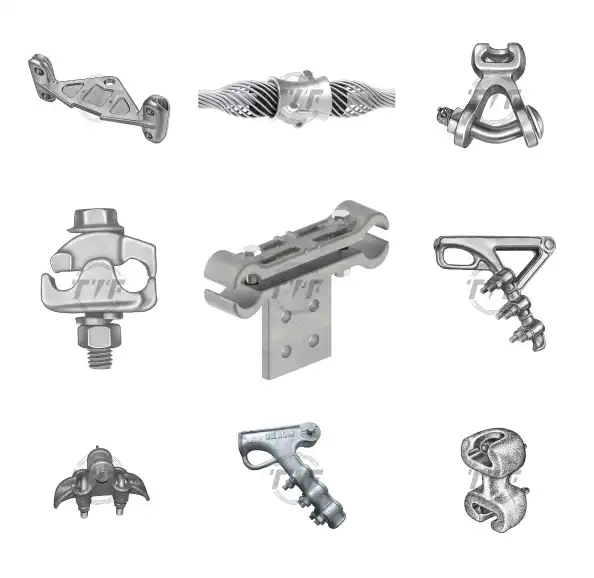
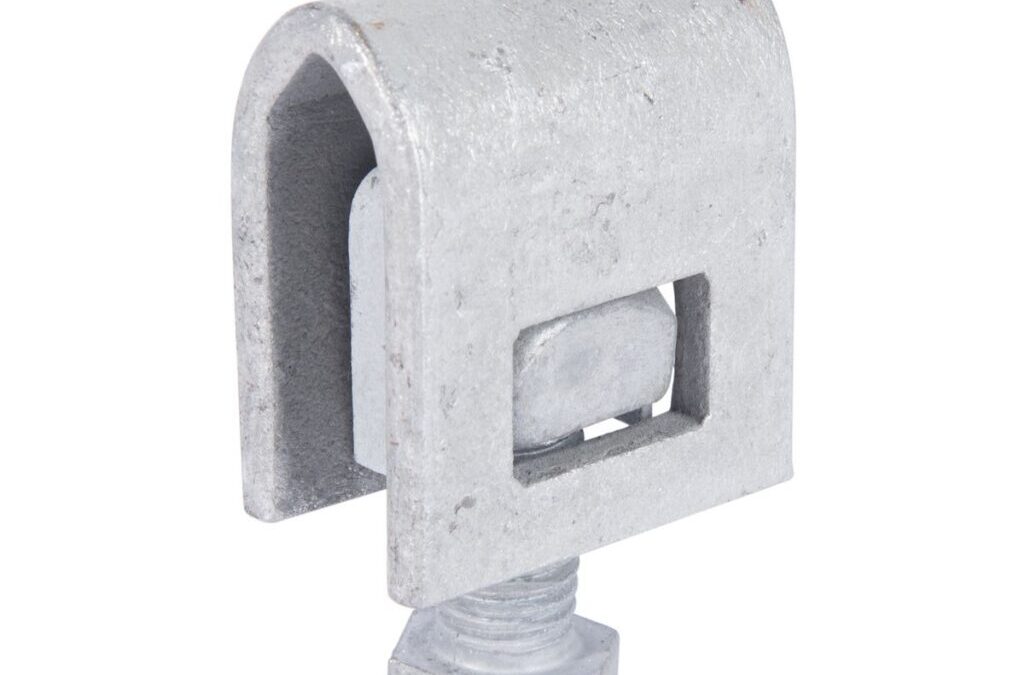
A messenger ground clamp is a component that establishes an electrical connection between a messenger wire and a grounding conductor. The messenger wire is a supporting steel strand used in overhead utility and communication networks. It carries the mechanical load of suspended cables such as aerial fiber-optic cables. Messenger ground clamps connects the metallic messenger strand to the grounding network. This ensures that fault current, induced electrical current, or lightning surge current has a conductive path toward earth. Its performance depends on its electrical conductivity, mechanical stability, corrosion resistance, and service life. The clamp’s material selection depends on the conductor combination, electrical requirements, environmental conditions, and utility specifications. Manufacturers should use quality-assurance processes to ensure their products meet their intended operating requirements. They should verify the chemical composition and mechanical properties of the selected materials.

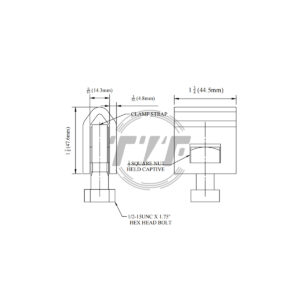


Messenger Ground Clamp
A ground rod clamp is a mechanical connector used in power line construction to securely bond a grounding conductor to a ground rod. It ensures low-resistance electrical continuity between the conductor and the grounding electrode, providing a reliable path for fault currents and enhancing system safety. Designed for durability, it withstands corrosion, mechanical stress, and varying environmental conditions in utility and industrial applications.
Key Features:
- Material: High-strength bronze or brass for excellent conductivity and corrosion resistance.
- Design: Precision-engineered clamp body for secure grip and easy installation.
- Compatibility: Accommodates standard copper, aluminum, or galvanized ground rods.
- Conductivity: Ensures low contact resistance for effective grounding performance.
- Durability: Resistant to mechanical stress, oxidation, and harsh outdoor conditions.
- Standards Compliance: Meets ASTM and IEEE grounding hardware specifications.
- Applications: Power transmission and distribution, substations, industrial grounding systems.
Structure and components of the messenger ground clamps in power line networks
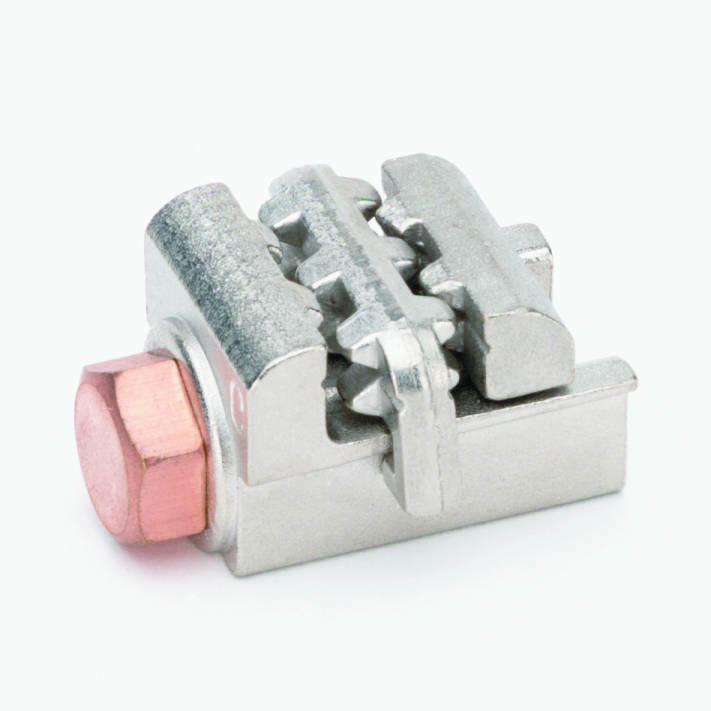
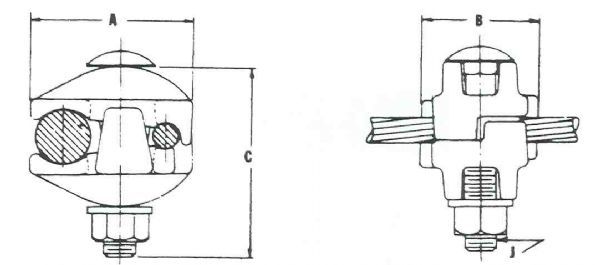
Messenger ground clamps bond metallic messenger strands to grounding conductors in overhead power and communication networks. Their design provides firm mechanical contact, low electrical resistance, and protection against environmental corrosion. The exact configuration varies depending on the conductor sizes, materials, and installation requirements. These components include:
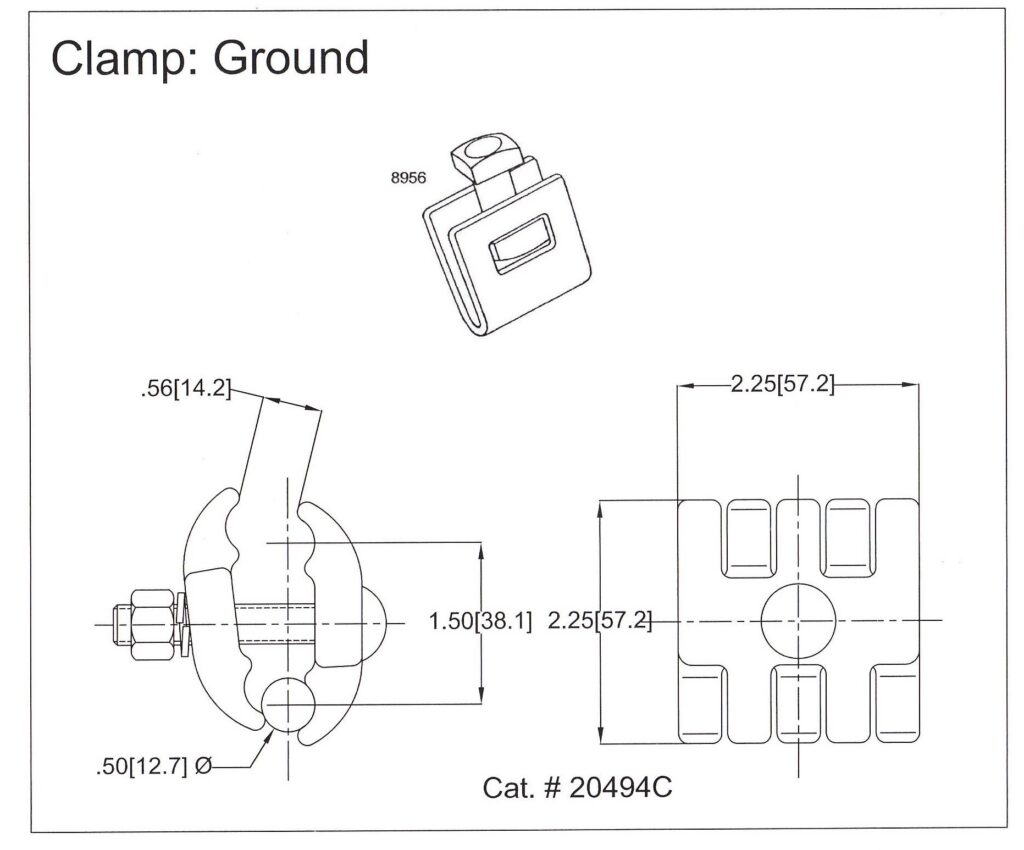
- Clamp body: this is the main component that holds the messenger strand and provides the mechanical support needed to maintain contact between the connected conductors. The body consists of copper alloys, including bronze, galvanized steel, or other conductive materials.
- Fastening bolts: these bolts secure the clamp around the messenger strand and grounding conductor. They generate the clamping force needed to hold the conductors against the contact surfaces.
- Pressure plate: this plate distributes the fastening force across the conductor contact area. Its design helps prevent excessive localized pressure that could damage messenger wire strands.
- Grounding conductor terminal: this one provides the connection point between the messenger ground clamp and the grounding wire. It often forms as a conductor opening, terminal lug, connector slot, or dedicated clamping section.
- Nuts and washers: nuts apply and maintain the required force, while the washers distribute pressure across fastening surfaces and help protect the clamp from localized damage.
Importance of quality assurance during the manufacture of messenger ground clamps
Quality assurance for the ground clamps ensures that they meet the required material, dimensional, mechanical, and electrical specifications before delivery. Messenger ground clamps establish electrical connections between metallic messenger strands and grounding conductors. Their performance depends on secure conductor contact, adequate clamping pressure, electrical conductivity, and resistance to environmental corrosion. Here are the common roles of quality assurance for the clamps during manufacture.
- Ensuring material quality and suitability: material selection determines the mechanical strength, electrical conductivity, and corrosion resistance of messenger ground clamps. Quality assurance verifies that the materials meet the required specifications before production begins.
- Maintaining dimensional accuracy: it determines whether messenger ground clamps fit their intended conductors and fastening arrangements. Quality control teams inspect the clamp body, pressure plates, U-bolts, terminal openings, and threaded sections against approved engineering drawings.
- Improving mechanical strength and fastening reliability: messenger ground clamps should maintain secure mechanical connections under load. Quality assurance helps manufacturers determine whether the clamp body and fastening components can withstand installation forces without cracking.
- Verifying electrical conductivity and contact resistance: the clamp should create a reliable conductive path between the messenger strand and grounding conductor. During quality assurance, manufacturers conduct electrical continuity testing, contact resistance measurements, and temperature-rise testing.
- Detecting manufacturing defects before product delivery: QA allows manufacturers to identify defects during production. Manufacturers conduct visual inspections, dimensional checks, and mechanical and electrical tests.
- Ensuring consistent production quality: QA establishes consistent manufacturing and inspection procedures. The controls help ensure that every production batch meets the same technical requirements.
Quality failure modes of messenger ground clamps in power networks
Messenger ground clamps connect metallic messenger strands to grounding conductors and help maintain electrical continuity within the grounding system. Their performance depends on material quality, dimensional accuracy, mechanical strength, electrical conductivity, and corrosion protection. Manufacturing defects can weaken the clamp structure, increase electrical contact resistance, or cause premature deterioration after installation. These failures compromise grounding continuity and increase maintenance requirements for utility operators. Common quality failure modes for the ground clamps include:
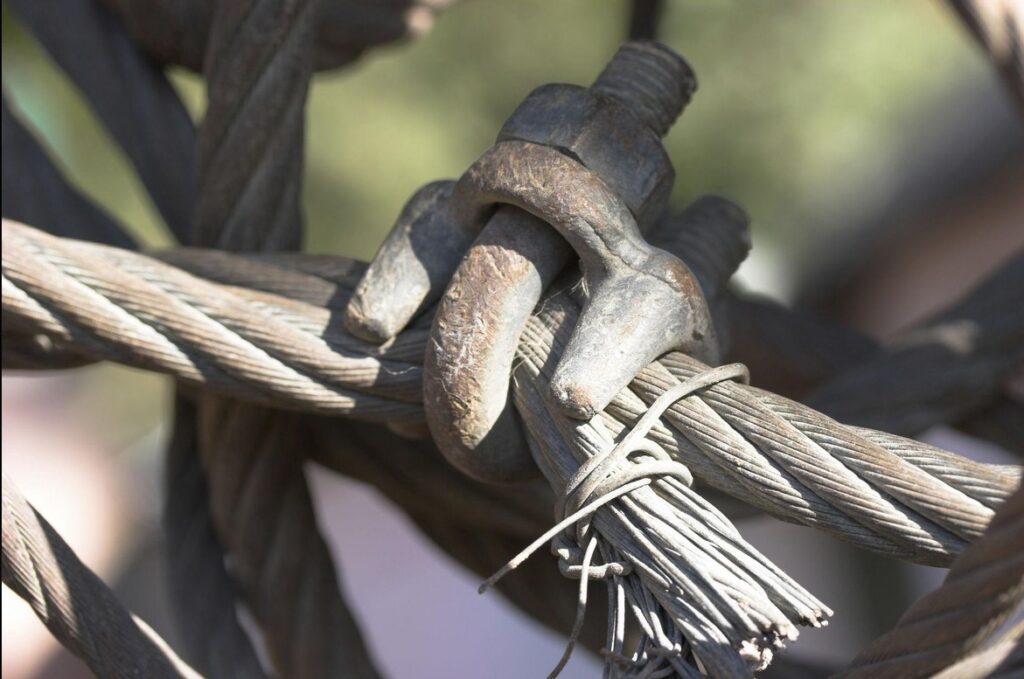
- Corrosion: Exposure to rain, moisture, salt, industrial pollutants, and temperature changes speeds up the corrosion of exposed metal surfaces. Corrosion reduces the effective cross-section of metal components, weakens fastening hardware, and increases electrical contact resistance.
- Incorrect dimensions and poor component fitment: dimensional inaccuracies can prevent messenger ground clamps from fitting their designated conductors. The clamp body, conductor openings, pressure plates, and fastening components should match the approved engineering drawings and specified conductor sizes.
- Insufficient mechanical strength: messenger ground clamps should withstand mechanical forces generated during installation and normal operation. Insufficient material strength can cause the clamp body, U-bolts, or pressure plate to deform.
- High electrical contact resistance: high electrical contact resistance occurs when the contact interface between the clamp, messenger strand, and grounding conductor does not provide enough electrical conductivity.
- Fastener loosening and thread defects: fasteners maintain the clamping pressure needed to secure messenger ground clamps around their conductors. Common defects include incorrect thread pitch, incomplete thread formation, and incorrect bolt dimensions.
- Conductor damage caused by excessive clamping pressure: the ground clamps should secure conductors without causing excessive deformation. Poor clamp geometry, incorrect conductor sizing, or excessive tightening can concentrate pressure on small contact areas.
- Cracks, porosity, and surface defects: these defects can develop during casting, forging, machining, or fabrication. The defects can reduce the structural integrity of the clamp body and create points where mechanical stress concentrates.
Materials used during the manufacture of messenger ground clamps and the importance of quality assurance
Messenger ground clamps consist of conductive and mechanically strong materials that can withstand outdoor operating conditions in power networks. The clamps connect metallic messenger strands to grounding conductors and help maintain electrical continuity within the grounding system. Material selection affects the clamp’s electrical conductivity, mechanical strength, corrosion resistance, and service life. Quality assurance protects the materials by verifying their composition, mechanical properties, dimensions, surface treatment, and performance during manufacturing. Common materials for the clamp include:
Copper and copper alloys
Copper and its alloys are common for electrical grounding and bonding connectors because of their high electrical conductivity and excellent corrosion resistance. They offer different combinations of conductivity, strength, and resistance to environmental deterioration. QA procedures include chemical composition testing, electrical conductivity testing, dimensional inspection, and surface inspection.
Galvanized steel
This is common in some messenger ground clamp designs where the fitting needs high mechanical strength and corrosion protection. Galvanized steel offers high mechanical strength and good resistance to mechanical deformation, and zinc coating provides sacrificial corrosion protection. QA verifies base material, zinc coating thickness, coating adhesion, and corrosion resistance.
Bronze
Silicon bronze and other specified bronze grades offer a critical combination of mechanical strength, electrical conductivity, and corrosion resistance. Its quality depends on the alloy composition, casting or machining process, and finished surface condition. Manufacturers should conduct chemical composition analysis, casting inspection, mechanical testing, and dimensional inspection.
Stainless steel
This is common for fastening components such as U-bolts, nuts, and washers in electrical hardware assemblies. Stainless steel has lower electrical conductivity than copper. Stainless steel offers good resistance to atmospheric corrosion, high mechanical strength, and good resistance to wear and is available in different grades for varying environmental conditions. QA inspections verify that stainless steel fasteners meet their specified material and mechanical requirements.
Aluminum alloys
Aluminum alloy is crucial for overhead electrical connector designs where low weight, corrosion performance, and compatibility with aluminum conductors are crucial. Their suitability depends on the specific design and grounding application. QA procedures conduct chemical composition testing, heat treatment verification, hardness testing, and dimensional inspection.
TTF-certified messenger ground clamps. Why choose our clamps?
TTF’s approach to power line hardware services results in optimal product quality, strict adherence to custom design, and reduced cost. We are constantly checking manufacturing processes, addressing material concerns, and improving staff expertise to ensure the best quality product. Our quality control for the messenger ground clamps begins with the first batch of samples that you received from us. And this continues through all production phases, where our QC staff never stop looking for opportunities to improve product quality. We offer:

- Tolerance Analysis
- Tooling Life Analysis
- Rockwell Hardness Testing per ASTM E18
- Brinell Hardness Testing per ASTM E10
- Magnetic Particle Testing per ASTM E1444 CMM (Coordinate Measuring Machine) Testing
- 24″ Optical Comparator for Complex Measurements
- Tensile/proof load testing up to 160,000 lbs (700 kN)
- Hot Dip Galvanizing Plating Thickness per ASTM E376
- Torque Testing
- Roughness Testing
- Lifetime Sample Retention
- Dimensional Testing
In summary,
Messenger ground clamps provide a reliable electrical connection between messenger conductors and grounding systems in power networks. Manufacturers use materials such as copper alloys, bronze, galvanized steel, stainless steel, and selected aluminum alloys depending on the design. Quality assurance ensures correct material composition, dimensional accuracy, mechanical strength, electrical conductivity, secure fastening, and corrosion resistance. Poor manufacturing processes can lead to cracking, poor coating, thread damage, loose connections, and high contact resistance. QA reduces equipment failures, improves grounding reliability, extends service life, and supports power network safety.