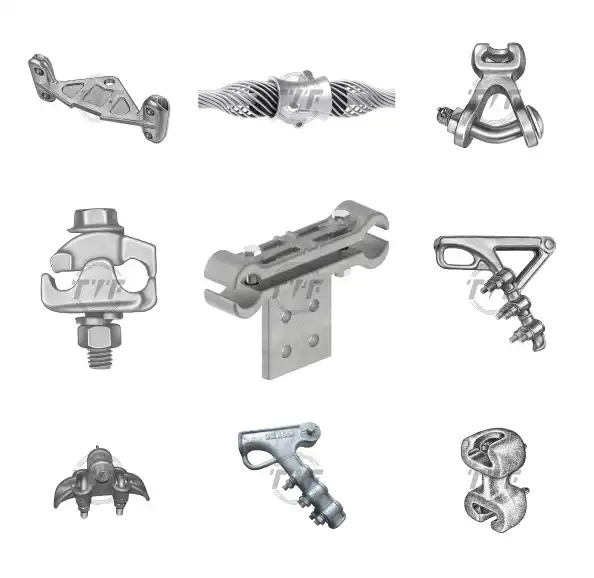

A helical dead-end is a specialized hardware fitting used in overhead power lines, telecommunication lines, and fiber optic networks to end or anchor conductors to poles. The clamp wraps around the conductor in a spiral, gripping it firmly without the need for bolts, nuts, or compression tools. Helical dead-end clamps are from high-strength galvanized steel or aluminum alloy wire in a preformed shape. It securely holds the conductors at the end of a span, such as poles or towers. The helical shape distributes mechanical stress evenly along the cable surface to prevent damage, cuts, or damage. It is designed for long-term outdoor use and is resistant to weather, corrosion, and vibration fatigue. A helical dead-end clamp is a preformed spiral clamp that grips and secures conductors at endpoints. It ensures reliability, durability, and safety in power and telecom infrastructure.

Aluminum Clad Steel Formed Wire Deadend
A helical dead-end clamp is a preformed spiral fitting designed to securely terminate and anchor conductors in overhead power line construction. It provides high tensile strength, uniform stress distribution, and long-term reliability without damaging the conductor. The clamp is installed by hand-wrapping preformed rods around the conductor, ensuring quick, tool-free application.
Engineered for use with AAC, AAAC, ACSR, OPGW, and ADSS cables, the helical dead-end clamp transfers tensile loads from the conductor to the supporting structure while protecting against vibration, fatigue, and corrosion.
Key Features
- Preformed Helical Design – ensures firm grip and stress-free cable termination.
- High Tensile Strength – withstands conductor loads equal to or greater than rated tensile strength.
- Even Stress Distribution – prevents crushing, abrasion, or hot-spot damage on conductors.
- Corrosion-Resistant Materials – made from aluminum-clad steel, galvanized steel, or FRP rods.
- Vibration & Fatigue Resistance – controls Aeolian vibration and enhances service life.
- Tool-Free Installation – quick application without bolts or compression tools.
- Versatile Compatibility – suitable for AAC, AAAC, ACSR, OPGW, and ADSS cables.
- Long Service Life – durable construction with minimal maintenance needs.
Operation of a helical dead-end clamp
A helical dead-end clamp works on the principle of mechanical gripping through preformed helical wires that wrap around the conductor or cable. The preformed spiral shape matches the conductor’s diameter. The rods wrap tightly around the conductor to grip it firmly through radial pressure and friction. As the conductor pulls under tension, the helical rods tighten to create a self-reinforcing grip. The grip becomes stronger the more the cable pulls to prevent slippage. The spiral design spreads the load evenly along the length of the cable. This helps prevent conductor deformation, abrasion, or hot spots. The clamp transfers the tensile load from the conductor to the supporting structures. This ensures the conductor remains securely anchored at end points. The helical shape absorbs vibrations caused by wind and withstands thermal expansion and contraction.
Importance of preformed dead-end clamps in overhead power lines
Helical dead-end clamps in overhead power lines provide reliability, safety, and cost-efficiency in transmission infrastructure. A helical dead-end clamp ensures the stability, durability, and efficiency of overhead power networks. It provides strong and reliable anchoring points for conductors at poles, towers, and substations. It prevents slippage or loosening of power lines under heavy loads, storms, or high winds. The helical design spreads tensile forces across the conductor surface to prevent conductor damage. It is also designed to resist corrosion, vibration, and thermal expansion. The helical dead-end clamps maintain mechanical strength equal to or greater than the conductor’s rated tensile strength. It ensures that lines stay safely anchored to reduce the risk of line drops.
Key features include helical dead-end clamps.
A helical dead-end clamp is designed for reliability and long-term performance in overhead line systems. These features make them crucial components in modern overhead power line and communication networks. These components include:

- Performed helical design—this consist of spiral-shaped rods that grip the conductor uniformly. It reduces the risk of sharp bends, cuts, or crushing that occur with traditional clamps.
- High tensile strength—this provides mechanical strength equal to or higher than that of the conductors. Rated tensile strength. This ensures safe and reliable anchoring of conductors under extreme loads.
- Even stress distribution—the helical wraps spread force along the conductor’s length to reduce localized stress points. This prevents premature damage to conductors to extend their service life.
- Tool-free installation—it installs manually without the need for compression tools, bolts, or hydraulic presses. It enables fast and cost-effective installation in remote areas.
- Corrosion and weather resistance—it is from galvanized steel, aluminum alloy, or other anti-corrosive materials. It is able to perform reliably in harsh outdoor environments.
- Vibration and fatigue resistance—the spiral rods absorb aeolian vibration and galloping effects caused by wind. They prevent fatigue-related conductor failure over long-term service.
- Wide compatibility—the helical dead end is compatible with different conductor types: AAC, AAAC, ACSR, and ACAR and ADSS cables.
- Long service life with low maintenance—the dead-end clamp provides durability and reliability to reduce the need for frequent inspections. It is ideal for high-voltage lines, telecom cables, and renewable energy projects.
Types of preformed dead-end clamps
Helical dead-end clamps for ACSR/AAC/AAAC conductors

This is designed for aluminum conductors used in power transmission. It provides strong termination for medium- and high-voltage overhead power lines. It functions in transmission lines, distribution lines, and substation connections.
Preformed clamps for OPGW cables

This is especially for OPGW cables, which combine grounding and fiber optic functions. It is able to protect delicate optical fibers while providing a firm grip. It functions in power utilities, combining communication and protection in grid systems. The clamp also uses aluminum-clad-steel rods that ensure both electrical conductivity and mechanical strength.
Helical dead-end clamps for ADSS cables

These are tailored for fiber optic cables that do not have metallic strength members. It is lightweight, non-conductive rods that prevent signal loss and cable crushing. It functions in telecommunication lines, smart grids, and renewable energy projects.
Preformed clamps for stay wires

These clamps anchor stay wires or guy wires that support poles and towers. They provide high strength and corrosion resistance to hold support wires in place. It serves in power line poles, telecom towers, and wind and solar structures.
Heavy-duty clamps

These are for extra-high-voltage and ultra-high-voltage lines where loads are extreme. They feature longer preformed rods with many layers for extra gripping force and vibration control. These clamps function in cross-country transmission lines, harsh climates, and high-capacity power grids.
Design and materials for conductor dead-end clamps
The design and materials of helical dead-end clamps make them strong, durable, and ideal for overhead power and telecom lines. They are carefully designed to combine mechanical strength, corrosion resistance, and long-term durability. The choice of material depends on the conductor type and environmental conditions. The common materials used for the clamps include aluminum-clad steel, galvanized steel wire, aluminum alloy wire, fiberglass-reinforced plastic rods, and protective coatings. These materials ensure strength, durability, and resistance to weathering. Proper selection of the design and material ensures a high strength-to-weight ratio, corrosion resistance, a stress-free grip, and versatility. They make the clamp a reliable and long-lasting solution for overhead power and communication lines. The design of the helical dead-end clamp is as discussed below.

- Preformed structure—the clamp consists of spiral-shaped rods preformed to match the conductor’s diameter. This shape ensures uniform gripping pressure along the cable without causing damage.
- Dead-end grip section—the main section where rods wrap around the conductor and transfer tensile load from the conductor to the supporting hardware.
- Thimble/eye loop—some of the clamps include a thimble-shaped loop at the end for easy connection to hooks, shackles, or insulators. This prevents wear on the conductor at the anchoring point.
- Multi-layer design—this is designed for extra-high voltage applications that use many rod layers. The design provides greater gripping force and better vibration control. Increasing pull on the conductor makes the grip stronger to ensure self-locking action under tension.
Key functions of conductor dead-ends in power and communication lines
Helical dead-end clamps ensure safety, stability, and reliability in overhead power networks. It allows it to serve several essential functions in both power transmission and telecommunication systems. Their functions make them indispensable for the safe, reliable, and long-lasting operation of modern overhead transmission and telecommunication systems. Here are the key functions of helical dead-end clamps.

- Anchoring and termination—the clamp provides firm and secure anchoring of conductors, fiber optic cables, or stay wires at poles and towers. This ensures the cables stay in place under mechanical tension, storms, and heavy loads.
- Tensile load transfer—the dead-end clamp transfers the mechanical load from the conductor to the support structure. This helps prevent stress from damaging the cable itself for long-span installations and high-voltage transmission systems.
- Even stress distribution—the spiral design spreads clamping pressure along the conductor’s length. It helps prevent conductor damage such as crushing, bending, or hot spots. It protects sensitive fiber optics in ADSS and OPGW cables to extend conductor lifespan in power grids.
- Vibration and fatigue resistance—the clamp controls aeolian vibration and galloping effects caused by wind. It reduces long-term fatigue to cut the risk of line breakage.
- Electrical safety and reliability—aluminum-clad steel or galvanized steel provides conductivity and strength. In telecom lines, non-metallic FRP rods ensure insulation to prevent interference.
- Adaptability to different cable types—the clamp works with AAC, AAAC, and ACSR conductors in transmission and distribution systems. It is compatible with ADSS fiber optic cables, OPGW cables, and stay wires.
- Quick and tool-free installation—the dead-end clamps install by hand and need no compression tools or bolts. This helps save time and cost during construction and maintenance.
Best practices for preformed dead-ends in power and communication lines
Helical dead-end clamps are designed for strength, durability, and ease of installation. Proper handling and installation practices help maximize their performance and lifespan. Following these practices ensures secure anchoring, longer service life, and reliable performance of both power conductors and communication cables. These practices include selecting the right clamp type, material inspection before installation, following the manufacturer’s installation guide, ensuring a clean conductor surface, and handling with care during installation. It is also advisable to check alignment and tension, conduct periodic inspection and maintenance, and use in recommended environmental conditions.