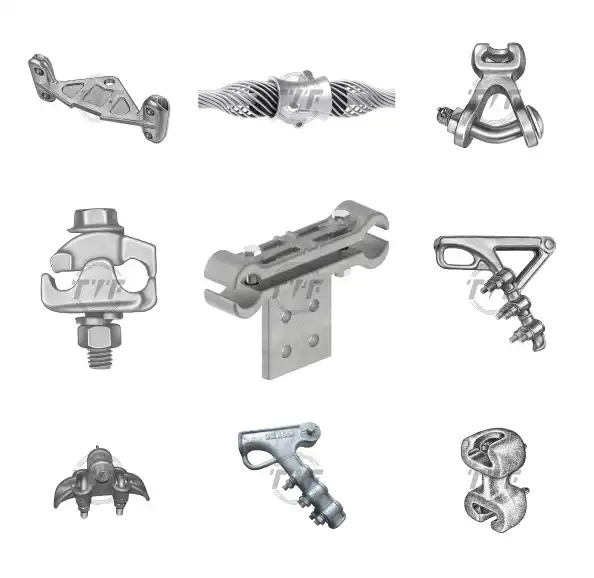
A B strand connector is a mechanical fitting used to join, tap, or terminate stranded conductors on overhead transmission and distribution networks. It is engineered specifically for ACSR, AAC, or AAAC cables used in medium and high-voltage systems. B strand connectors create a low-resistance electrical and mechanical join between two stranded conductors. It ensures electrical continuity, mechanical strength under tensile load, and minimal voltage drop at the joint. The connectors enable the derivation of a secondary line from a primary conductor without compromising ampacity. B strand connectors assist in anchoring or securing conductors at poles, crossarms, or substation entry points. Ensuring quality assurance for the connectors influences grid reliability, thermal stability, and system safety. Poor quality assurance results in micro-gaps, improper crimp geometry, or surface oxidation. These lead to overheating, voltage drop, and joint failure.
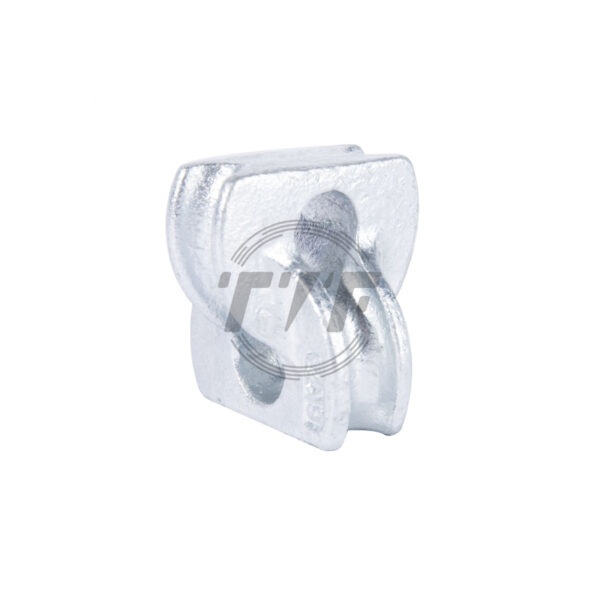
B Strand Connector
The B strand connector is a compression-type fitting designed for securely joining aluminum or copper conductors in overhead power line construction. It provides a reliable mechanical and electrical connection, ensuring optimal conductivity and long-term performance under varying environmental conditions. Engineered for ease of installation, the connector is widely used in splicing, tapping, and extending conductors in transmission and distribution networks.
Key Features:
- Material: High-strength aluminum alloy or copper for excellent conductivity.
- Design: Compression-type for strong mechanical grip and low-resistance connection.
- Compatibility: Suitable for ACSR, AAAC, and copper conductors.
- Durability: Corrosion-resistant finish for extended service life in outdoor environments.
- Performance: Ensures stable electrical continuity under load and thermal cycling.
- Installation: Simple compression process with standard crimping tools.
Importance of conducting quality assurance for B strand connectors
Quality assurance for B strand connectors is a risk-control mechanism within transmission and distribution engineering. The connectors serve electrical joints and mechanical load points in overhead transmission networks. B strand connectors must maintain low and stable contact resistance across their service life. Quality assurance verifies proper alloy conductivity, correct crimp or compression geometry. It also checks compliance with resistance limits under standards. QA for the connectors includes tensile pull testing, dimensional checks, and metallurgical validation. This is crucial to ensure the connector maintains structural integrity under loads. Overhead transmission and distribution conductors undergo load fluctuations. QA testing simulates thermal cycling to ensure no loosening under expansion and contraction. A defective connector can cause line faults and outages, fire risk from overheating, and increased maintenance interventions. QA reduces these failures and improves asset reliability metrics.
The role of quality assurance in B strand connectors manufacturing
Quality assurance in B strand connector manufacturing is a system that ensures each unit meets defined electrical, mechanical, and dimensional performance needs before use. Quality assurance during manufacturing validates mechanical strength, dimensional accuracy, and long-term performance under service. Here are the roles of quality assurance in B strand connector manufacturing.

- Raw material verification—this includes material inspection in chemical composition analysis of aluminum alloy, verification of conductivity ratings, and hardness and tensile property validation. Material inconsistencies lead to reduced ampacity, premature corrosion, or mechanical deformation under load.
- Dimensional and tolerance control—B strand connectors must conform to strict geometric tolerances. This is crucial to ensure proper conductor fit and compression performance. The process includes precision measurement of bore diameter. It also includes wall thickness and verification of strand compatibility.
- Process control during manufacturing—manufacturing QA integrates in-process controls such as monitoring extrusion, surface finish inspection, defect removal checks, and compression sleeve.
- Mechanical performance testing—after finishing, the connectors undergo mechanical validation to confirm tensile strength. It also tests pull-out resistance and resistance to vibration-induced fatigue.
- Electrical performance testing—this includes tests such as contact resistance measurement, current-carrying capacity testing, and thermal cycling assessments.
- Corrosion and environmental durability—this process includes surface treatment and alloy composition validation through salt spray testing and environmental exposure simulations.
Common quality failures on B strand connectors used in overhead transmission networks
B strand connectors operate under electrical, mechanical, thermal, and environmental stress. Connector failure results from design mismatch, manufacturing defects, improper installation, or long-term degradation mechanisms. The common failures include:

- Overheating due to high contact resistance—this arises from inadequate compression during crimping, surface contamination, incorrect connector-to-conductor sizing, and poor alloy conductivity.
- Mechanical slippage—slippage may arise from insufficient compression force, dimensional mismatch, inadequate tensile strength of connector material, and installation errors. These failures may lead to mechanical separation and line outage.
- Fatigue cracking from vibration—overhead conductors experience aeolian vibration and galloping. This may arise from poor crimp uniformity, stress concentration points, and metallurgical defects.
- Galvanic corrosion—this occurs when dissimilar metals are in contact in the presence of moisture. This stems from improper material pairing and industrial environments.
- Thermal creep and relaxation—connector deformation reduces compression pressure, increases resistance, and promotes overheating. The root causes include high current loading, overloading beyond rated ampacity, and poor alloy selection.
- Installation-related failures—improper installation is the leading cause of premature connector failure. Common issues include incorrect crimp die selection, under-crimping or over-crimping, lack of oxide inhibitor application, and failure to follow manufacturer torque.
- Environmental degradation—exposure to UV radiation, moisture ingress, pollution, and salt spray. These conditions speeds up surface deterioration.
Quality assurance protecting materials for B strand connectors
B strand connectors made from conductive and robust materials such as aluminum alloy. that should enhance their performance in electrical joints and structural interfaces. Quality assurance protects the materials from degradation, variability, and premature failure. Quality assurance acts at preventive control, detection control, and lifecycle protection. TTF-certified connectors ensure conductivity protection, structural integrity, corrosion resistance, and grid reliability. Here are the common materials for B strand connectors and QA protection measures.
Aluminum alloys
Aluminum offers high electrical conductivity, strength-to-weight ratio, corrosion resistance, and compatibility with AAC, AAAC, and aluminum strands of ACSR conductors. Quality assurance protection measures include chemical composition analysis, conductivity testing, mechanical testing for tensile strength, and microstructure inspection to detect casting defects, porosity, or inclusions.
Bimetallic components
Bi-metallic connectors prevent galvanic corrosion where aluminum conductors interface with copper systems. Bi-metal prevents electrochemical reaction between dissimilar metals and maintains conductivity at transition points. QA measures include bond integrity testing, non-destructive testing, galvanic compatibility verification, and salt spray testing for corrosion resistance.

Steel reinforcement
Steel components offer extra mechanical strength to support ACSR conductors. The steel offers high tensile capacity and resistance to mechanical deformation. QA protection measures include hardness and tensile strength verification, coating thickness inspection, and corrosion resistance validation.
Surface treatments and oxide inhibitors
B strand connectors include surface finish compounds to enhance performance in overhead networks. The treatments reduce oxidation, improve contact conductivity, and enhance environmental durability. Quality assurance protection measures include coating adhesion testing, surface roughness inspection, and environmental exposure simulations.
TTF certified B strand connectors. Why we certify.
TTF’s approach to power line hardware services results in optimal product quality, strict adherence to custom design, and reduced cost. We are constantly checking manufacturing processes, addressing material concerns, and improving staff expertise to ensure the best quality product. Our quality control for B strand connectors begins with the first batch of samples that you received from us. And this continues through all production phases, where our QC staff never stop looking for opportunities to improve product quality. We offer:

- Tolerance Analysis
- Tooling Life Analysis
- Rockwell Hardness Testing per ASTM E18
- Brinell Hardness Testing per ASTM E10
- Magnetic Particle Testing per ASTM E1444
- CMM (Coordinate Measuring Machine) Testing
- 24″ Optical Comparator for Complex Measurements
- Tensile/proof load testing up to 160,000 lbs (700 kN)
- Hot Dip Galvanizing Plating Thickness per ASTM E376
- Torque Testing
- Roughness Testing
- Lifetime Sample Retention
- Dimensional Testing
- Mechanical Testing
Advantages of quality assurance for B strand connectors in transmission networks
Quality assurance for B strand connectors in transmission networks influences grid stability, asset longevity, and operational cost efficiency. Quality assurance offers electrical stability, mechanical reliability, corrosion resistance, and reduced outage risks. Connector integrity correlates with system performance and infrastructure resilience. Here are the benefits of conducting quality assurance for the connectors.

- Enhanced electrical reliability—quality assurance ensures low and stable contact resistance, controlled temperature rise under rated load, and consistent compression geometry. This reduces overheating, prevents thermal runaway, and maintains conductor ampacity across the system.
- Improved mechanical integrity—B-strand connectors face sustained tensile stress from conductor weight and dynamic forces. These stresses may be from wind-induced vibration and thermal expansion. Quality assurance provides verified tensile strength, confirmed pull-out resistance, fatigue resistance under cyclic loading, and dimensional precision for secure crimping.
- Corrosion resistance—QA validates alloy composition consistency, galvanic compatibility, surface treatment performance, and salt spray endurance.
- Reduced outage risk—connector failure can lead to phase imbalance, arcing faults, forced line trips, and emergency maintenance interventions. Quality assurance lowers the probability of unplanned outages and improves network reliability indices.
- Compliance with utility and international standards—B strand connectors must conform to IEC, ANSI, or utility-specific technical requirements. QA ensures traceability of materials and batches, documented test results, and certification compliance.
- Reputation and asset protection—consistent QA protects utility reputation, supports long-term asset management strategies, and reinforces stakeholder confidence in grid reliability.
- Lower lifecycle costs—QA for the connectors include fewer replacements, reduced maintenance frequency, reduced downtime losses, and lower emergency repair expenses. Ensuring preventive validation during manufacturing reduces the total cost of ownership.
In conclusion,
B strand connectors act as electrical conductors and mechanical load-bearing joints in overhead transmission networks. Their reliability depends on high-conductivity aluminum alloys, bi-metallic, or reinforced elements. Common quality failures on the connectors include contact resistance, thermal creep, vibration-induced fatigue, galvanic corrosion, and mechanical pull-out. The quality control process includes raw material verification, in-process control, mechanical and electrical performance testing, and standards compliance. These processes mitigate the risks related to the connectors to prevent failures. QA enhances transmission network reliability, reduces outage probability, optimizes lifecycle costs, and protects grid infrastructure. This is by ensuring low-resistance continuity, tensile integrity, corrosion resistance, and long-term thermal stability. High-quality connectors are crucial to system performance and operational resilience.