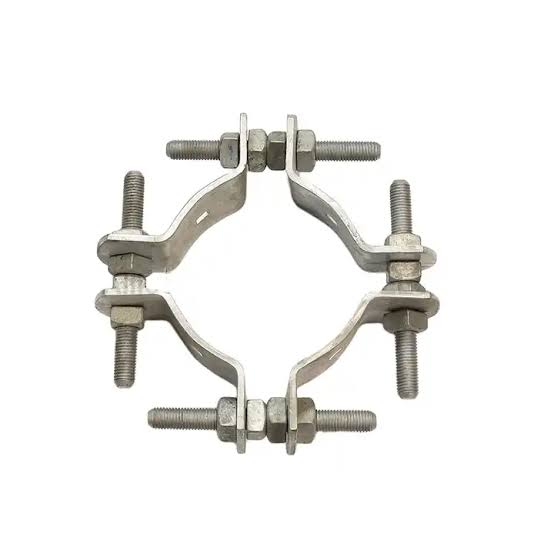
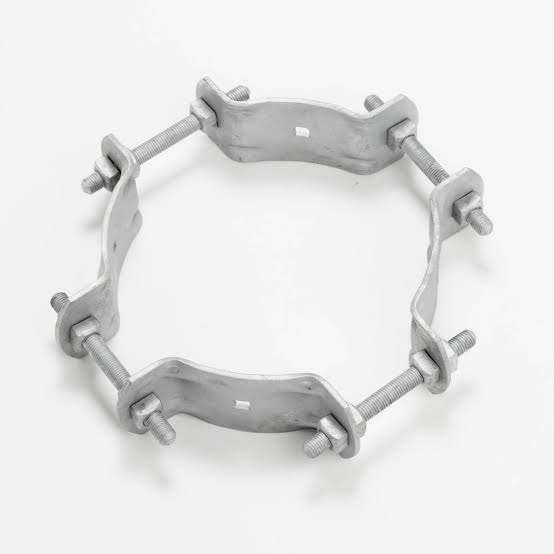
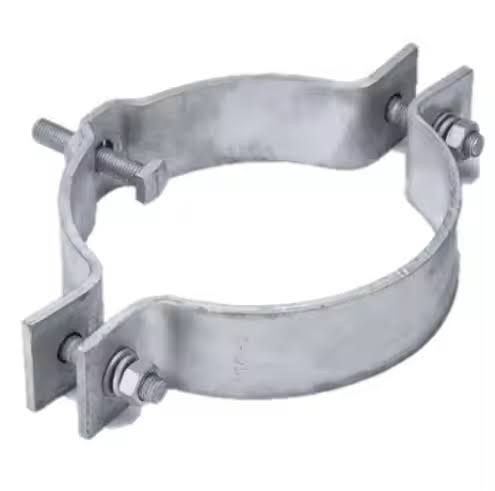
A pole band is a metal fastening component used in utility poles to secure attachment points for overhead power transmission and distribution hardware. The pole band attaches equipment and line hardware to a pole without drilling into the pole’s structure. It supports crossarms and brackets, insulators, guying and bracing hardware, cables, communication equipment, and transmission and distribution line accessories. Pole bands consist of steel or galvanized steel to prevent damage and corrosion. Galvanized steel offers high mechanical strength and improved resistance to atmospheric corrosion. These materials allow it to withstand mechanical loads, vibration, wind forces, conductor tension, and environmental exposure. The pole clamp is positioned around the pole and tightened to provide enough clamping force and friction against the pole surface. It connects threaded studs, eyelets, brackets, or holes. Conducting quality assurance for the pole bands prevents loosening, corrosion, deformation, or slip under mechanical loading.
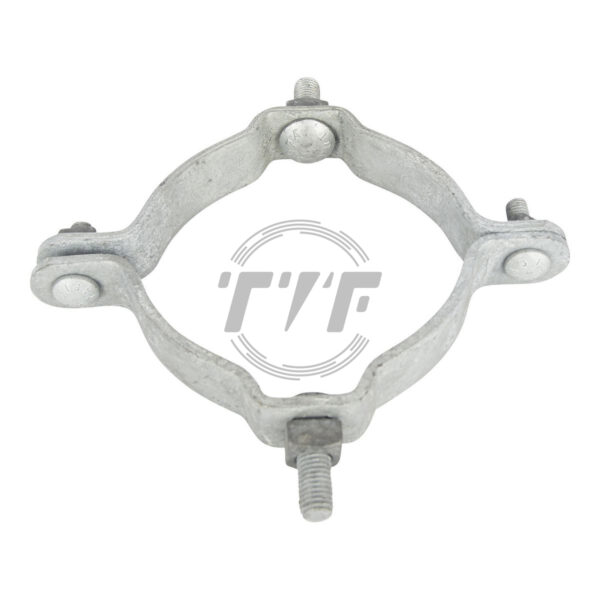
Pole Band for Secondary Rack, Double Mounting, Pole Dia 4-3/8″ – 5″
A pole band is a heavy-duty metal strap used in power line construction to securely mount hardware—such as insulators, transformers, crossarms, or brackets—to utility poles without drilling or compromising pole integrity. Commonly made from galvanized steel, pole bands ensure reliable load distribution and corrosion resistance, making them essential for overhead line infrastructure, including electric vehicle (EV) charging systems and renewable energy grids.
Key Features:
- Material: Hot-dip galvanized steel for enhanced corrosion resistance
- Design: Adjustable or fixed diameters to fit various pole sizes
- Installation: Easy wrap-around application—no drilling required
- Durability: High mechanical strength for long-term stability
- Compatibility: Supports mounting of insulators, clamps, brackets, and electrical gear
- Applications: Suitable for wood, concrete, and metal poles in transmission and distribution systems
Components and features of the pole band
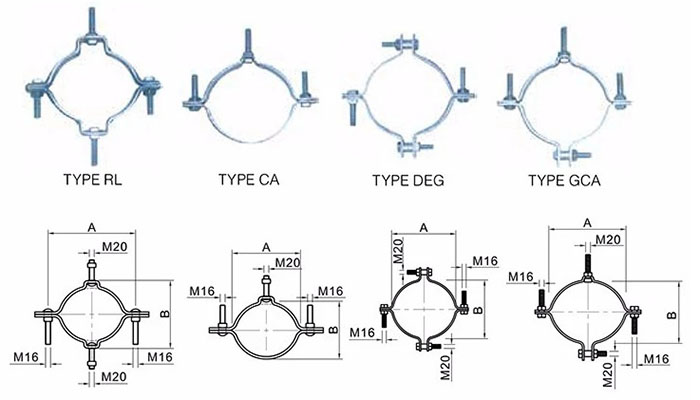
The pole band consists of various mechanical components that create a secure attachment around a utility pole. Its configuration varies depending on the pole type, loading requirements, and equipment to support. The pole band offers high mechanical strength, corrosion resistance, adjustable diameter, secure clamping, and vibration resistance. Here are the common components of the pole band.
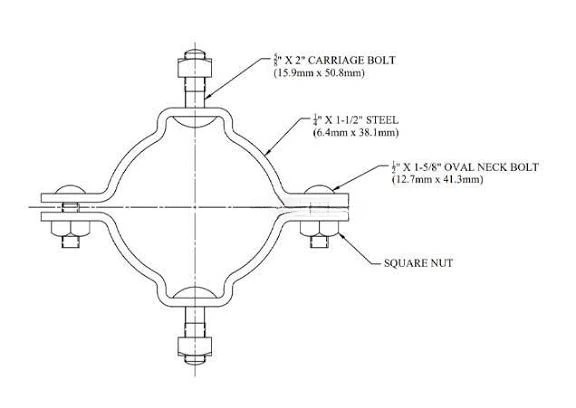
- Steel band – this is the main structure that wraps around the pole. It consists of carbon steel or galvanized steel. The band provides the circumferential clamping force.
- Bolts – these connect the ends of the band and allow the installer to tighten the assembly around the pole.
- Nuts – these secure the bolts and maintain the needed clamping pressure for the connection. They protect against vibration and movement.
- Mounting holes – these provide connection points for brackets, crossarms, insulators, grounding components, and cables.
- Attachment brackets – some bands have welded or formed brackets that allow specific equipment to be mounted to the pole.
- Spacers – these components help distribute mechanical loads and maintain the correct positioning of the band and attached hardware.
The roles of quality assurance during the manufacture of pole bands
Conducting quality assurance for the pole bands during manufacture prevents failures in material strength, dimensions, fastening, or corrosion protection. It ensures the pole band provides mechanical connections between utility poles and power-line hardware. Here are the key roles of quality assurance during pole band manufacture.
- Material verification – QA verifies raw materials used in the manufacture of the pole band. It checks steel grade and chemical composition, yield and tensile strength, material thickness, hardness, bolt and nut grade, and material traceability.
- Dimensional and tolerance control – pole bands must fit around poles and maintain compatibility with other hardware. Conducting QA verifies dimensions throughout manufacturing. The inspections cover band thickness and width, internal diameter, hole diameter, bolt-hole alignment, thread dimensions, and component tolerances.
- Forming and fabrication inspection – bending and forming can cause excessive deformation that can weaken the steel or produce dimensional inconsistencies. Quality assurance checks whether the band maintains its specified geometry after forming. It checks weld dimensions, weld penetration, surface defects, and weld alignment.
- Fastener quality control – the pole band works with bolts, nuts, and washers. This helps maintain the pole band’s clamping force. QA verifies their dimensions, material grade, thread quality, and mechanical performance.
- Corrosion-protection quality – the pole bands often face rain, humidity, pollutants, and other environmental conditions. Quality assurance controls the corrosion-protection process through zinc coating thickness, coating uniformity, surface coverage, adhesion, and excess surface irregularities.
- Mechanical and load testing – QA verifies that the finished pole band can withstand the mechanical loads. The tests check tensile strength, clamping strength, load-bearing capacity, bolt strength, and deformation under load.
- Standards and specification compliance – QA ensures that the pole band conforms to the customer’s technical drawings, approved specifications, and applicable industry standards. This is important for projects involving transmission utilities, EPC contractors, and infrastructure procurement.
Common quality failure modes of pole bands in power networks
Pole bands secure brackets, crossarms, cables, and other equipment to utility poles. They serve in diverse conditions facing wind, vibration, conductor tension, and environmental stresses. Quality assurance prevents manufacturing or installation defects that compromise their performance in power networks. Here are the common quality failure modes of pole bands in power networks.
- Corrosion and inadequate galvanizing – the pole band consists of protective coatings for protection against corrosion. Uneven protective coatings can leave areas vulnerable to moisture and atmospheric contaminants. Common defects include insufficient zinc coating thickness, bare spots, peeling, poor coating adhesion, and corrosion at cut edges, holes, or welds.
- Incorrect material grade – use of steel with lower mechanical properties can reduce the band’s ability to withstand service loads. Lack of material verification results in tensile strength, yield strength, ductility, hardness, and fatigue resistance.
- Dimensional inaccuracies – poor dimensional control can cause uneven loading, installation difficulties, or insufficient clamping force.
- Cracking and deformation – excessive forming forces, poor material quality, or improper manufacturing processes can produce cracks in the band. Cracks in the pole band may cause poor load distribution around the pole.
- Weld defects – a defective weld can reduce the load-bearing capability of an attachment point. Common defects include cracks, porosity, incomplete fusion, incomplete penetration, undercutting, and excessive spatter.
- Bolt and fastener failure – the pole band depends on its fastening system to maintain the clamping force. Low-quality bolts can fail through tensile overload, thread damage, corrosion, or fatigue.
Materials for pole bands and the importance of quality assurance
Pole bands in power transmission and distribution networks combine mechanical strength, corrosion resistance, durability, and dimensional stability. It is crucial to select the material depending on the pole type, environmental conditions, loading requirements, and applicable project specifications. Quality assurance controls the material through material certification, chemical analysis, mechanical testing, thickness inspection, and process control.
Carbon steel
This is the most common material for pole bands that provides good tensile strength, rigidity, formability, and cost efficiency. It is ideal for bands that face mechanical loads from mounted equipment and line hardware. Quality assurance protects carbon steel pole bands through verifying the specified steel grade, checking tensile and yield strength, confirming material thickness, and inspecting materials for cracks, laminations, and surface defects before fabrication.
Hot-dip galvanized steel
This combines the mechanical properties of steel with a zinc protective coating. Galvanized steel is ideal for pole bands exposed to rain, humidity, pollutants, and temperature variations. Quality assurance conducts zinc coating thickness, coating uniformity, adhesion, surface coverage, bare areas, and excess zinc.
Stainless steel
Stainless steel is ideal for pole bands used in highly corrosive environments. It provides better corrosion resistance than carbon steel. QA offers stainless steel grade verification, chemical composition testing where needed, surface inspection, dimensional inspection, and verification of corrosion-resistance needs.
High-strength steel
This steel provides greater load capacity without needing a thicker component. Quality assurance verifies that the material meets the specified mechanical properties through testing, yield-strength verification, hardness testing, and chemical-composition checks.
Fastener materials
The pole band serves with bolts, nuts, and washers manufactured from carbon steel, galvanized steel, or stainless steel. QA checks fastener grade, dimensions, thread accuracy, mechanical strength, surface coating, and corrosion resistance.
TTF Certified pole bands. Why we certify:
TTF’s approach to power line hardware services results in optimal product quality, strict adherence to custom design, and reduced cost. We are constantly checking manufacturing processes, addressing material concerns, and improving staff expertise to ensure the best quality product. Our quality control for the pole bands begins with the first batch of samples that you received from us. And this continues through all production phases, where our QC staff never stop looking for opportunities to improve product quality. We offer:

- Tolerance Analysis
- Tooling Life Analysis
- Rockwell Hardness Testing per ASTM E18
- Brinell Hardness Testing per ASTM E10
- Magnetic Particle Testing per ASTM E1444 CMM (Coordinate Measuring Machine) Testing
- 24″ Optical Comparator for Complex Measurements
- Tensile/proof load testing up to 160,000 lbs (700 kN)
- Hot Dip Galvanizing Plating Thickness per ASTM E376
- Torque Testing
- Roughness Testing
- Lifetime Sample Retention
- Dimensional Testing
- Mechanical Testing
The benefits of pole bands in power networks
Pole bands in power transmission and distribution networks attach brackets, crossarms, cables, insulators, grounding components, and other equipment to utility poles. They offer mechanical design that provides benefits to attachment methods that need extensive drilling or structural modification of the pole. Key benefits include:
- Secure mechanical attachment – the pole band provides a stable mounting point for power-line hardware. It is able to withstand loads generated by wind pressure, conductor tension, equipment weight, vibration, and mechanical movement.
- Easy and efficient installation – pole bands can be installed using standard fastening tools without extensive modification of the pole.
- Reduced pole damage – pole bands provide an external mounting point with minimal modification to the pole.
- Good load distribution – load distribution helps reduce localized stress and improve the stability of mounted equipment.
In conclusion,
Pole bands provide secure attachment points for crossarms, cables, brackets, and other pole-mounted equipment in power transmission and distribution networks. Their performance depends on material selection, accurate dimensions, reliable fastening, and effective corrosion protection. The bands are from carbon steel, galvanized steel, stainless steel, and high-strength steel. Conducting quality assurance protects these materials through inspections, mechanical testing, dimensional verification, weld assessment, coating evaluation, and traceability. QA prevents failures such as corrosion, deformation, fastener failure, cracking, and loosening. It also ensures safer, durable, and cost-effective power-network infrastructure.