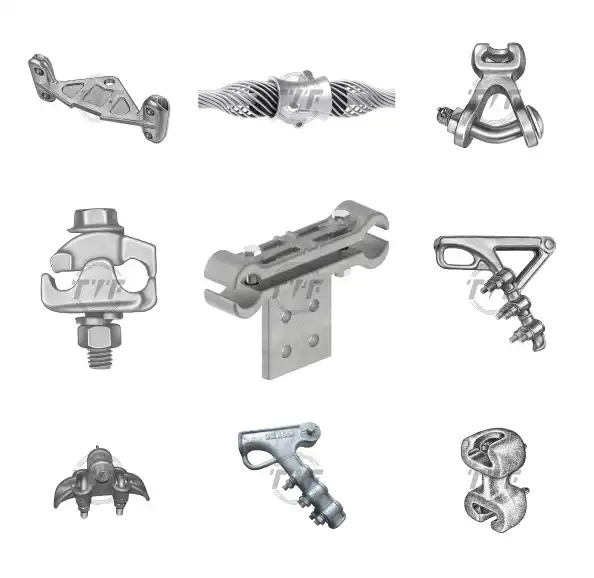
A trunnion suspension clamp is a mechanical fitting used to suspend conductors from utility poles or towers. Trunnion suspension clamps does so while allowing limited movement caused by wind, temperature changes, and line tension. The trunnion clamp serves on medium- and high-voltage power lines where conductor stability, flexibility, and vibration resistance are needed. The clamp supports the conductor at suspension points without compressing or damaging the cable. Its trunnion design allows the conductor assembly to pivot and reduce mechanical stress on the conductor and the insulator string. The conductor sits inside the clamp groove and is secured by the keeper. The trunnion allows the clamp to rotate under dynamic loads such as wind-induced conductor motion, thermal expansion and contraction, and line galloping and vibration. The flexibility helps distribute stress across the conductor and support structure. Thorough quality assurance for the clamps prevents conductor damage, line failures, and outages.
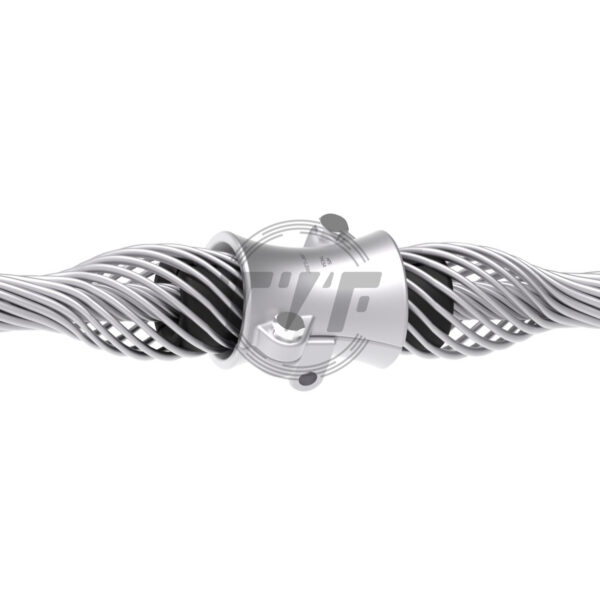
Trunnion Suspension Clamp
Trunnion Suspension Clamp is a high-strength overhead line fitting designed to suspend and support conductors on transmission and distribution power lines. Engineered with a pivoting trunnion mechanism, the clamp allows controlled conductor movement caused by wind, vibration, and thermal expansion while reducing mechanical stress and conductor wear. It is widely used in medium- and high-voltage power networks for reliable conductor retention and long-term operational stability.
Key Features:
- Heavy-duty aluminum alloy or ductile iron construction
- High mechanical strength and load-bearing capacity
- Pivoting trunnion design for improved flexibility
- Corrosion-resistant hot-dip galvanized finish
- Smooth conductor groove to minimize abrasion
- Excellent vibration and fatigue resistance
- Compatible with ACSR, AAAC, and aluminum conductors
- Suitable for transmission and distribution line applications
- Precision-engineered for secure conductor grip
- Long service life in harsh outdoor environments
Key components of the trunnion suspension clamp
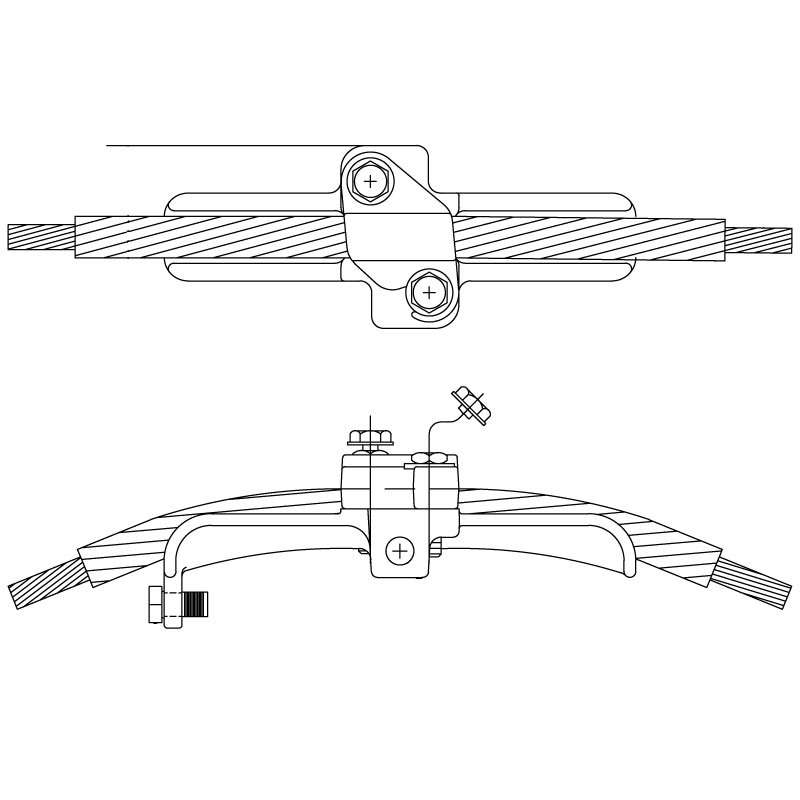
A trunnion suspension clamp consists of components designed to support, secure, and protect overhead conductors. Each component helps maintain conductor stability, flexibility, and reliability. These components include:
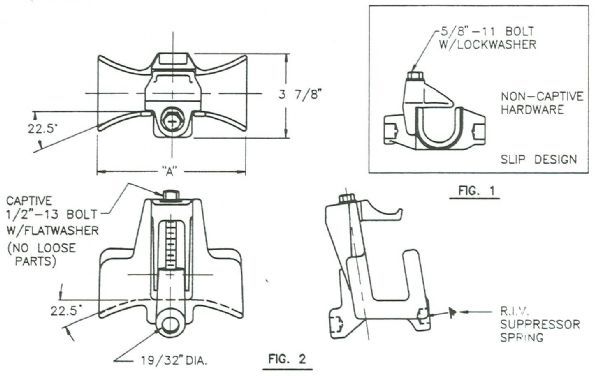
- Clamp body – this is the structural component that holds the conductor in place. It consists of materials like aluminum alloy, ductile iron, and forged steel. The inner groove is smooth to reduce conductor abrasion and mechanical stress.
- Keeper—this is the upper section that locks the conductor into the clamp body. It has a bolted connection and precision-machined contact surface. It is designed to maintain controlled clamping pressure on conductors.
- Trunnion pivot assembly—this acts as the articulating connection between the clamp and suspension hardware. It allows angular movement, reduces stress concentration, and improves flexibility in suspension systems.
- Bolts, nuts, and washers—these are the fastening hardware that secures the clamp components together. They maintain mechanical tightness, ensure proper compression force, and prevent component separation. They consist of hot-dip galvanized steel and stainless steel materials
Quality assurance roles during the manufacture of trunnion suspension clamps
Quality assurance during the clamp manufacture ensures that every component meets the mechanical, dimensional, and metallurgical standards. QA prevents clamp failures and ensures long-term reliability. Here are the roles of quality assurance in trunnion suspension clamp manufacture.
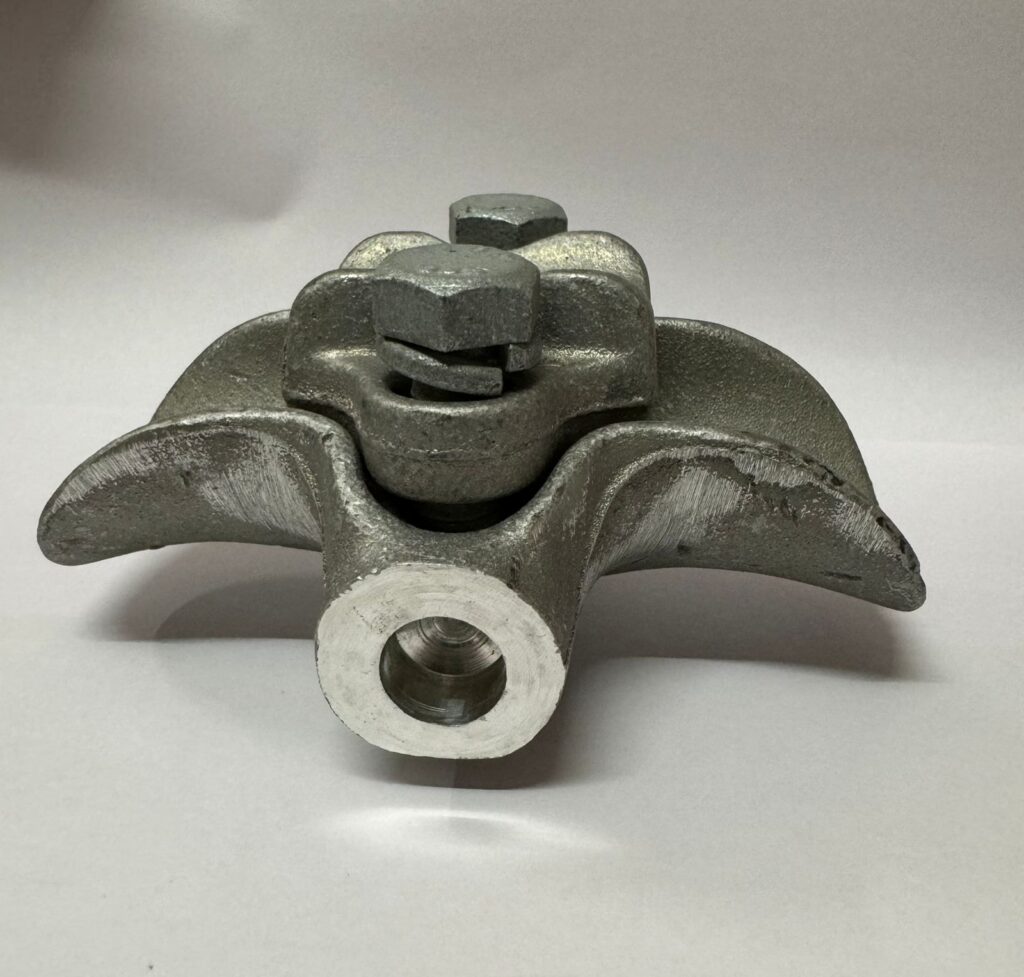
- Raw material verification – this is to confirm that all raw materials follow engineering specifications and international standards. The process includes chemical composition analysis, material certification verification, mechanical property testing, and traceability documentation review. Material verification prevents premature cracking, corrosion failures, low tensile strength, and structural weakness.
- Controlling dimensional accuracy – precise dimensions ensure proper conductor fit and mechanical compatibility with insulators and tower hardware. The process includes dimensional inspection, tolerance verification, groove profile measurement, and bolt hole alignment checks.
- Monitoring casting and forging quality—QA conducts surface defect detection, crack inspection, porosity evaluation, and grain structure assessment. This prevents air voids, shrinkage cavities, surface fractures, and incomplete metal filling.
- Ensuring proper heat treatment—heat treatment improves the mechanical strength and durability of clamp components. QA monitors heating temperatures, verifies cooling cycles, checks hardness values, and confirms metallurgical properties.
- Inspecting surface finishing and galvanization—the process includes galvanization thickness testing, coating adhesion inspection, surface smoothness evaluation, and corrosion resistance verification. It ensures uniform zinc coating, reduced oxidation, and improved environmental durability.
- Conducting mechanical performance testing—the trunnion clamp undergoes tensile strength testing, slip strength testing, load endurance testing, fatigue testing, and impact resistance testing. The tests ensure the clamp can withstand conductor loads, resist vibration stress, and maintain structural integrity.
Common quality failure modes of trunnion suspension clamps in overhead lines
Reliable power distribution relies on the structural integrity of pole line hardware such as trunnion clamps. The clamps operate under continuous mechanical loading, environmental exposure, and vibration stress. Poor manufacturing quality control leads to defects that affect conductor integrity, line stability, and system reliability. These defects include:

- Material defects—poor material quality arises from incorrect alloy composition, low tensile strength materials, and excess impurities. These lead to premature cracking under load, reduced fatigue resistance, and brittle fracture.
- Casting and forging defects—these include porosity, shrinkage cavities, cold shuts, internal micro-cracks, and grain structure inconsistencies. These lead to sudden mechanical failure under tension, reduced load-bearing capacity, and crack propagation under vibration.
- Dimensional inaccuracies—the clamp may face incorrect groove diameter, misaligned bolts, and improper trunnion alignment. These defects lead to conductor slippage, uneven pressure on conductor strands, and installation difficulties.
- Poor surface finish and machining defects—these include sharp edges in the conductor groove, burrs left after machining, uneven surfaces, and tool marks. These lead to conductor strand damage, hot spots, increased friction, and wear.
- Galvanization and coating failures—coating issues include uneven zinc coating thickness, poor adhesion of galvanization layer, and contamination before coating. These lead to rust formation, reduced service life, and structural weakening.
- Trunnion pivot failures—the trunnion mechanism enables movement and load flexibility. It may experience misalignment of the pivot axis, friction, wear due to poor lubrication, and cracking at pivot points. These lead to reduced flexibility, stress concentration on the conductor, and premature fatigue failure.
Materials used for trunnion suspension clamps and the importance of quality assurance
Trunnion suspension clamps are from high-strength, corrosion-resistant materials designed to withstand mechanical loading and harsh outdoor exposure in overhead transmission systems. The material selection determines service life, load capacity, and resistance to environmental degradation. Quality assurance ensures that these materials meet strict performance and safety requirements before and during manufacturing. Here are the common materials for the clamps and how quality assurance protects them.
Aluminum alloys
Aluminum alloys offer a high strength-to-weight ratio, corrosion resistance, good thermal conductivity, and ease of machining. Quality assurance ensures the alloys are suitable through chemical composition verification, tensile and yield strength testing, and hardness testing. This prevents cracking, deformation, and premature wear.
Ductile iron
This is common for clamp bodies and load-bearing components because it provides high mechanical strength, good fatigue resistance, and vibration damping. QA systems protect ductile iron performance through microstructure analysis, non-destructive testing, hardness and impact testing, and casting defect inspection. This ensures the material can withstand cyclic loading without brittle failure.
Forged steel
Forged steel offers tensile strength, high fatigue resistance, and superior toughness under dynamic loads. Quality assurance offers ultrasonic testing for internal cracks, magnetic particle inspection for surface defects, heat treatment verification, and load testing for mechanical integrity. These controls prevent failures under high tension or extreme weather conditions.
Hot-dip galvanized steel
Hot-dip galvanization enhances corrosion resistance in bolts and nuts, suspension links, and structural connectors. QA protection measures ensure coating integrity through zinc coating thickness, adhesion testing, surface uniformity inspection, and inspection for bare spots. This prevents rust formation and extends service life in diverse environments.
Stainless steel
This is used in fastening and locking parts due to high corrosion resistance, good mechanical strength, and stability in harsh environments. Quality assurance ensures stainless steel reliability through grade verification, corrosion resistance testing, thread quality inspection, and torque performance testing.
Elastomeric materials
Modern trunnion suspension clamps include elastomeric inserts to absorb vibration, reduce conductor abrasion, improve load distribution, and reduce mechanical noise. These materials include rubber and neoprene inserts. Quality assurance verifies elastomers through hardness testing, aging and UV resistance tests, compression set testing, and elastic recovery evaluation.
TTF certifies trunnion suspension clamps. Why we certify.
TTF’s approach to power line hardware services results in optimal product quality, strict adherence to custom design, and reduced cost. We are constantly checking manufacturing processes, addressing material concerns, and improving staff expertise to ensure the best quality product. Our quality control for the trunnion suspension clamps begins with the first batch of samples that you received from us. And this continues through all production phases, where our QC staff never stop looking for opportunities to improve product quality. We offer:

- Tolerance Analysis
- Tooling Life Analysis
- Rockwell Hardness Testing per ASTM E18
- Brinell Hardness Testing per ASTM E10
- Magnetic Particle Testing per ASTM E1444
- CMM (Coordinate Measuring Machine) Testing
- 24″ Optical Comparator for Complex Measurements
- Tensile/proof load testing up to 160,000 lbs (700 kN)
- Hot Dip Galvanizing Plating Thickness per ASTM E376
- Torque Testing
- Roughness Testing
- Lifetime Sample Retention
- Dimensional Testing
- Mechanical Testing
Benefits of trunnion suspension clamps in overhead power networks
Trunnion suspension clamps improve mechanical stability, reduce conductor stress, and enhance line reliability. Their design influences their performance over suspension fittings in dynamic environments. Their benefits include:
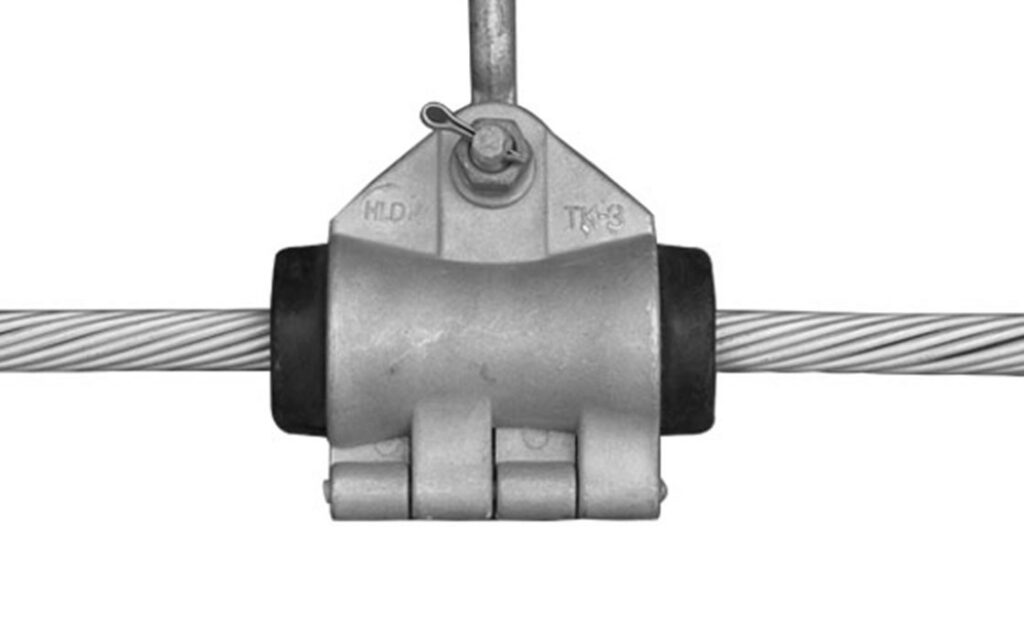
- Reduced mechanical stress on conductors – the trunnion mechanism allows controlled movement, which distributes tensile loads, reduces bending stress at suspension points, and prevents localized pressure damage on conductor strands.
- Improved flexibility and movement accommodation—the pivoting design allows the clamp to rotate and adjust dynamically, maintain alignment under changing loads, and reduce rigid constraints on the conductor.
- Enhanced vibration resistance—the clamp works with dampers and armor rods, reduces stress concentration at suspension points, and reduces micro-movement damage. This leads to lower fatigue failure rates and reduced risk of conductor breakage.
- Protection of conductor surface integrity—the clamp offers smooth load transfer through clamp grooves, reduced abrasion and friction, and controlled clamping pressure through keeper design.
In conclusion
Trunnion suspension clamps provide secure conductor support while accommodating mechanical movement from wind, thermal changes, and vibration. Their design enhances load distribution, reduces conductor stress, and improves line reliability. The clamps are made from materials such as aluminum alloys, ductile iron, and forged steel combined with corrosion-resistant coatings that ensure durability. Conducting quality assurance during manufacturing prevents defects, ensures dimensional accuracy, and verifies mechanical performance. The clamps improve safety, reduce maintenance costs, and extend the service life of transmission infrastructure.